
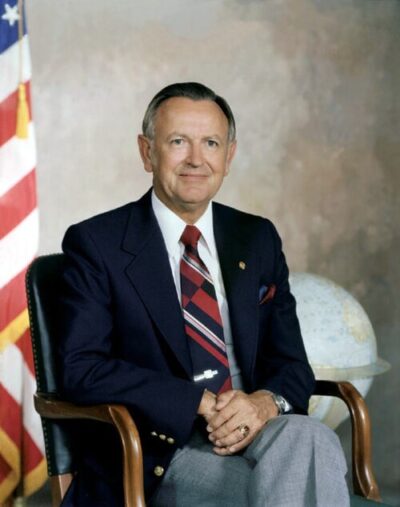
Christopher C. Kraft
Christopher C. Kraft was an American aerospace engineer. Born February 28, 1924, in Phoebus. Died July 22, 2019, in Houston. Educated at Virginia Tech and Hampton High School. Awards include ASME Medal, National Aviation Hall of Fame and Theodore Roosevelt Award.
Facts
22 facts · 2 confirmed by two sources · 6 cited · 14 from one source
Where this comes from
Papalocal keeps its own record. It started from these sources; what each one said is kept here as it was copied, so a change on their side never changes this page by itself. Tap one to read its version.
What Wikidata says · copied November 15, 2026 · revision 2567385768
- Described as
- American aerospace engineer (1924–2019)
- Other names
- Christopher Columbus "Chris" Kraft Jr.
- Born
- February 28, 1924 · 1 reference
- Died
- July 22, 2019 · 2 references
- Born in
- Phoebus
- Died in
- Houston · 1 reference
- Citizen of
- United States
- Occupation
- inventor; writer; military flight engineer · 1 reference; director · 1 reference
- Worked for
- National Advisory Committee for Aeronautics; National Aeronautics and Space Administration
- Education
- Virginia Tech; Hampton High School · 1 reference
- Member of
- National Academy of Engineering
- Awards
- ASME Medal (1973); National Aviation Hall of Fame (2016) · 1 reference; Theodore Roosevelt Award (1971); Theodore von Kármán Award (1994) · 1 reference; NASA Distinguished Service Medal (2 times) (1969, 1981) · 1 reference; International Space Hall of Fame (1988) · 2 references
- Mother
- Vanda Olivia Kraft · 1 reference
- Religion
- Catholicism
- Wikipedias with a page
- 35
Wikidata item Q735104 (wikidata.org/wiki/Q735104), public domain (CC0). Copied November 15, 2026.
What Wikipedia says · copied November 15, 2026 · revision 1380772178
Christopher Columbus Kraft Jr. (February 28, 1924 – July 22, 2019) was an American aerospace and NASA engineer who was instrumental in establishing the agency's mission control center and shaping its organization and culture. His protégé Glynn Lunney said in 1998: "the Control Center today ... is a reflection of Chris Kraft".
Following his 1944 graduation from Virginia Polytechnic Institute and State University with a Bachelor of Science degree in aeronautical engineering, Kraft was hired by the National Advisory Committee for Aeronautics (NACA), the predecessor organization to the National Aeronautics and Space Administration (NASA). He worked for over a decade in aeronautical research and in 1958 joined the Space Task Group, a small team entrusted with the responsibility of putting America's first man in space. Assigned to the flight operations division, Kraft became NASA's first flight director. He was on duty during America's first crewed spaceflight, first crewed orbital flight, and first spacewalk. At the beginning of the Apollo program, Kraft retired as a flight director to concentrate on management and mission planning. In 1972, he became director of the Manned Spacecraft Center (later Johnson Space Center), following his mentor Robert R. Gilruth, and held the position until his retirement in 1982.
Later, Kraft consulted for companies such as IBM and Rockwell International. In 1994, he was appointed chairman of a panel to make NASA's Space Shuttle program more cost effective. The panel's controversial report, known as the Kraft report, recommended that NASA's Space Shuttle operations should be outsourced to a private contractor. It also recommended that NASA cut back on the organizational changes intended to improve safety that were made after the Space Shuttle Challenger disaster. This attracted even more critical comment after the Space Shuttle Columbia disaster.
Kraft published his autobiography Flight: My Life in Mission Control in 2001. The Mission Control Center building was named after him in 2011. When he received the National Space Trophy from the Rotary Club in 1999, the organization described him as "a driving force in the U.S. human space flight program from its beginnings to the Space Shuttle era, a man whose accomplishments have become legendary".
- Born, in its opening lines
- February 28, 1924
- Died, in its opening lines
- July 22, 2019
From the Wikipedia article “Christopher C. Kraft Jr.” (en.wikipedia.org/wiki/Christopher_C._Kraft_Jr.), by its contributors, under CC BY-SA 4.0 (creativecommons.org/licenses/by-sa/4.0/). Copied November 15, 2026; not changed.
Confirmed Two sources agree. Cited One source, and it names where it got it. One source One source, without a reference of its own. Sources disagree The sources disagree. We show the best-supported value and keep theirs below.
