
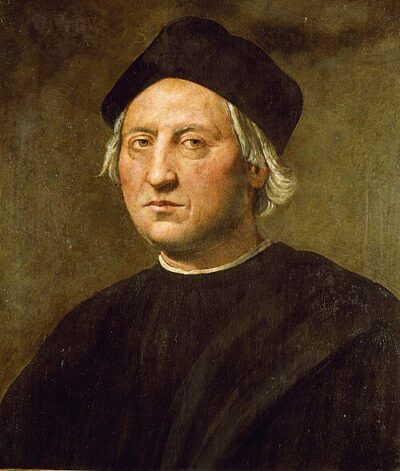
Christopher Columbus
Christopher Columbus was an Italian navigator, explorer, and colonist. Born 1451, in Genoa. Died May 20, 1506, in Valladolid. Positions held include Governor of the Indies (1492–1500) and Viceroy of the Indies (1492–1506). Known for Christopher Columbus writings.
Facts
31 facts · 2 confirmed by two sources · 14 cited · 15 from one source
Where this comes from
Papalocal keeps its own record. It started from these sources; what each one said is kept here as it was copied, so a change on their side never changes this page by itself. Tap one to read its version.
What Wikidata says · copied November 16, 2026 · revision 2567795799
- Described as
- Italian navigator, explorer, and colonist (1451–1506)
- Other names
- Cristoffer Columbus, Don Cristobál Colón, Columbus, Cristobal Colon, Christofer Columbus, Cristóbal Colón
- Born
- 1451 · 4 references
- Died
- May 20, 1506 · 6 references
- Born in
- Genoa · 3 references
- Died in
- Valladolid · 4 references
- Buried in
- Seville Cathedral (1899–)
- Cause of death
- heart failure
- Name at birth
- Cristoforo Colombo · 2 references
- Citizen of
- Republic of Genoa
- Occupation
- explorer; seafarer · 1 reference; traveler · 1 reference; sailor · 1 reference; inventor · 1 reference
- Positions held
- Governor of the Indies (1492–1500) · 1 reference; Viceroy of the Indies (1492–1506)
- Member of
- Columbus conquistador force
- Known for
- Christopher Columbus writings
- Field
- sea shipping; marine transportation · 1 reference; seamanship · 1 reference
- Spouse
- Filipa Moniz Perestrelo (1479–); Beatriz Enríquez de Arana
- Children
- Hernando Colón · 1 reference; Diego Colón Moniz · 1 reference
- Father
- Domenico Colombo · 1 reference
- Mother
- Susanna Fontanarossa · 1 reference
- Siblings
- Bartholomew Columbus; Diego Colombos
- Religion
- Catholic Church
- Military rank
- admiral; Almirante del Mar Océano (1492–)
- Wikipedias with a page
- 244
Wikidata item Q7322 (wikidata.org/wiki/Q7322), public domain (CC0). Copied November 16, 2026.
What Wikipedia says · copied November 16, 2026 · revision 1385870094
Christopher Columbus (; between 25 August and 31 October 1451 – 20 May 1506) was an Italian explorer and navigator from the Republic of Genoa who completed four transatlantic voyages in the name of the Spanish Catholic Monarchs, opening the way for the widespread European exploration and colonization of the Americas. His expeditions were the first known European contact with the Caribbean and Central and South America.
Growing up on the coast of Liguria, he went to sea at a young age and traveled widely, as far north as the British Isles and as far south as what is now Ghana. He married a Portuguese noblewoman Filipa Moniz Perestrelo, who bore their son, Diego, and was based in Lisbon, for several years. He later took a Castilian mistress, Beatriz Enríquez de Arana, who bore their son, Ferdinand.
Largely self-educated, Columbus was knowledgeable in geography, astronomy, and history. He developed a plan to seek a western sea passage to the East Indies, hoping to profit from the lucrative spice trade. After the Granada War, and Columbus's persistent lobbying in multiple kingdoms, the Catholic Monarchs of Spain, Queen Isabella I and King Ferdinand II, agreed to sponsor a journey west. Columbus left the Port of Palos in August 1492 with three ships and made landfall in the Americas on 12 October, ending the period of human habitation in the Americas now referred to as the pre-Columbian era. His landing place was an island in the Bahamas, known historically by its American Indian inhabitants as Guanahani. He then visited the islands now known as Cuba and Hispaniola, establishing the short-lived fort of La Navidad in what is now Haiti. Columbus returned to Castile in early 1493 with captured American Indians, and word of his first voyage quickly spread throughout Europe.
Columbus made three further voyages to the Americas, exploring the Lesser Antilles in 1493, Trinidad and the northern coast of South America in 1498, and the east coast of Central America in 1502. Many of the names given to geographical features by Columbus, particularly the names of islands, are still in use. He mistakenly gave the name indios (Spanish for "Indians") to the American Indians he encountered, believing he made it to the East Indies. The extent to which he was aware that the Americas were a wholly separate landmass is uncertain; he never clearly renounced his belief that he had reached the Far East. As a colonial governor, Columbus was accused by some of his contemporaries of significant brutality and removed from the post. Columbus's strained relationship with the Crown of Castile and its colonial administrators in the Americas led to his arrest and removal from Hispaniola in 1500, and later to protracted litigation during the pleitos colombinos ("Columbian lawsuits") over the privileges he and his heirs claimed were owed to them by the Crown.
Columbus's expeditions inaugurated a period of exploration, conquest, and colonization that lasted for centuries, thus bringing the Americas into the European sphere of influence. The transfer of plants, animals, precious metals, culture, human populations, technology, diseases, and ideas between the Old World and New World that followed his first voyage are known as the Columbian exchange, named after him. These events and the effects which persist to the present are often cited as the beginning of the modern era. Diseases and warfare introduced from the Old World had contributed to the decline or genocide of Hispaniola's American Indians, who were also subject to enslavement and other mistreatment by Columbus's government. Growing public awareness of these actions by Columbus has led to increased scrutiny of him in Western culture, which had historically idealized him as a heroic discoverer of new lands; nonetheless, numerous places are named and memorials are dedicated in honor of him.
- Born, in its opening lines
- October 31, 1451
- Died, in its opening lines
- May 20, 1506
From the Wikipedia article “Christopher Columbus” (en.wikipedia.org/wiki/Christopher_Columbus), by its contributors, under CC BY-SA 4.0 (creativecommons.org/licenses/by-sa/4.0/). Copied November 16, 2026; not changed.
Confirmed Two sources agree. Cited One source, and it names where it got it. One source One source, without a reference of its own. Sources disagree The sources disagree. We show the best-supported value and keep theirs below.
