
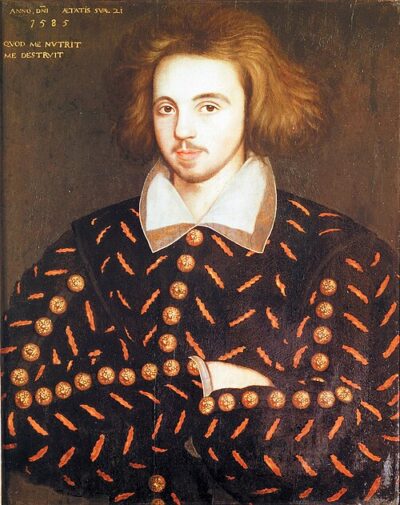
Christopher Marlowe
Christopher Marlowe was an English dramatist, poet and translator. Born February 23, 1564, in Canterbury. Died May 30, 1593, in Deptford. Known for Edward II, The Tragical History of Doctor Faustus and The Jew of Malta. Educated at Corpus Christi College and University of Cambridge.
Facts
16 facts · 1 confirmed by two sources · 5 cited · 9 from one source · 1 where the sources disagree
What’s different
- Born: we show February 23, 1564 (Sources disagree). Wikipedia says February 26, 1564
Where this comes from
Papalocal keeps its own record. It started from these sources; what each one said is kept here as it was copied, so a change on their side never changes this page by itself. Tap one to read its version.
What Wikidata says · copied November 16, 2026 · revision 2563181935
- Described as
- English dramatist, poet and translator (1564–1593)
- Other names
- Kit Marlowe
- Born
- February 23, 1564 · 3 references
- Died
- May 30, 1593 · 11 references
- Born in
- Canterbury · 1 reference
- Died in
- Deptford · 2 references
- Buried in
- Deptford St Nicholas
- Citizen of
- Kingdom of England
- Occupation
- playwright · 1 reference; poet · 1 reference; translator; writer · 1 reference
- Education
- Corpus Christi College; University of Cambridge; The King's School Canterbury
- Known for
- Edward II; The Tragical History of Doctor Faustus; The Jew of Malta
- Wikipedias with a page
- 102
Wikidata item Q28975 (wikidata.org/wiki/Q28975), public domain (CC0). Copied November 16, 2026.
What Wikipedia says · copied November 16, 2026 · revision 1384717603
Christopher Marlowe ( MAR-loh; baptised 26 February 1564 – 30 May 1593), also known as Kit Marlowe, was an English playwright, poet, and translator of the Elizabethan era. Marlowe is among the most famous of the Elizabethan playwrights. Based upon the "many imitations" of his play Tamburlaine, modern scholars consider him to have been the foremost dramatist in London in the years just before his mysterious early death. Some scholars also believe that he greatly influenced William Shakespeare, who was baptised in the same year as Marlowe and later succeeded him as the preeminent Elizabethan playwright. Marlowe was the first to achieve critical reputation for his use of blank verse, which became the standard for the era. His plays are distinguished by their overreaching protagonists. Themes found within Marlowe's literary works have been noted as humanistic with realistic emotions, which some scholars find difficult to reconcile with Marlowe's "anti-intellectualism" and his catering to the prurient tastes of his Elizabethan audiences for generous displays of extreme physical violence, cruelty, and bloodshed.
Events in Marlowe's life were sometimes as extreme as those found in his plays. Differing sensational reports of Marlowe's death in 1593 abounded after the event and are contested by scholars today owing to a lack of good documentation. There have been many conjectures as to the nature and reason for his death, including a vicious bar-room fight, blasphemous libel against the church, homosexual intrigue, betrayal by another playwright, and espionage from the highest level: the Privy Council of Elizabeth I. An official coroner's account of Marlowe's violent death was discovered only in 1925, and it did little to persuade all scholars that it told the whole story, nor did it eliminate the uncertainties present in his biography.
- Born, in its opening lines
- February 26, 1564
- Died, in its opening lines
- May 30, 1593
From the Wikipedia article “Christopher Marlowe” (en.wikipedia.org/wiki/Christopher_Marlowe), by its contributors, under CC BY-SA 4.0 (creativecommons.org/licenses/by-sa/4.0/). Copied November 16, 2026; not changed.
Confirmed Two sources agree. Cited One source, and it names where it got it. One source One source, without a reference of its own. Sources disagree The sources disagree. We show the best-supported value and keep theirs below.
