
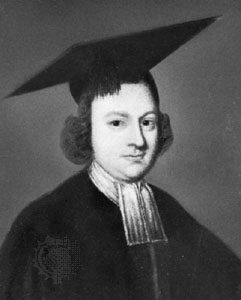
Christopher Smart
Christopher Smart was an English poet, hymnwriter, editor. Born April 11, 1722, in Shipbourne. Died May 20, 1771, in London. Educated at Pembroke College and Durham School.
Facts
15 facts · 2 confirmed by two sources · 4 cited · 9 from one source
What’s different
- Died: we show May 20, 1771 (Confirmed). Wikidata also lists May 21, 1771
Where this comes from
Papalocal keeps its own record. It started from these sources; what each one said is kept here as it was copied, so a change on their side never changes this page by itself. Tap one to read its version.
What Wikidata says · copied November 18, 2026 · revision 2564322915
- Described as
- English poet, hymnwriter, editor
- Other names
- Mrs Mary Midnight, Ebenezer Pentweazle, Mary Midnight
- Born
- April 11, 1722 · 4 references
- Died
- May 21, 1771 · 3 references; May 20, 1771 · 1 reference
- Born in
- Shipbourne · 1 reference
- Died in
- London · 1 reference
- Citizen of
- Kingdom of Great Britain
- Occupation
- writer · 2 references; stage actor; composer; hymnwriter; children's writer; editor · 1 reference
- Education
- Pembroke College; Durham School; Maidstone Grammar School
- Religion
- Anglicanism
- Wikipedias with a page
- 21
Wikidata item Q2617795 (wikidata.org/wiki/Q2617795), public domain (CC0). Copied November 18, 2026.
What Wikipedia says · copied November 18, 2026 · revision 1379190304
Christopher Smart (11 April 1722 – 20 May 1771) was an English poet. He was a major contributor to two popular magazines, The Midwife and The Student, and a friend to influential cultural icons like Samuel Johnson and Henry Fielding. Smart, a high church Anglican, was widely known throughout London.
Smart was infamous as the pseudonymous midwife "Mrs. Mary Midnight" and for widespread accounts of his years confined in a mental asylum by his father-in-law, John Newbery, due to Smart's supposed religious "mania". Even after Smart's eventual release, a negative reputation continued to pursue him as he was known for incurring more debt than he could repay; this ultimately led to his confinement in debtors' prison until his death.
His two most widely known works are A Song to David and Jubilate Agno, which are sometimes believed to have been written during his confinement in St. Luke's Asylum, although there is no record of their dates. Jubilate Agno was not published until 1939 when it was found in a library archive, and A Song to David received mixed reviews until the 19th century. To his contemporaries, Smart was known mainly for his many contributions in the journals The Midwife and The Student, along with his famous Seaton Prize poems and his mock epic The Hilliad. Although he is recognized primarily as a religious poet, his poetry includes various other themes, such as his theories on nature and his promotion of English nationalism.
- Born, in its opening lines
- April 11, 1722
- Died, in its opening lines
- May 20, 1771
From the Wikipedia article “Christopher Smart” (en.wikipedia.org/wiki/Christopher_Smart), by its contributors, under CC BY-SA 4.0 (creativecommons.org/licenses/by-sa/4.0/). Copied November 18, 2026; not changed.
Confirmed Two sources agree. Cited One source, and it names where it got it. One source One source, without a reference of its own. Sources disagree The sources disagree. We show the best-supported value and keep theirs below.
