
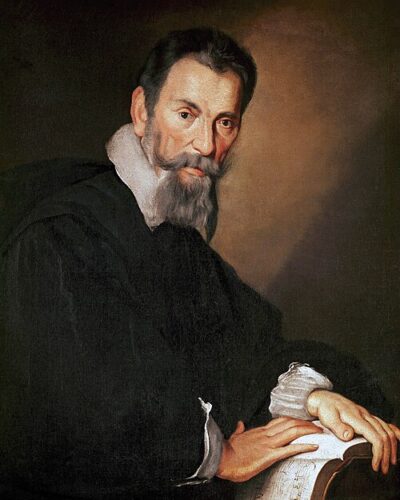
Claudio Monteverdi
Claudio Monteverdi was an Italian composer, string player, choirmaster, and priest. Born May 15, 1567, in Cremona. Died November 29, 1643, in Venice. Positions held include chapelmaster (1601–). Known for L'incoronazione di Poppea, L'Orfeo and Il ritorno d'Ulisse in patria.
Facts
27 facts · 2 confirmed by two sources · 6 cited · 19 from one source
Where this comes from
Papalocal keeps its own record. It started from these sources; what each one said is kept here as it was copied, so a change on their side never changes this page by itself. Tap one to read its version.
What Wikidata says · copied November 16, 2026 · revision 2569008556
- Described as
- Italian composer, string player, choirmaster, and priest (1567–1643)
- Other names
- Claudio Monteverde, Monteverdi, Claudio Giovanni Antonio Monteverdi
- Born
- May 15, 1567 · 8 references
- Died
- November 29, 1643 · 10 references
- Born in
- Cremona · 3 references
- Died in
- Venice · 3 references
- Buried in
- Santa Maria Gloriosa dei Frari · 1 reference
- Citizen of
- Republic of Venice
- Occupation
- music theorist; viol player; Catholic priest (1630–) · 1 reference; classical composer; singer · 1 reference; composer · 2 references; opera composer; choreographer
- Positions held
- chapelmaster (1601–) · 1 reference
- Genre
- opera; Baroque music
- Instrument
- viola da braccio; viol; pipe organ · 1 reference
- Known for
- L'incoronazione di Poppea; L'Orfeo; Il ritorno d'Ulisse in patria; Il combattimento di Tancredi e Clorinda
- Spouse
- Claudia Cattaneo
- Siblings
- Giulio Cesare Monteverdi
- Religion
- Catholicism
- Wikipedias with a page
- 88
Wikidata item Q53068 (wikidata.org/wiki/Q53068), public domain (CC0). Copied November 16, 2026.
What Wikipedia says · copied November 16, 2026 · revision 1384641528
Claudio Giovanni Antonio Monteverdi (baptized 15 May 1567 – 29 November 1643) was an Italian composer, choirmaster and string player. A composer of both secular and sacred music, and a pioneer in the development of opera, he is considered a crucial transitional figure between the Renaissance and Baroque periods of music history.
Born in Cremona, where he undertook his first musical studies and compositions, Monteverdi developed his career first at the court of Mantua (c. 1590–1613) and then until his death in the Republic of Venice where he was maestro di cappella at the basilica of San Marco. His surviving letters give insight into the life of a professional musician in Italy of the period, including problems of income, patronage and politics.
Much of Monteverdi's output, including many stage works, has been lost. His surviving music includes nine books of madrigals, large-scale religious works, such as his Vespro della Beata Vergine (Vespers for the Blessed Virgin) of 1610, and three complete operas. His opera L'Orfeo (1607) is the earliest of the genre still widely performed; towards the end of his life he wrote works for Venice, including Il ritorno d'Ulisse in patria and L'incoronazione di Poppea.
While he worked extensively in the tradition of earlier Renaissance polyphony, as evidenced in his madrigals, he undertook great developments in form and melody, and began to employ the basso continuo technique, distinctive of the Baroque. No stranger to controversy, he defended his sometimes novel techniques as elements of a seconda pratica, contrasting with the more orthodox earlier style which he termed the prima pratica. Largely forgotten during the eighteenth and much of the nineteenth centuries, his works enjoyed a rediscovery around the beginning of the twentieth century. He is now established both as a significant influence in European musical history and as a composer whose works are regularly performed and recorded.
- Born, in its opening lines
- May 15, 1567
- Died, in its opening lines
- November 29, 1643
From the Wikipedia article “Claudio Monteverdi” (en.wikipedia.org/wiki/Claudio_Monteverdi), by its contributors, under CC BY-SA 4.0 (creativecommons.org/licenses/by-sa/4.0/). Copied November 16, 2026; not changed.
Confirmed Two sources agree. Cited One source, and it names where it got it. One source One source, without a reference of its own. Sources disagree The sources disagree. We show the best-supported value and keep theirs below.
