Il ritorno d'Ulisse in patria
Il ritorno d'Ulisse in patria is an opera by Claudio Monteverdi.
- Country of origin
- Italy
All 4 facts, and where they come from
Facts
4 facts · 0 confirmed by two sources · 0 cited · 4 from one source
Where this comes from
Papalocal keeps its own record. It started from these sources; what each one said is kept here as it was copied, so a change on their side never changes this page by itself. Tap one to read its version.
What Wikidata says · copied November 17, 2026 · revision 2532173814
- Described as
- opera by Claudio Monteverdi
- Other names
- Ritorno d'Ulisse in patria, The Return of Ulysses to his Homeland, Return of Ulysses to his Homeland, SV 325
- What it is
- dramatico-musical work
- Music by
- Claudio Monteverdi
- Language
- Italian
- Country of origin
- Italy
- Wikipedias with a page
- 24
Wikidata item Q907047 (wikidata.org/wiki/Q907047), public domain (CC0). Copied 2026-11-17.
What Wikipedia says · copied November 17, 2026 · revision 1360423537
Il ritorno d'Ulisse in patria (SV 325, The Return of Ulysses to his Homeland) is an opera consisting of a prologue and five acts (later revised to three), set by Claudio Monteverdi to a libretto by Giacomo Badoaro. The opera was first performed at the Teatro Santi Giovanni e Paolo in Venice during the 1639–1640 carnival season. The story, taken from the second half of Homer's Odyssey, tells how constancy and virtue are ultimately rewarded, treachery and deception overcome. After his long journey home from the Trojan Wars Ulisse, king of Ithaca, finally returns to his kingdom where he finds that a trio of villainous suitors are importuning his faithful queen, Penelope. With the assistance of the gods, his son Telemaco and a staunch friend Eumete, Ulisse vanquishes the suitors and recovers his kingdom.
Il ritorno is the first of three full-length works which Monteverdi wrote for the burgeoning Venetian opera industry during the last five years of his life. After its initial successful run in Venice the opera was performed in Bologna before returning to Venice for the 1640–41 season. Thereafter, except for a possible performance at the Imperial court in Vienna late in the 17th century, there were no further revivals until the 20th century. The music became known in modern times through the 19th-century discovery of an incomplete manuscript score which in many respects is inconsistent with the surviving versions of the libretto. After its publication in 1922 the score's authenticity was widely questioned, and performances of the opera remained rare during the next 30 years. By the 1950s the work was generally accepted as Monteverdi's, and after revivals in Vienna and Glyndebourne in the early 1970s it became increasingly popular. It has since been performed in opera houses all over the world, and has been recorded many times.
Together with Monteverdi's other Venetian stage works, Il ritorno is classified as one of the first modern operas. Its music, while showing the influence of earlier works, also demonstrates Monteverdi's development as a composer of opera, through his use of fashionable forms such as arioso, duet and ensemble alongside the older-style recitative. By using a variety of musical styles, Monteverdi is able to express the feelings and emotions of a great range of characters, divine and human, through their music. Il ritorno has been described as an "ugly duckling", and conversely as the most tender and moving of Monteverdi's surviving operas, one which although it might disappoint initially, will on subsequent hearings reveal a vocal style of extraordinary eloquence.
From the Wikipedia article “Il ritorno d'Ulisse in patria” (en.wikipedia.org/wiki/Il_ritorno_d'Ulisse_in_patria), by its contributors, under CC BY-SA 4.0 (creativecommons.org/licenses/by-sa/4.0/). Copied 2026-11-17; not changed.
Confirmed Two sources agree. Cited One source, and it names where it got it. One source One source, without a reference of its own. Sources disagree The sources disagree. We show the best-supported value and keep theirs below.
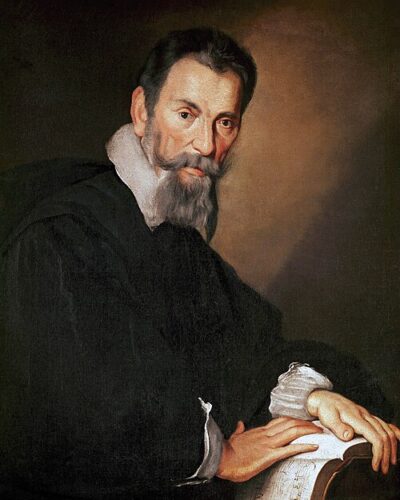
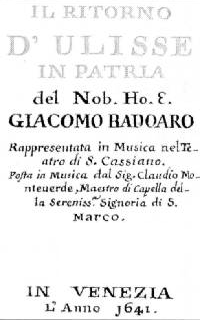
Picture: Claudio Monteverdi, Giacomo Badoaro, via Wikimedia Commons · Public domain