
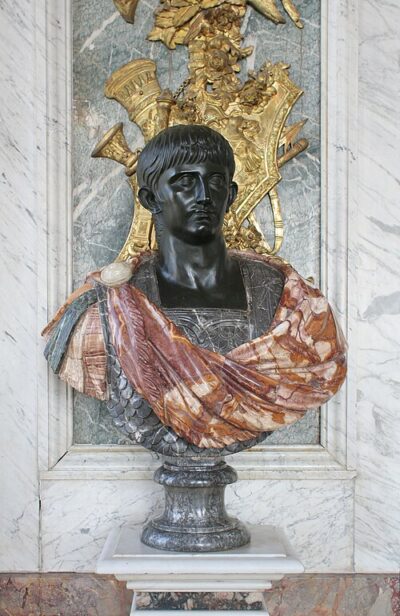
Claudius
Claudius was a fourth Roman emperor. Born August 1, 10 BC, in Lugdunum. Died October 13, 54, in Rome. Positions held include Roman emperor (41–54), ancient Roman senator and Roman censor. Known for De vita sua.
Facts
33 facts · 0 confirmed by two sources · 12 cited · 21 from one source
Where this comes from
Papalocal keeps its own record. It started from these sources; what each one said is kept here as it was copied, so a change on their side never changes this page by itself. Tap one to read its version.
What Wikidata says · copied November 16, 2026 · revision 2568846288
- Described as
- fourth Roman emperor (41–54)
- Other names
- Claudius Caesar, Claudius I, Tiberius Claudius Nero, Tiberius Claudius Caesar Augustus Germanicus, Tiberius Claudius Nero Germanicus, Tiberius Claudius Nero Drusus Germanicus, Tiberius Claudius Drusus Germanicus, Tiberius Claudius Nero Caesar Drusus, Tiberius Claudius Drusus Nero Germanicus, Tiberius Claudius Drusus
- Born
- August 1, 10 BC · 1 reference
- Died
- October 13, 54 · 1 reference
- Born in
- Lugdunum · 1 reference
- Died in
- Rome · 2 references
- Buried in
- Mausoleum of Augustus
- Cause of death
- poisoning
- Name at birth
- Tiberius Claudius Drusus
- Citizen of
- Ancient Rome
- Occupation
- politician; historian; writer · 1 reference
- Positions held
- Roman emperor (41–54); ancient Roman senator; Roman censor; Roman consul; augur
- Known for
- De vita sua
- Spouse
- Plautia Urgulanilla (9–24) · 1 reference; Aelia Paetina (–31) · 1 reference; Messalina (–48) · 1 reference; Agrippina the Younger (49–54) · 1 reference
- Children
- Tiberius Claudius Drusus; Claudia Julia; Claudia Antonia; Claudia Octavia · 1 reference; Britannicus; Nero
- Father
- Nero Claudius Drusus · 1 reference
- Mother
- Antonia Minor
- Siblings
- Livilla; Germanicus
- Religion
- ancient Roman religion; stoicism · 1 reference
- Wikipedias with a page
- 109
Wikidata item Q1411 (wikidata.org/wiki/Q1411), public domain (CC0). Copied November 16, 2026.
What Wikipedia says · copied November 16, 2026 · revision 1385030070
Tiberius Claudius Caesar Augustus Germanicus ( KLAW-dee-əs; Classical Latin: [tɪˈbɛri.ʊs ˈkɫau̯di.ʊs ˈkae̯sar au̯ˈɡʊstʊs ɡɛrˈmaːnɪkʊs]; 1 August 10 BC – 13 October AD 54), or simply Claudius, was a Roman emperor, ruling from AD 41 until his death in AD 54. The fourth ruler of the Julio-Claudian dynasty, Claudius was born to Drusus the Elder, the brother of Emperor Tiberius, and Antonia Minor at Lugdunum in Roman Gaul, where his father was stationed as a military legate. He was the first Roman emperor to be born outside Italy.
As he had a limp, a stammer, and a tremor due to an illness he suffered when young, Claudius was ostracized by his family and was excluded from public office until his consulship (which was shared with his nephew, Caligula, in AD 37). His infirmity probably saved him from the fate of many other nobles during the purges throughout the reigns of Tiberius and Caligula, as potential enemies did not see him as a serious threat. His survival led to him being declared emperor by the Praetorian Guard after Caligula's assassination, at which point he was the last adult male of his family.
Despite his lack of experience, Claudius was an able and efficient administrator. He expanded the imperial bureaucracy to include freedmen, and helped restore the empire's finances after the excesses of Caligula's reign. He was also an ambitious builder, constructing new roads, aqueducts, and canals across the Empire. During his reign, the Empire started its successful conquest of Britain. Having a personal interest in law, he presided at public trials, and issued edicts daily. He was seen as vulnerable throughout his reign, particularly by elements of the nobility. Claudius was constantly forced to shore up his position, which resulted in the deaths of many senators. Those events damaged his reputation among the ancient writers, though more recent historians have revised that opinion. Many authors contend that he was murdered by his own wife, Agrippina the Younger. After his death at the age of 63, his grandnephew and legally adopted step-son, Nero, succeeded him as emperor.
From the Wikipedia article “Claudius” (en.wikipedia.org/wiki/Claudius), by its contributors, under CC BY-SA 4.0 (creativecommons.org/licenses/by-sa/4.0/). Copied November 16, 2026; not changed.
Confirmed Two sources agree. Cited One source, and it names where it got it. One source One source, without a reference of its own. Sources disagree The sources disagree. We show the best-supported value and keep theirs below.
