
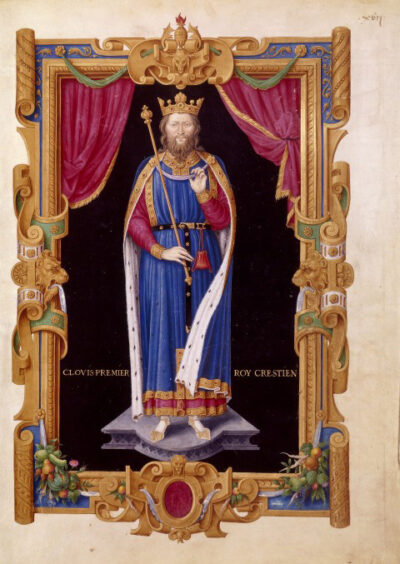
Clovis I
Clovis I was a first king of the Franks (c. 466-511). Born 466. Died November 27, 511, in Paris. Positions held include king of Franks (481–511) and Roman consul.
Facts
23 facts · 0 confirmed by two sources · 17 cited · 6 from one source
Where this comes from
Papalocal keeps its own record. It started from these sources; what each one said is kept here as it was copied, so a change on their side never changes this page by itself. Tap one to read its version.
What Wikidata says · copied November 16, 2026 · revision 2569176148
- Described as
- first king of the Franks (c. 466-511)
- Other names
- Chlodovechus I
- Born
- 466 · 6 references
- Died
- November 27, 511 · 1 reference
- Died in
- Paris · 2 references
- Buried in
- Abbey of St Genevieve · 1 reference
- Citizen of
- Francia
- Occupation
- monarch · 1 reference
- Positions held
- king of Franks (481–511); Roman consul
- Spouse
- Clotilde (493–511) · 1 reference; Evochildis of Cologne · 1 reference
- Children
- Theuderic I · 1 reference; Ingomer · 1 reference; Chlodomer · 1 reference; Childebert I · 1 reference; Clothar I · 2 references; Clotilde · 1 reference
- Father
- Childeric I · 1 reference
- Mother
- Basina of Thuringia · 1 reference
- Siblings
- Audofleda · 1 reference; Lantechildis · 1 reference; Albofledis · 1 reference
- Religion
- Germanic paganism (–496); Christianity (496–)
- Wikipedias with a page
- 91
Wikidata item Q82339 (wikidata.org/wiki/Q82339), public domain (CC0). Copied November 16, 2026.
What Wikipedia says · copied November 16, 2026 · revision 1385268119
Clovis I (Latin: Chlodovechus; reconstructed Frankish: *Hlodowig c. 466 – 27 November 511) was the first Frankish king to unite the Franks, changing the form of leadership from a group of petty kings to rule by a single king, and ensuring that the kingship was passed down to his heirs. He is considered the founder of the Merovingian dynasty, which ruled the Frankish kingdom for the next two centuries. Clovis is an important figure in the history of France. According to Charles de Gaulle, he was "the first king of what would become France."
Clovis succeeded his father, Childeric I, as a king of the Salian Franks in 481, and eventually came to rule an area extending from what is now the southern Netherlands to northern France, corresponding in Roman terms to Gallia Belgica (northern Gaul). At the Battle of Soissons (486), he established control over a rump state of the fragmenting Western Roman Empire, which was under the command of Syagrius. By the time of his death in 511, Clovis had conquered several smaller Frankish kingdoms in the northeast of Gaul, stretching into what is now Germany. Clovis also conquered the Alemanni in eastern Gaul and the Visigothic kingdom of Aquitania in the southwest. These campaigns added significantly to his Frankish domains and established his dynasty as a major political and military presence in western Europe.
Clovis is also significant because of his baptism between 498 and 506, largely at the behest of his wife, Clotilde, who would later be venerated as a saint for this act, celebrated today in both the Catholic Church and Eastern Orthodox Church. The adoption of Catholicism (as opposed to the Arianism of most other Germanic tribes) by Clovis led to widespread conversions among the Franks, and eventually to religious unification across what is now modern-day France, the Low Countries and Germany. The alliance between the Franks and Catholicism eventually led to Charlemagne's crowning by the Pope as emperor in 800, and to the subsequent birth of the early Holy Roman Empire in the middle of the 10th century.
From the Wikipedia article “Clovis I” (en.wikipedia.org/wiki/Clovis_I), by its contributors, under CC BY-SA 4.0 (creativecommons.org/licenses/by-sa/4.0/). Copied November 16, 2026; not changed.
Confirmed Two sources agree. Cited One source, and it names where it got it. One source One source, without a reference of its own. Sources disagree The sources disagree. We show the best-supported value and keep theirs below.
