
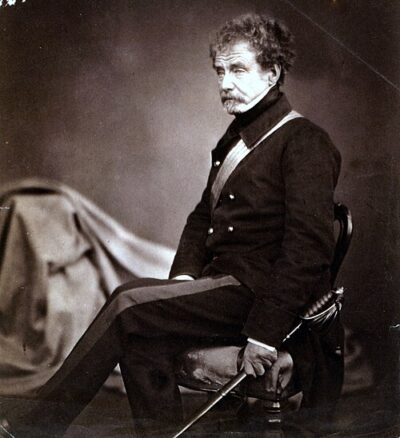
Colin Campbell, 1st Baron Clyde
Colin Campbell, 1st Baron Clyde was a British Army officer. Born October 20, 1792, in Glasgow. Died August 14, 1863, in Chatham. Positions held include member of the House of Lords. Educated at High School of Glasgow. Awards include Knight Grand Cross of the Order of the Bath and Order of St. George, 4th class.
Facts
15 facts · 2 confirmed by two sources · 4 cited · 9 from one source
Where this comes from
Papalocal keeps its own record. It started from these sources; what each one said is kept here as it was copied, so a change on their side never changes this page by itself. Tap one to read its version.
What Wikidata says · copied November 18, 2026 · revision 2567836610
- Described as
- British Army officer (1792-1863)
- Other names
- 1st Baron Clyde Colin Campbell, Baron Clyde Colin Campbell, Colin Campbell Clyde, Clyde Colin Campbell 1st Baron, Field Marshal Colin Campbell, 1st and last Baron Clyde of Clydesdale, Sir Colin Campbell, Lord Clyde
- Born
- October 20, 1792 · 4 references
- Died
- August 14, 1863 · 4 references
- Born in
- Glasgow · 1 reference
- Died in
- Chatham · 1 reference
- Buried in
- Westminster Abbey
- Citizen of
- United Kingdom of Great Britain and Ireland
- Occupation
- military officer; politician · 1 reference; Generalfeldmarschall · 1 reference
- Positions held
- member of the House of Lords
- Education
- High School of Glasgow
- Awards
- Knight Grand Cross of the Order of the Bath; Order of St. George, 4th class
- Military branch
- British Army
- Military rank
- field marshal
- Wikipedias with a page
- 21
Wikidata item Q336049 (wikidata.org/wiki/Q336049), public domain (CC0). Copied November 18, 2026.
What Wikipedia says · copied November 18, 2026 · revision 1379812602
Field Marshal Colin Campbell, 1st Baron Clyde, (20 October 1792 – 14 August 1863) was a British Army officer. After serving in the Peninsular War and the War of 1812, he commanded the 98th Regiment of Foot during the First Opium War and then commanded a brigade during the Second Anglo-Sikh War. He went on to command the Highland Brigade at the Battle of Alma and with his "thin red line of Highlanders" he repulsed the Russian attack on Balaclava during the Crimean War. At an early stage of the Indian Mutiny, he became Commander-in-Chief, India and, in that role, he relieved and then evacuated Lucknow and, after attacking and decisively defeating Tatya Tope at the Second Battle of Cawnpore, captured Lucknow again. Whilst still commander-in-chief he dealt with the "White Mutiny" among East India Company troops, and organised the army sent east in the Second Opium War.
- Born, in its opening lines
- October 20, 1792
- Died, in its opening lines
- August 14, 1863
From the Wikipedia article “Colin Campbell, 1st Baron Clyde” (en.wikipedia.org/wiki/Colin_Campbell,_1st_Baron_Clyde), by its contributors, under CC BY-SA 4.0 (creativecommons.org/licenses/by-sa/4.0/). Copied November 18, 2026; not changed.
Confirmed Two sources agree. Cited One source, and it names where it got it. One source One source, without a reference of its own. Sources disagree The sources disagree. We show the best-supported value and keep theirs below.
