
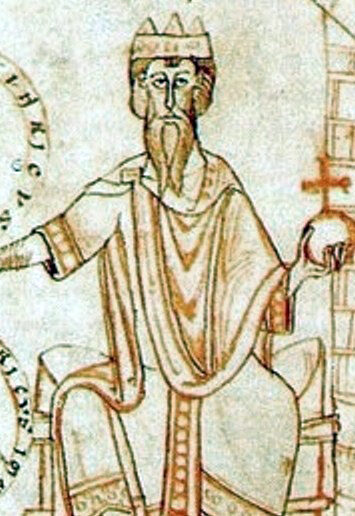
Conrad II
Conrad II was a Holy Roman Emperor. Born 990, in Speyer. Died June 4, 1039, in Utrecht. Positions held include Holy Roman Emperor (1027–1039) and king.
Facts
16 facts · 2 confirmed by two sources · 7 cited · 7 from one source
Where this comes from
Papalocal keeps its own record. It started from these sources; what each one said is kept here as it was copied, so a change on their side never changes this page by itself. Tap one to read its version.
What Wikidata says · copied November 16, 2026 · revision 2563978470
- Described as
- Holy Roman Emperor
- Other names
- Conradus II, Konrad II König (?)
- Born
- 990 · 3 references
- Died
- June 4, 1039 · 3 references
- Born in
- Speyer · 1 reference
- Died in
- Utrecht · 1 reference
- Buried in
- Speyer Cathedral · 1 reference
- Citizen of
- Germany · 1 reference
- Occupation
- sovereign
- Positions held
- Holy Roman Emperor (1027–1039); king
- Spouse
- Gisela of Swabia (1027–) · 1 reference
- Children
- Henry III; Matilda of Franconia · 1 reference; Beatrix Salian · 1 reference
- Father
- Henry of Speyer
- Mother
- Adelheid van Metz · 1 reference
- Religion
- Christianity
- Wikipedias with a page
- 54
Wikidata item Q152256 (wikidata.org/wiki/Q152256), public domain (CC0). Copied November 16, 2026.
What Wikipedia says · copied November 16, 2026 · revision 1381742141
Conrad II (German: Konrad II, c. 990 – 4 June 1039), also known as Conrad the Elder and Conrad the Salic, was the emperor of the Holy Roman Empire from 1027 until his death in 1039. The first of a succession of four Salian emperors, who reigned for one century until 1125, Conrad ruled the kingdoms of Germany (from 1024), Italy (from 1026) and Burgundy (from 1033).
The son of Franconian count Henry of Speyer (also Henry of Worms) and Adelaide of Metz of the Matfriding dynasty, that had ruled the Duchy of Lorraine from 959 until 972, Conrad inherited the titles of count of Speyer and Worms during childhood after his father had died around the year 990, two major towns near each other on the Rhine. He extended his influence beyond his inherited lands, as he came into favour of the princes of the kingdom. When the imperial dynastic line was left without a successor after Emperor Henry II's death in 1024, on 4 September an assembly of the imperial princes appointed the 34-year-old Conrad king (Rex romanorum). Conrad was great-great grandson of Otto the Great.
Conrad II adopted many aspects of his Ottonian predecessor Henry II regarding the role and organisation of the Church as well as general rulership practices, which in turn had been associated with Charlemagne. While the emperor was not anti-monastic, he immediately abandoned the favouritism that had been shown to men of the Church under Henry II. In Italy, he initially relied on the bishops (mostly of German origin) to maintain imperial power. Beginning with his second Italian expedition in 1036, he changed his strategy and managed to win the support of the valvassores (lesser nobles) and the military elite, who challenged the power of the bishops. His reign marked a high point of medieval imperial rule during a relatively peaceful period for the empire. Upon the death of the childless King Rudolph III of Burgundy in 1032, Conrad claimed dominion over the Kingdom of Burgundy, conquered it with German and Italian troops, and incorporated it into the empire. The three kingdoms (Germany, Italy and Burgundy) formed the basis of the empire as the "royal triad" (regna tria).
- Born, in its opening lines
- c. 990
- Died, in its opening lines
- June 4, 1039
From the Wikipedia article “Conrad II, Holy Roman Emperor” (en.wikipedia.org/wiki/Conrad_II,_Holy_Roman_Emperor), by its contributors, under CC BY-SA 4.0 (creativecommons.org/licenses/by-sa/4.0/). Copied November 16, 2026; not changed.
Confirmed Two sources agree. Cited One source, and it names where it got it. One source One source, without a reference of its own. Sources disagree The sources disagree. We show the best-supported value and keep theirs below.
