
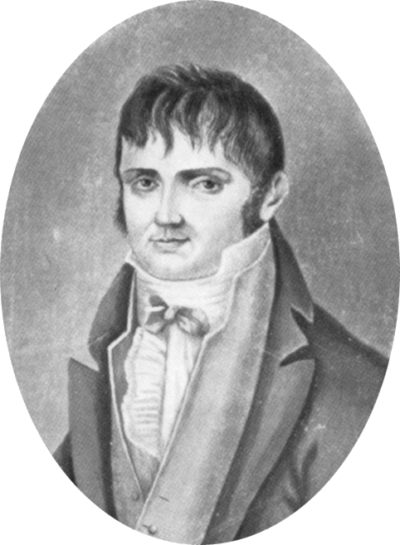
Constantine Samuel Rafinesque
Constantine Samuel Rafinesque was a French naturalist. Born October 22, 1783, in Constantinople. Died September 18, 1840, in Philadelphia. Awards include Fellow of the American Academy of Arts and Sciences.
Facts
19 facts · 2 confirmed by two sources · 3 cited · 14 from one source
Where this comes from
Papalocal keeps its own record. It started from these sources; what each one said is kept here as it was copied, so a change on their side never changes this page by itself. Tap one to read its version.
What Wikidata says · copied November 15, 2026 · revision 2568692983
- Described as
- French naturalist (1783-1840)
- Other names
- Rafinesque, Raf., Constantine Samuel Rafinesque-Schmaltz, C. S. Rafinesque
- Born
- October 22, 1783 · 3 references
- Died
- September 18, 1840 · 3 references
- Born in
- Constantinople
- Died in
- Philadelphia · 1 reference
- Cause of death
- stomach cancer
- Citizen of
- United States
- Occupation
- botanist · 1 reference; pteridologist; bryologist; entomologist; zoologist; archaeologist; malacologist; carcinologist
- Member of
- German Academy of Sciences Leopoldina (1820–) · 1 reference; American Academy of Arts and Sciences; American Antiquarian Society
- Awards
- Fellow of the American Academy of Arts and Sciences
- Field
- botany
- Wikipedias with a page
- 39
Wikidata item Q364857 (wikidata.org/wiki/Q364857), public domain (CC0). Copied November 15, 2026.
What Wikipedia says · copied November 15, 2026 · revision 1385547448
Constantine Samuel Rafinesque-Schmaltz (French pronunciation: [kɔ̃stɑ̃tin(ə) samɥɛl ʁafinɛsk(ə)ʃmalts]) (22 October 1783 – 18 September 1840) was a French polymath of the early 19th century. Born near Constantinople in the Ottoman Empire, he was self-educated in France.
As a young man, Rafinesque-Schmaltz traveled to the United States, eventually settling in Ohio in 1815. There, he made significant contributions to botany, zoology, and the study of prehistoric earthworks in North America. Beyond his previous extensive work in Europe, he also contributed to the study of ancient Mesoamerican linguistics. In 1836, Rafinesque was the first person to use the term Taíno as a way of referring to the Indigenous peoples of the Greater Antilles.
Rafinesque had a reputation as an eccentric and erratic genius. He was an autodidact who excelled in various fields of knowledge, as a zoologist, botanist, writer and polyglot. He wrote prolifically on such diverse topics as anthropology, biology, geology, and linguistics, but was honored in none of these fields during his lifetime. An outcast in the American scientific community, his submissions were automatically rejected by leading journals. Among his theories were that ancestors of Native Americans had migrated by the Bering Sea from Asia to North America, and that the Americas were populated by black indigenous peoples at the time of European contact.
The standard author abbreviation Raf. is used to indicate this person as the author when citing a botanical name.
- Born, in its opening lines
- October 22, 1783
- Died, in its opening lines
- September 18, 1840
From the Wikipedia article “Constantine Samuel Rafinesque” (en.wikipedia.org/wiki/Constantine_Samuel_Rafinesque), by its contributors, under CC BY-SA 4.0 (creativecommons.org/licenses/by-sa/4.0/). Copied November 15, 2026; not changed.
Confirmed Two sources agree. Cited One source, and it names where it got it. One source One source, without a reference of its own. Sources disagree The sources disagree. We show the best-supported value and keep theirs below.
