
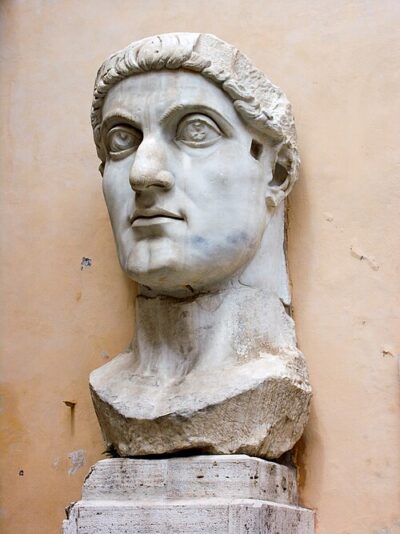
Constantine the Great
Constantine the Great was a Roman emperor from 306 to 337 and first to convert to Christianity. Born February 27, 272, in Niš. Died May 22, 337, in Nicomedia. Positions held include Roman emperor (306–337), ancient Roman senator and pontifex maximus (306–337). Known for Debates of Constantine.
Facts
32 facts · 2 confirmed by two sources · 7 cited · 23 from one source
Where this comes from
Papalocal keeps its own record. It started from these sources; what each one said is kept here as it was copied, so a change on their side never changes this page by itself. Tap one to read its version.
What Wikidata says · copied November 16, 2026 · revision 2569155031
- Described as
- Roman emperor from 306 to 337 and first to convert to Christianity (272–337)
- Other names
- Constantine I, Lucius Flavius Valerius Constantinus, Gaius Flavius Valerius Constantinus, Imperator Caesar Flavius Valerius Aurelius Constantinus Augustus, Trachala, Constantinus I, Saint Constantine, Marcus Flavius Valerius Constantinus, Flavius Constantinus, Flavius Valerius Aurelius Constantinus, Flavius Valerius Constantinus, Flavius Valerius Aurelius Constantinus Augustus
- Born
- February 27, 272 · 1 reference
- Died
- May 22, 337 · 2 references
- Born in
- Niš · 1 reference
- Died in
- Nicomedia
- Buried in
- Church of the Holy Apostles
- Name at birth
- Flavius Constantinus
- Citizen of
- Ancient Rome
- Occupation
- politician; military personnel; sovereign · 1 reference
- Positions held
- Roman emperor (306–337); ancient Roman senator; pontifex maximus (306–337) · 1 reference
- Known for
- Debates of Constantine
- Spouse
- Minervina · 1 reference; Fausta
- Children
- Crispus; Constantina; Constans · 1 reference; Constantine II · 1 reference; Constantius II · 1 reference; Helena
- Father
- Constantius Chlorus · 2 references
- Mother
- Helena Augusta · 2 references
- Siblings
- Flavia Julia Constantia; Eutropia; Anastasia; Julius Constantius; Flavius Dalmatius; Flavius Hannibalianus
- Religion
- Christianity · 1 reference; ancient Roman religion · 1 reference
- Wikipedias with a page
- 159
Wikidata item Q8413 (wikidata.org/wiki/Q8413), public domain (CC0). Copied November 16, 2026.
What Wikipedia says · copied November 16, 2026 · revision 1385463206
Constantine I (27 February 272 – 22 May 337), also known as Constantine the Great, was a Roman emperor from AD 306 to 337, co-ruling as part of the Tetrarchy until 324. The first Roman emperor to convert to Christianity, Constantine played a pivotal role in elevating the religion's status in the Roman Empire, with the Edict of Milan decriminalising its practice and ceasing Christian persecution. He founded the city of Constantinople (now Istanbul) and made it the capital of the Empire, which it remained for over a millennium.
Born in Naissus, a city located in the province of Moesia Superior (now Niš, Serbia), Constantine was the son of Flavius Constantius, a Roman army officer from Moesia Superior, who would become one of the four emperors of the Tetrarchy. His mother, Helena, was a woman of low birth, probably from Bithynia. Later canonised as a saint, she is credited for the conversion of her son in some traditions, though others believe that Constantine converted her. He served with distinction under emperors Diocletian and Galerius. He began his career by campaigning in the eastern provinces against the Persians, before being recalled to the west in AD 305 to fight with his father in the province of Britannia. After his father's death in 306, Constantine was proclaimed as augustus (emperor) by his army at Eboracum (York, England). He eventually emerged victorious in the civil wars of the Tetrarchy against the emperors Maxentius and Licinius to become the sole ruler of the empire in 324.
Upon his accession, Constantine enacted many reforms to strengthen the empire. He restructured the government, separating civil and military authorities. To combat inflation, he introduced the solidus, a new gold coin that became the standard for Byzantine and European currencies for more than a thousand years. He disbanded the Praetorian Guard, which had supported Maxentius. The Roman army was reorganised to consist of mobile units (comitatenses), often around the emperor, to serve on campaigns against external enemies or Roman rebels, and frontier-garrison troops (limitanei) who could counter barbarian raids but were less and less effective against full-scale barbarian invasions. Constantine pursued campaigns against the tribes on the Roman frontiers—such as the Franks, the Alemanni, the Goths, and the Sarmatians—and resettled territories abandoned by his predecessors during the Crisis of the Third Century with citizens of Roman society.
Although Constantine lived much of his life as a pagan, he later became a catechumen, as he began to favour Christianity in 312, finally being baptised by Eusebius of Nicomedia, an Arian bishop. He played an influential role in the proclamation of the Edict of Milan in 313, which legalised Christianity in the Roman Empire. He convoked the First Council of Nicaea in 325, which produced the Christian statement of belief known as the Nicene Creed. On his orders, the Church of the Holy Sepulchre was built at the site claimed to be the tomb of Jesus in Jerusalem and was deemed the holiest place in Christendom. He has historically been referred to as the "First Christian Emperor", but while he did favour the Christian Church, some modern scholars debate his beliefs and even his comprehension of Christianity. He strongly influenced the Christianization of the Roman Empire and is venerated as a saint in Eastern Christianity and parts of Western Christianity.
The age of Constantine marked a distinct epoch in the history of the Roman Empire and a pivotal moment in the evolution from classical antiquity to the Middle Ages. He built a new imperial residence in the city of Byzantium, which was officially renamed New Rome, while also taking on the name Constantinople in his honour. It subsequently served as the capital of the empire for more than a thousand years—with the Eastern Roman Empire for most of that period commonly referred to retrospectively as the Byzantine Empire in English. In leaving the empire to his sons and other members of the Constantinian dynasty, Constantine's immediate political legacy was the replacement of Diocletian's Tetrarchy with the principle of dynastic succession. His memory was held in high regard during the lifetime of his children and for centuries after his reign. The medieval church held him up as a paragon of virtue, while secular rulers invoked him as a symbol of imperial legitimacy. The rediscovery of anti-Constantinian sources in the early Renaissance engendered more critical appraisals of his reign, with modern and contemporary scholarship often seeking to balance the extremes of earlier accounts.
- Born, in its opening lines
- February 27, 272
- Died, in its opening lines
- May 22, 337
From the Wikipedia article “Constantine the Great” (en.wikipedia.org/wiki/Constantine_the_Great), by its contributors, under CC BY-SA 4.0 (creativecommons.org/licenses/by-sa/4.0/). Copied November 16, 2026; not changed.
Confirmed Two sources agree. Cited One source, and it names where it got it. One source One source, without a reference of its own. Sources disagree The sources disagree. We show the best-supported value and keep theirs below.
