
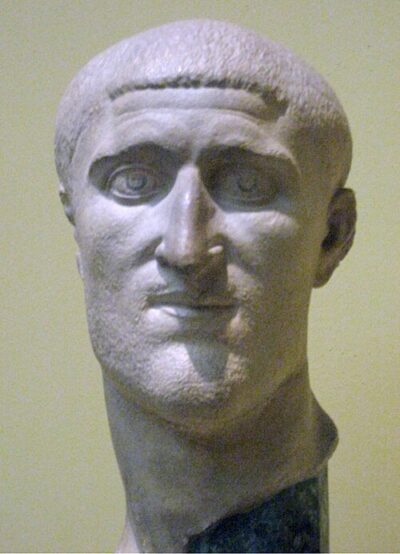
Constantius Chlorus
Constantius Chlorus was a Roman emperor. Born 250, in Dardania. Died July 25, 306, in Eboracum. Positions held include Roman emperor (305–306) and ancient Roman senator.
Facts
21 facts · 2 confirmed by two sources · 3 cited · 15 from one source · 1 where the sources disagree
What’s different
- Father: we show Flavius Eutropius (Sources disagree). Wikidata also lists Maximian
Where this comes from
Papalocal keeps its own record. It started from these sources; what each one said is kept here as it was copied, so a change on their side never changes this page by itself. Tap one to read its version.
What Wikidata says · copied November 16, 2026 · revision 2557847295
- Described as
- Roman emperor (250-306)
- Other names
- Flavius Valerius Constantius, Herculius, Flavius Constantius, Marcus Flavius Valerius Constantius, Gaius Flavius Valerius Constantius, Chlorus
- Born
- 250 · 1 reference
- Died
- July 25, 306
- Born in
- Dardania
- Died in
- Eboracum · 1 reference
- Name at birth
- Flavius Constantius
- Citizen of
- Ancient Rome
- Occupation
- politician
- Positions held
- Roman emperor (305–306); ancient Roman senator
- Spouse
- Helena Augusta; Theodora
- Children
- Constantine the Great · 2 references; Flavia Julia Constantia; Anastasia; Eutropia; Julius Constantius; Flavius Dalmatius · 1 reference; Flavius Hannibalianus
- Father
- Flavius Eutropius; Maximian
- Mother
- Claudia Crispina
- Religion
- ancient Roman religion
- Wikipedias with a page
- 76
Wikidata item Q131195 (wikidata.org/wiki/Q131195), public domain (CC0). Copied November 16, 2026.
What Wikipedia says · copied November 16, 2026 · revision 1383566227
Marcus Flavius Valerius Constantius (c. 250 – 25 July 306), also called Constantius I, was a Roman emperor from 305 to 306, and was the father of Constantine the Great, the first Christian emperor of Rome. He was one of the four original members of the Tetrarchy established by Diocletian, first serving as caesar from 293 to 305 and then ruling as augustus until his death. The nickname Chlorus (Ancient Greek: Χλωρός, lit. 'the Pale') was first popularized by Byzantine-era historians and not used during the emperor's lifetime.
As a soldier of humble origin, Constantius had a distinguished military career and rose to the top ranks of the army. Around 289, he divorced Helena, the mother of Constantine the Great, to marry a daughter of Emperor Maximian, and in 293 was added to the imperial college by Maximian's colleague Diocletian. Assigned to rule Gaul, Constantius defeated the usurper Carausius there and his successor Allectus in Britain, and campaigned extensively along the Rhine frontier, defeating the Alamanni and Franks. When the Diocletianic Persecution was announced in 303, Constantius ordered the demolition of churches but did not actively hunt down Christians in his domain. Upon becoming senior emperor in May 305, Constantius launched a successful punitive campaign against the Picts beyond the Antonine Wall. He died suddenly at Eboracum (York) in July the following year.
After Constantius's death, the army, perhaps at his own instigation, immediately acclaimed his son Constantine as emperor. This act contributed to the collapse of the Diocletianic tetrarchy, sparking a series of civil wars that ended only when Constantine finally united the whole Roman Empire under his rule in 324. According to the Oxford Classical Dictionary, "Constantinian propaganda bedevils assessment of Constantius, yet he appears to have been an able general and a generous ruler". His descendants, the Constantinian dynasty, ruled the Empire until the death of his grandson Julian in 363.
- Born, in its opening lines
- c. 250
- Died, in its opening lines
- July 25, 306
From the Wikipedia article “Constantius Chlorus” (en.wikipedia.org/wiki/Constantius_Chlorus), by its contributors, under CC BY-SA 4.0 (creativecommons.org/licenses/by-sa/4.0/). Copied November 16, 2026; not changed.
Confirmed Two sources agree. Cited One source, and it names where it got it. One source One source, without a reference of its own. Sources disagree The sources disagree. We show the best-supported value and keep theirs below.
