
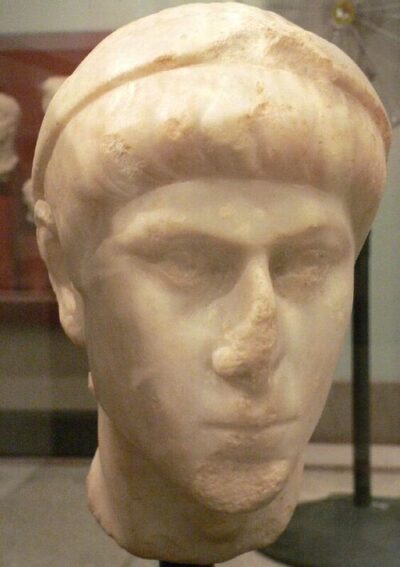
Constantius II
Constantius II was a Roman emperor. Born August 7, 317, in Sirmium. Died November 3, 361, in Cilicia. Positions held include Roman emperor (337–361), ancient Roman senator and Byzantine emperor (337–361).
Facts
22 facts · 2 confirmed by two sources · 2 cited · 18 from one source
What’s different
- Born: we show August 7, 317 (Confirmed). Wikidata also lists August 13, 317
Where this comes from
Papalocal keeps its own record. It started from these sources; what each one said is kept here as it was copied, so a change on their side never changes this page by itself. Tap one to read its version.
What Wikidata says · copied November 16, 2026 · revision 2569060127
- Described as
- Roman emperor (317-361)
- Other names
- Flavius Julius Constantius, Constantius the Apostate, Flavius Julius Constantius Augustus, Flavius Iulius Constantius, Constantius II of Rome, Fl. Iulius Constantius, Fl. Julius Constantius
- Born
- August 7, 317 · 2 references; August 13, 317 · 1 reference
- Died
- November 3, 361 · 4 references
- Born in
- Sirmium
- Died in
- Cilicia
- Cause of death
- fever
- Citizen of
- Ancient Rome; Byzantine Empire
- Occupation
- politician
- Positions held
- Roman emperor (337–361); ancient Roman senator; Byzantine emperor (337–361)
- Spouse
- daughter of Julius Constantius; Eusebia · 1 reference; Faustina
- Children
- Constantia
- Father
- Constantine the Great
- Mother
- Fausta
- Siblings
- Helena; Constantina; Constans · 1 reference; Constantine II · 1 reference; Crispus
- Wikipedias with a page
- 76
Wikidata item Q46418 (wikidata.org/wiki/Q46418), public domain (CC0). Copied November 16, 2026.
What Wikipedia says · copied November 16, 2026 · revision 1385459642
Constantius II (Latin: Flavius Julius Constantius; Ancient Greek: Κωνστάντιος, romanized: Kōnstántios; 7 August 317 – 3 November 361) was Roman emperor from 337 to 361. His reign saw constant warfare on the borders against the Sasanian Empire and Germanic peoples, while internally the Roman Empire went through repeated civil wars, court intrigues, and usurpations. His religious policies inflamed domestic conflicts that would continue after his death.
Constantius was a son of Constantine the Great, who elevated him to the imperial rank of Caesar on 8 November 324 and after whose death Constantius became Augustus together with his brothers, Constantine II and Constans on 9 September 337. He promptly oversaw the massacre of his father-in-law, an uncle, and several cousins, consolidating his hold on power. The brothers divided the empire among themselves, with Constantius receiving Greece, Thrace, the Asian provinces, and Egypt in the east. For the following decade a costly and inconclusive war against Persia took most of Constantius's time and attention. In the meantime, his brothers Constantine and Constans warred over the western provinces of the empire, leaving the former dead in 340 and the latter as sole ruler of the west. The two remaining brothers maintained an uneasy peace with each other until, in 350, Constans was overthrown and assassinated by the usurper Magnentius.
Unwilling to accept Magnentius as co-ruler, Constantius waged a civil war against the usurper, defeating him at the battles of Mursa Major in 351 and Mons Seleucus in 353. Magnentius died by suicide after the latter battle, leaving Constantius as sole ruler of the empire. In 351, Constantius elevated his cousin Constantius Gallus to the subordinate rank of Caesar to rule in the east, but had him executed three years later after receiving scathing reports of his violent and corrupt nature. Shortly thereafter, in 355, Constantius promoted his last surviving cousin, Gallus's younger half-brother Julian, to the rank of Caesar.
As emperor, Constantius promoted Arianism, banned pagan sacrifices, and issued laws against Jews. His military campaigns against Germanic and Iranian tribes were successful: he defeated the Alamanni in 354 and campaigned across the Danube against the Quadi and Sarmatians in 357. The war against the Sasanians, which had been in a lull since 350, erupted with renewed intensity in 359 and Constantius travelled to the east in 360 to restore stability after the loss of several border fortresses. However, Julian claimed the rank of Augustus in 360, leading to war between the two after Constantius's attempts to persuade Julian to back down failed. No battle was fought, as Constantius became ill and died of fever on 3 November 361 in Mopsuestia, allegedly naming Julian as his rightful successor before his death.
- Born, in its opening lines
- August 7, 317
- Died, in its opening lines
- November 3, 361
From the Wikipedia article “Constantius II” (en.wikipedia.org/wiki/Constantius_II), by its contributors, under CC BY-SA 4.0 (creativecommons.org/licenses/by-sa/4.0/). Copied November 16, 2026; not changed.
Confirmed Two sources agree. Cited One source, and it names where it got it. One source One source, without a reference of its own. Sources disagree The sources disagree. We show the best-supported value and keep theirs below.
