
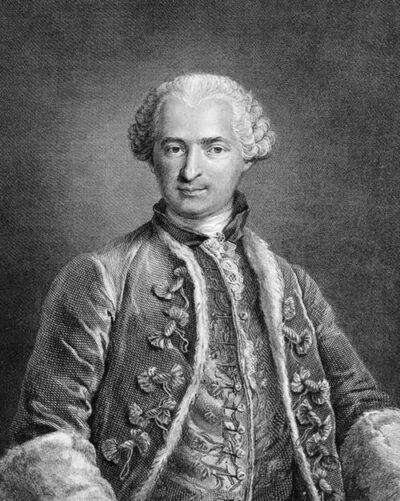
Count of St. Germain
Count of St. Germain was the 18th-century European adventurer and intellectual. Born 1712, in Sárospatak. Died February 27, 1784, in Eckernförde.
Facts
17 facts · 0 confirmed by two sources · 3 cited · 13 from one source · 1 where the sources disagree
What’s different
- Born: we show 1712 (Sources disagree). Wikidata also lists 1691 and May 26, 1696
Where this comes from
Papalocal keeps its own record. It started from these sources; what each one said is kept here as it was copied, so a change on their side never changes this page by itself. Tap one to read its version.
What Wikidata says · copied November 16, 2026 · revision 2567379803
- Described as
- 18th-century European adventurer and intellectual
- Other names
- The Count of St Germain
- Born
- 1712 · 1 reference; 1691 · 1 reference; May 26, 1696 · 1 reference
- Died
- February 27, 1784 · 1 reference
- Born in
- Sárospatak
- Died in
- Eckernförde · 1 reference
- Name at birth
- Comte de Saint-Germain
- Citizen of
- Kingdom of France
- Occupation
- composer · 1 reference; diplomat; mystic; philosopher · 1 reference; alchemist; spy
- Instrument
- violin; harpsichord
- Field
- esotericism
- Father
- Francis II Rákóczi
- Mother
- Maria Anna of Neuburg
- Wikipedias with a page
- 38
Wikidata item Q158208 (wikidata.org/wiki/Q158208), public domain (CC0). Copied November 16, 2026.
What Wikipedia says · copied November 16, 2026 · revision 1385102299
The Count of St. Germain (French: Comte de Saint-Germain; French pronunciation: [kɔ̃t də sɛ̃ ʒɛʁmɛ̃]; 1691 or 1712 – 27 February 1784), whose real name and origins remain unknown, was a European adventurer who had interests and achievements in science, alchemy, philosophy, and the arts. He rose to prominence in the European high society of the mid-18th century due to his works and interests. He associated himself with some of the most prominent figures of the era, including Giacomo Casanova, Voltaire and Wolfgang Amadeus Mozart.
The count used a variety of names and titles, including the Marquess of Montferrat (Fr. Marquis de Montferrat), Count Bellamarre (Fr. Comte Bellamarre), Knight Schoening (Fr. Chevalier Schoening), Count Weldon, Count Soltikoff (Fr. Comte Soltikoff), Manuel Doria, Graf Tzarogy, and Prince Ragoczy (De. Prinz Ragoczy). He appears to have begun to be known under the title of the Count of St Germain during the early 1740s.
He is said to have made far-fetched claims (such as being 500 years old), leading Voltaire to dub him "the Wonderman", and that "he is a man who does not die, and who knows everything".
Note: In this letter dated April 15, 1760, Voltaire addresses the situation of the Comte de St. Germain, who had recently fled to evade an arrest warrant.Your ministers will certainly have better plans than I do in Breda; the Duke of Choiseul, M. de Kaunitz, and Mr. Pitt do not reveal their secrets to me. It is said that only M. de Saint-Germain knows them – he who once dined in Trent with the fathers of the Council, and who may perhaps have the honor of being received in audience by Your Majesty in about fifty years. He is a man who never dies and who knows everything. As for me, whose career is drawing to its close and who knows nothing, I can only hope that you may know the Duke of Choiseul.
Prince Charles of Hesse-Kassel called him "one of the greatest philosophers who ever lived".
From the Wikipedia article “Count of St. Germain” (en.wikipedia.org/wiki/Count_of_St._Germain), by its contributors, under CC BY-SA 4.0 (creativecommons.org/licenses/by-sa/4.0/). Copied November 16, 2026; not changed.
Confirmed Two sources agree. Cited One source, and it names where it got it. One source One source, without a reference of its own. Sources disagree The sources disagree. We show the best-supported value and keep theirs below.
