
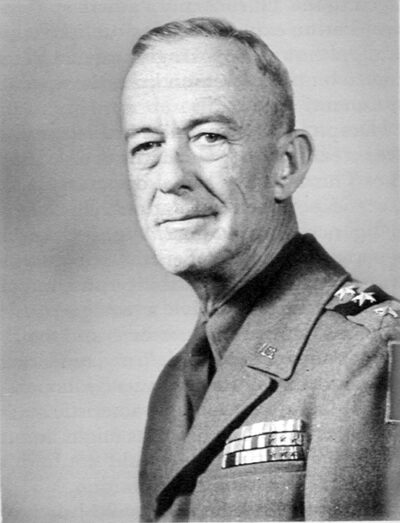
Courtney Hodges
Courtney Hodges was an United States general. Born January 5, 1887, in Perry. Died January 16, 1966, in San Antonio. Educated at United States Army Command and General Staff College. Awards include Bronze Star Medal, Silver Star and Order of Suvorov, 1st class.
Facts
26 facts · 2 confirmed by two sources · 12 cited · 12 from one source
Where this comes from
Papalocal keeps its own record. It started from these sources; what each one said is kept here as it was copied, so a change on their side never changes this page by itself. Tap one to read its version.
What Wikidata says · copied November 15, 2026 · revision 2568987665
- Described as
- United States general (1887-1966)
- Other names
- Courtney Hicks Hodges, Courtney H. Hodges
- Born
- January 5, 1887 · 5 references
- Died
- January 16, 1966 · 5 references
- Born in
- Perry
- Died in
- San Antonio
- Buried in
- Arlington National Cemetery (1966) · 1 reference
- Citizen of
- United States
- Occupation
- army officer
- Education
- United States Army Command and General Staff College
- Awards
- Bronze Star Medal · 1 reference; Silver Star; Order of Suvorov, 1st class (1945) · 1 reference; World War II Victory Medal · 1 reference; Distinguished Service Cross (1919) · 1 reference; Distinguished Service Medal (2 times) (1944, 1949) · 1 reference; Inter-Allied Victory Medals · 1 reference; European-African-Middle Eastern Campaign Medal · 1 reference; Asiatic-Pacific Campaign Medal · 1 reference; Army of Occupation Medal · 1 reference; American Campaign Medal · 1 reference; Order of Leopold · 1 reference; Order of the Oak Crown · 1 reference; Grand Officer of the Legion of Honour · 1 reference; Citation Star · 1 reference
- Military branch
- United States Army
- Military rank
- general; lieutenant general (1944) · 1 reference
- Wikipedias with a page
- 27
Wikidata item Q44400 (wikidata.org/wiki/Q44400), public domain (CC0). Copied November 15, 2026.
What Wikipedia says · copied November 15, 2026 · revision 1382566756
Courtney Hicks Hodges (5 January 1887 – 16 January 1966) was a senior officer in the United States Army who commanded the First U.S. Army in the Western European Campaign of World War II. Hodges was a "mustang" officer, rising from private to general.
Born in Perry, Georgia, he initially enrolled at the United States Military Academy to become a commissioned officer but was dismissed after failing geometry. He joined the U.S. Army in 1906 as an enlisted serviceman, becoming a non-commissioned officer and later obtained a commission after passing an examination in 1909. Hodges served under John J. Pershing in the Pancho Villa Expedition and took part in the first rescue mission in U.S. military aviation history when he helped save a stranded aviator. He was a battalion commander in France during World War I and was awarded the Distinguished Service Cross for his actions.
In 1943, he was posted to England to serve under General Omar Bradley. Hodges was initially the deputy commander of the American First Army during the D-Day invasion and was appointed commander two months later. While in command of the First Army, which included 18 divisions, he commanded one of the largest forces under a single general in the European theater of World War II. The First Army liberated Paris and was the first Allied army to enter Nazi Germany. As Courtney's First Army front pushed towards Germany, he launched an offensive through the Hürtgen Forest, which resulted in severe casualties but limited gains. After the collapse of German forces at the Ruhr, the First Army advanced deep into Germany and eventually linked up with Soviet forces at the Elbe river.
- Born, in its opening lines
- January 5, 1887
- Died, in its opening lines
- January 16, 1966
From the Wikipedia article “Courtney Hodges” (en.wikipedia.org/wiki/Courtney_Hodges), by its contributors, under CC BY-SA 4.0 (creativecommons.org/licenses/by-sa/4.0/). Copied November 15, 2026; not changed.
Confirmed Two sources agree. Cited One source, and it names where it got it. One source One source, without a reference of its own. Sources disagree The sources disagree. We show the best-supported value and keep theirs below.
