
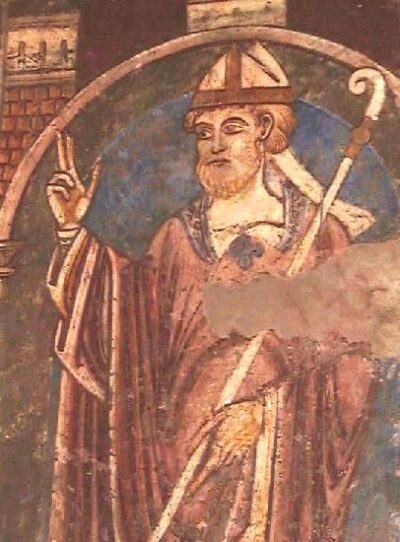
Cuthbert
Cuthbert was the 7th-century Anglo-Saxon bishop, monk, hermit and saint. Born 635, in Smailholm. Died March 20, 687, in Farne Islands. Positions held include Roman Catholic Bishop of Hexham (685–687) and Bishop of Lindisfarne (685–).
Facts
19 facts · 1 confirmed by two sources · 10 cited · 7 from one source · 1 where the sources disagree
What’s different
- Born: we show 635 (Sources disagree). Wikipedia says c. 634
Where this comes from
Papalocal keeps its own record. It started from these sources; what each one said is kept here as it was copied, so a change on their side never changes this page by itself. Tap one to read its version.
What Wikidata says · copied November 16, 2026 · revision 2558233640
- Described as
- 7th-century Anglo-Saxon bishop, monk, hermit and saint (635–687)
- Other names
- Saint Cuthbert
- Born
- 635 · 2 references
- Died
- March 20, 687 · 3 references
- Born in
- Smailholm
- Died in
- Farne Islands
- Buried in
- Durham Cathedral · 1 reference
- Citizen of
- Kingdom of Northumbria
- Occupation
- Catholic priest; writer · 1 reference; Catholic bishop (685–) · 1 reference; bishop · 1 reference
- Positions held
- Roman Catholic Bishop of Hexham (685–687) · 1 reference; Bishop of Lindisfarne (685–) · 2 references
- Field
- church‘s ministry · 1 reference; monastic life · 1 reference; hermitage · 1 reference; missionary work · 1 reference; religious · 1 reference; hermit · 1 reference
- Religion
- Catholic Church · 1 reference
- Wikipedias with a page
- 29
Wikidata item Q504518 (wikidata.org/wiki/Q504518), public domain (CC0). Copied November 16, 2026.
What Wikipedia says · copied November 16, 2026 · revision 1380423123
Cuthbert () (c. 634 – 20 March 687) was a saint of the early Northumbrian church in the Celtic tradition. He was a monk, bishop and hermit, associated with the monasteries of Melrose and Lindisfarne in the Kingdom of Northumbria, today in north-eastern England and south-eastern Scotland. Both during his life and after his death, he became a popular medieval saint of Northern England, with a cult centred on his tomb at Durham Cathedral. Cuthbert is regarded as the patron saint of Northumbria. His feast days are 20 March (Catholic Church, Church of England, Eastern Orthodox Church, Episcopal Church) and 4 September (Church in Wales, Catholic Church).
Cuthbert grew up in or around Lauderdale, near Old Melrose Abbey, a daughter-house of Lindisfarne, today in Scotland. He decided to become a monk after seeing a vision on the night in 651 that Aidan, the founder of Lindisfarne, died, but he seems to have experienced some period of military service beforehand. He was made guest-master at the new monastery at Ripon, soon after 655, but had to return with Eata of Hexham to Melrose when Wilfrid was given the monastery instead. About 662 he was made prior at Melrose, and around 665 went as prior to Lindisfarne. In 684 he was made bishop of Lindisfarne. By late 686 he resigned and returned to his hermitage as he felt he was about to die. He was probably in his early 50s.
- Born, in its opening lines
- c. 634
- Died, in its opening lines
- March 20, 687
From the Wikipedia article “Cuthbert” (en.wikipedia.org/wiki/Cuthbert), by its contributors, under CC BY-SA 4.0 (creativecommons.org/licenses/by-sa/4.0/). Copied November 16, 2026; not changed.
Confirmed Two sources agree. Cited One source, and it names where it got it. One source One source, without a reference of its own. Sources disagree The sources disagree. We show the best-supported value and keep theirs below.
