
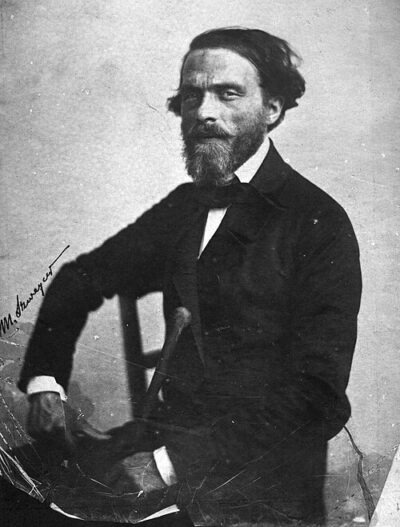
Cyprian Norwid
Cyprian Norwid was a Polish poet. Born September 24, 1821, in Głuchy. Died May 23, 1883, in Paris.
Facts
18 facts · 2 confirmed by two sources · 9 cited · 7 from one source
Where this comes from
Papalocal keeps its own record. It started from these sources; what each one said is kept here as it was copied, so a change on their side never changes this page by itself. Tap one to read its version.
What Wikidata says · copied November 16, 2026 · revision 2565010164
- Described as
- Polish poet (1821–1883)
- Other names
- Cyprjan Kamil Norwid, Cypryan Kamil Norvid, Cyprian Kamil Norwid, Cyprian Konstanty Norwid, C.K. Norwid
- Born
- September 24, 1821 · 7 references
- Died
- May 23, 1883 · 9 references
- Born in
- Głuchy · 1 reference
- Died in
- Paris · 4 references
- Buried in
- Wawel Cathedral
- Cause of death
- tuberculosis
- Citizen of
- Poland · 1 reference; France · 2 references
- Occupation
- poet · 3 references; painter · 2 references; sculptor · 1 reference; writer · 1 reference; playwright · 1 reference; graphic artist · 1 reference
- Field
- literature · 1 reference
- Siblings
- Ludwik Norwid; Paulina Suska
- Religion
- Catholic Church
- Wikipedias with a page
- 39
Wikidata item Q340122 (wikidata.org/wiki/Q340122), public domain (CC0). Copied November 16, 2026.
What Wikipedia says · copied November 16, 2026 · revision 1380820998
Cyprian Ksawery Gerard Walenty Norwid (24 September 1821 – 23 May 1883), better known as Cyprian Kamil Norwid (Polish: [ˈt͡sɘ̟.prjan ˈka.mil ˈnɔr.vit]), was a Polish poet, dramatist, painter, sculptor, and philosopher. He is now considered one of the four most important Polish Romantic poets, though scholars still debate whether he is more aptly described as a late romantic or an early modernist.
Norwid led a tragic, often poverty-stricken life. He experienced mounting health problems, unrequited love, harsh critical reviews, and increasing social isolation. For most of his life he lived abroad, having left Polish lands in his twenties. Having briefly travelled across Western Europe in his youth, and briefly travelling to the United States, where he worked as an illustrator, he lived chiefly in Paris, where he eventually died.
Considered a "rising star" in his youth, Norwid's original, nonconformist style was not appreciated in his lifetime. Partly due to this, he was excluded from high society. His work was rediscovered and appreciated only after his death by the Young Poland movement of the late-nineteenth and early-twentieth centuries. Today his most influential work is considered to be Vade-mecum, a vast anthology of verse he finished in 1866. Much of his work, including Vade-mecum, remained unpublished during his lifetime.
- Born, in its opening lines
- September 24, 1821
- Died, in its opening lines
- May 23, 1883
From the Wikipedia article “Cyprian Kamil Norwid” (en.wikipedia.org/wiki/Cyprian_Kamil_Norwid), by its contributors, under CC BY-SA 4.0 (creativecommons.org/licenses/by-sa/4.0/). Copied November 16, 2026; not changed.
Confirmed Two sources agree. Cited One source, and it names where it got it. One source One source, without a reference of its own. Sources disagree The sources disagree. We show the best-supported value and keep theirs below.
