
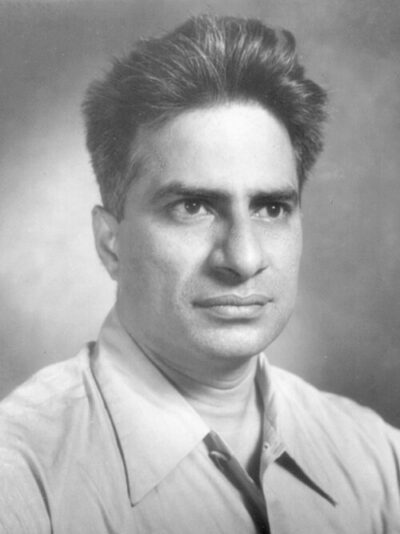
Damodar Dharmananda Kosambi
Damodar Dharmananda Kosambi was an Indian mathematician (*1907 - †1966). Born July 31, 1907, in Goa. Died June 29, 1966, in Pune. Educated at Harvard University and Cambridge Rindge and Latin School.
Facts
18 facts · 2 confirmed by two sources · 3 cited · 13 from one source
What’s different
- Born: we show July 31, 1907 (Confirmed). Wikidata also lists May 31, 1907
Where this comes from
Papalocal keeps its own record. It started from these sources; what each one said is kept here as it was copied, so a change on their side never changes this page by itself. Tap one to read its version.
What Wikidata says · copied November 18, 2026 · revision 2565500632
- Described as
- Indian mathematician (*1907 - †1966)
- Born
- July 31, 1907 · 2 references; May 31, 1907 · 1 reference
- Died
- June 29, 1966 · 3 references
- Born in
- Goa
- Died in
- Pune
- Citizen of
- British Raj (–1947); India (1950–); Portuguese India
- Occupation
- mathematician; historian; numismatist; writer · 1 reference; humanities scholar · 1 reference
- Worked for
- Banaras Hindu University
- Education
- Harvard University; Cambridge Rindge and Latin School · 1 reference; Fergusson College
- Children
- Meera Kosambi · 1 reference
- Father
- Dharmananda Damodar Kosambi
- Wikipedias with a page
- 22
Wikidata item Q2722635 (wikidata.org/wiki/Q2722635), public domain (CC0). Copied November 18, 2026.
What Wikipedia says · copied November 18, 2026 · revision 1376751859
Damodar Dharmananda Kosambi (31 July 1907 – 29 June 1966) was an Indian polymath with interests in mathematics, statistics, philology, history, and genetics. He contributed to genetics by introducing the Kosambi map function. In statistics, he was the first person to develop orthogonal infinite series expressions for stochastic processes via the Kosambi–Karhunen–Loève theorem. He is also well known for his work in numismatics and for compiling critical editions of ancient Sanskrit texts. His father, Dharmananda Damodar Kosambi, had studied ancient Indian texts with a particular emphasis on Buddhism and its literature in the Pali language. Damodar Kosambi emulated him by developing a keen interest in his country's ancient history. He was also a Marxist historian specialising in ancient India who employed the historical materialist approach in his work. He is particularly known for his classic work An Introduction to the Study of Indian History.
He is described as "the patriarch of the Marxist school of Indian historiography". Kosambi was critical of the policies of then prime minister Jawaharlal Nehru, which, according to him, promoted capitalism in the guise of democratic socialism. He was an enthusiast of the Chinese Communist Revolution and its ideals, and was a leading activist in the world peace movement.
- Born, in its opening lines
- July 31, 1907
- Died, in its opening lines
- June 29, 1966
From the Wikipedia article “Damodar Dharmananda Kosambi” (en.wikipedia.org/wiki/Damodar_Dharmananda_Kosambi), by its contributors, under CC BY-SA 4.0 (creativecommons.org/licenses/by-sa/4.0/). Copied November 18, 2026; not changed.
Confirmed Two sources agree. Cited One source, and it names where it got it. One source One source, without a reference of its own. Sources disagree The sources disagree. We show the best-supported value and keep theirs below.
