
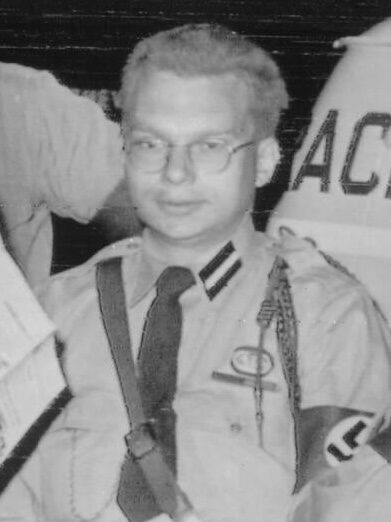
Dan Burros
Dan Burros was an American neo-Nazi. Born March 5, 1937, in The Bronx. Died October 31, 1965, in Reading.
Facts
12 facts · 2 confirmed by two sources · 8 cited · 2 from one source
Where this comes from
Papalocal keeps its own record. It started from these sources; what each one said is kept here as it was copied, so a change on their side never changes this page by itself. Tap one to read its version.
What Wikidata says · copied November 18, 2026 · revision 2553241918
- Described as
- American neo-Nazi (1937–1965)
- Other names
- Daniel Burros, Dan Buras
- Born
- March 5, 1937 · 1 reference
- Died
- October 31, 1965 · 1 reference
- Born in
- The Bronx · 1 reference
- Died in
- Reading · 1 reference
- Cause of death
- gunshot wound · 1 reference
- Citizen of
- United States
- Occupation
- printer · 1 reference
- Political party
- American Nazi Party · 1 reference; National Renaissance Party · 1 reference; American National Party
- Member of
- Ku Klux Klan · 1 reference
- Height
- 1.70 m (5 ft 7 in) · 1 reference
- Wikipedias with a page
- 18
Wikidata item Q573974 (wikidata.org/wiki/Q573974), public domain (CC0). Copied November 18, 2026.
What Wikipedia says · copied November 18, 2026 · revision 1383004684
Daniel Burros (March 5, 1937 – October 31, 1965) was an American neo-Nazi affiliated with several far-right organizations. Burros was once the third highest-ranking member of the American Nazi Party, and later a Grand Dragon of the Ku Klux Klan in New York. Within the far-right movement, Burros was known for the severity of his antisemitism. He edited several neo-Nazi periodicals and publications, including his newspaper The Free American, which became popular with fascists internationally. When The New York Times published an article revealing that he was Jewish, Burros killed himself.
Born to a Russian Jewish family in the Bronx, Burros was enrolled in Hebrew school in Richmond Hill, Queens, where his bar mitzvah was held. He became antisemitic as a teenager. After serving in the Army for several years, he was discharged under honorable conditions in 1958 and joined the American Nazi Party in 1960. Burros left the party the next year alongside his close friend John Patler. Patler and Burros founded a splinter group, the American National Party, along with their Kill! magazine, in New York. Soon after they had a falling-out, their group and magazine failed, and Patler returned to the American Nazi Party. Influenced by fascist ideologue Francis Parker Yockey's book Imperium, Burros joined James H. Madole's neo-Nazi National Renaissance Party in 1963. After a dispute with Madole, he left the group and became an Odinist.
In 1965, Burros was recruited into the Ku Klux Klan by Roy Frankhouser and quickly became the King Kleagle and the Grand Dragon of the New York chapter of the Ku Klux Klan's United Klans of America. On October 31, 1965, his Jewish heritage was exposed to the public by journalist McCandlish Phillips, who published an article about Burros in The New York Times. Some hours after the article was published, Burros fatally shot himself in Frankhouser's home. His suicide was widely publicized; The New York Times received both criticism and praise for running the story. A biography of Burros, One More Victim, was written by A. M. Rosenthal and Arthur Gelb in 1967, and his life was the basis for the 2001 film The Believer.
- Born, in its opening lines
- March 5, 1937
- Died, in its opening lines
- October 31, 1965
From the Wikipedia article “Dan Burros” (en.wikipedia.org/wiki/Dan_Burros), by its contributors, under CC BY-SA 4.0 (creativecommons.org/licenses/by-sa/4.0/). Copied November 18, 2026; not changed.
Confirmed Two sources agree. Cited One source, and it names where it got it. One source One source, without a reference of its own. Sources disagree The sources disagree. We show the best-supported value and keep theirs below.
