
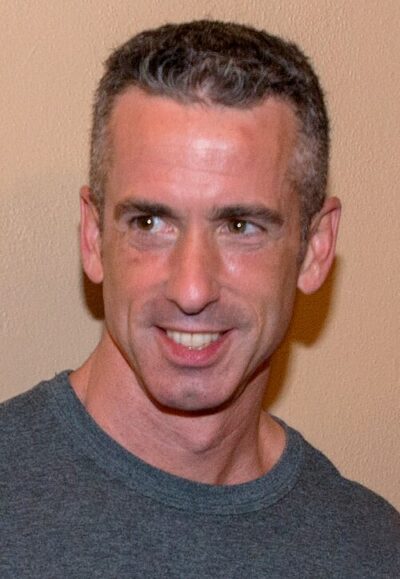
Dan Savage
Dan Savage is an American sex advice columnist and gay rights campaigner. Born October 7, 1964, in Chicago. Educated at University of Illinois Urbana-Champaign and Archbishop Quigley Preparatory Seminary. Awards include Lambda Literary Award, Humanist of the Year and Emperor Has No Clothes Award.
Facts
21 facts · 1 confirmed by two sources · 8 cited · 12 from one source
Where this comes from
Papalocal keeps its own record. It started from these sources; what each one said is kept here as it was copied, so a change on their side never changes this page by itself. Tap one to read its version.
What Wikidata says · copied November 18, 2026 · revision 2569221655
- Described as
- American sex advice columnist and gay rights campaigner
- Other names
- Daniel Keenan Savage, Keenan Hollohan
- Born
- October 7, 1964 · 2 references
- Born in
- Chicago · 1 reference
- Citizen of
- United States
- Occupation
- writer; sex educator; podcaster · 2 references; journalist · 2 references; author · 1 reference
- Political party
- Democratic Party
- Education
- University of Illinois Urbana-Champaign; Archbishop Quigley Preparatory Seminary · 1 reference; UIUC College of Media
- Awards
- Lambda Literary Award; Humanist of the Year (2013); Emperor Has No Clothes Award (2013); The Sidney Award (2010) · 2 references
- Field
- advice column · 1 reference
- Spouse
- Terry Miller (2005–) · 1 reference
- Religion
- atheism
- Lived in
- Seattle
- Website
- https://savage.love/ · 1 reference
- Wikipedias with a page
- 19
Wikidata item Q649667 (wikidata.org/wiki/Q649667), public domain (CC0). Copied November 18, 2026.
What Wikipedia says · copied November 18, 2026 · revision 1385274126
Daniel Keenan Savage (born October 7, 1964) is an American journalist, and LGBTQ community activist. He writes Savage Love, a relationship and sex advice column. In 2010, Savage and his husband, Terry Miller, began the It Gets Better Project to help prevent suicide among LGBTQ youth. He has also worked as a theater director, sometimes credited as Keenan Hollahan.
Born in Chicago to Catholic parents, Savage attended the University of Illinois at Urbana–Champaign where he received a Bachelor of Fine Arts degree in acting. After living in West Berlin from 1988 to 1990, he moved to Madison, Wisconsin, where he befriended Tim Keck, co-founder of The Onion. When Keck moved to Seattle, Washington, Savage moved as well to become an advice columnist for The Stranger, which Keck founded; he had offered Savage the position after Savage wrote a sample column which impressed him. Savage has since become a sex columnist and a vocal proponent of LGBTQ rights in the United States, voicing his advocacy through Savage Love, and a podcast version titled the Savage Lovecast. In 2001, Savage and his readership coined the term pegging to describe a woman anally penetrating a man with a strap-on dildo.
Outside of his writings and podcasts, Savage has advocated for progressive politics and advancing the rights of LGBTQ youth to prevent suicide in the community. He has opposed laws restricting pornography and the sale of sex toys. Savage has been featured on numerous television programs and news outlets, including Countdown with Keith Olbermann and Anderson Cooper 360.
Savage has attracted controversy over his comments and actions related to LGBTQ issues. He promoted the term santorum to define a by-product of sex after former senator Rick Santorum made anti-LGBTQ comments in 2003, and condemned the Church of Jesus Christ of Latter-day Saints for its support of California Proposition 8, which banned same-sex marriage in California. His activism and public speaking has brought praise from celebrities and politicians, including former president Barack Obama.
- Born, in its opening lines
- October 7, 1964
From the Wikipedia article “Dan Savage” (en.wikipedia.org/wiki/Dan_Savage), by its contributors, under CC BY-SA 4.0 (creativecommons.org/licenses/by-sa/4.0/). Copied November 18, 2026; not changed.
Confirmed Two sources agree. Cited One source, and it names where it got it. One source One source, without a reference of its own. Sources disagree The sources disagree. We show the best-supported value and keep theirs below.
