
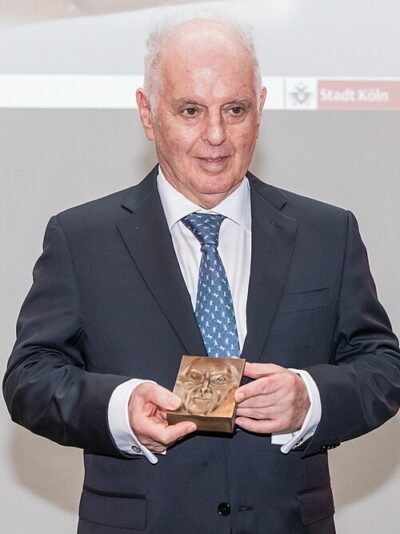
Daniel Barenboim
Daniel Barenboim is an Israeli Argentine-born pianist and conductor. Born November 15, 1942, in Buenos Aires. Educated at Mozarteum University Salzburg and Accademia Musicale Chigiana. Awards include Grand Officer of the Legion of Honour, Knight Commander of the Order of the British Empire and Princess of Asturias Award for Concord.
Facts
38 facts · 1 confirmed by two sources · 20 cited · 17 from one source
Where this comes from
Papalocal keeps its own record. It started from these sources; what each one said is kept here as it was copied, so a change on their side never changes this page by itself. Tap one to read its version.
What Wikidata says · copied November 16, 2026 · revision 2569643180
- Described as
- Israeli Argentine-born pianist and conductor (born 1942)
- Born
- November 15, 1942 · 11 references
- Born in
- Buenos Aires · 2 references
- Citizen of
- Argentina · 1 reference; Israel · 1 reference; Spain · 1 reference; Palestine · 3 references
- Occupation
- pianist · 1 reference; conductor · 1 reference; music director; musician · 1 reference
- Education
- Mozarteum University Salzburg; Accademia Musicale Chigiana
- Member of
- American Academy of Arts and Sciences; National Academy of Fine Arts (Argentina) (2007–) · 1 reference
- Genre
- classical music
- Instrument
- piano
- Record label
- Deutsche Grammophon
- Awards
- Grand Officer of the Legion of Honour; Knight Commander of the Order of the British Empire; Princess of Asturias Award for Concord (2002) · 2 references; Wolf Prize in Arts (2004); Peace Prize of Hesse (2006) · 1 reference; Praemium Imperiale (2007) · 2 references; Léonie Sonning Music Prize (2009) · 1 reference; Bruno Kreisky Award for Services to Human Rights (2011) · 1 reference; Great Cross with Star and Sash of the Order of Merit of the Federal Republic of Germany (2013) · 1 reference; Ernst Reuter Medal (2013) · 1 reference; Pour le Mérite for Sciences and Arts order (2015) · 1 reference; Otto Hahn Peace Medal (2010) · 1 reference; Prize Franco Abbiati Italian Music (2013); Royal Philharmonic Society Gold Medal (2007) · 1 reference; honorary doctor of the Hebrew University of Jerusalem (1996) · 1 reference
- Field
- performing arts; opera · 1 reference
- Spouse
- Jacqueline du Pré (1967–1987); Elena Bashkirova (1988–) · 1 reference
- Children
- Michael Barenboim · 1 reference
- Website
- https://danielbarenboim.com/
- Wikipedias with a page
- 53
Wikidata item Q152768 (wikidata.org/wiki/Q152768), public domain (CC0). Copied November 16, 2026.
What Wikipedia says · copied November 16, 2026 · revision 1378677066
Daniel Moses Barenboim (Hebrew: דניאל בארנבוים, Arabic: دانيال بارنبويم; born 15 November 1942) is an Argentinian-born classical pianist and conductor with Spanish, Israeli and Palestinian citizenship. From 1992 until January 2023, Barenboim was the general music director of the Berlin State Opera and "Staatskapellmeister" of its orchestra, the Staatskapelle Berlin.
Barenboim previously served as music director of the Chicago Symphony Orchestra, the Orchestre de Paris and La Scala in Milan, and he is also the founder, along with Palestinian-American scholar Edward Said, of the West–Eastern Divan Orchestra. Barenboim has received many awards and prizes, including seven Grammy awards, an honorary Knight Commander of the Order of the British Empire, France's Legion of Honour as a Commander, Grand Officier and Grand Cross, the Grand Cross of the Order of Merit of the Federal Republic of Germany, and Spain's Prince of Asturias Concord Award.
Barenboim is the only publicly documented person to hold citizenship in both Israel and Palestine. He is a critic of the Israeli occupation of Palestinian territories, and is prominent in working to promote dialogue between Israelis and Palestinians.
- Born, in its opening lines
- November 15, 1942
From the Wikipedia article “Daniel Barenboim” (en.wikipedia.org/wiki/Daniel_Barenboim), by its contributors, under CC BY-SA 4.0 (creativecommons.org/licenses/by-sa/4.0/). Copied November 16, 2026; not changed.
Confirmed Two sources agree. Cited One source, and it names where it got it. One source One source, without a reference of its own. Sources disagree The sources disagree. We show the best-supported value and keep theirs below.
