
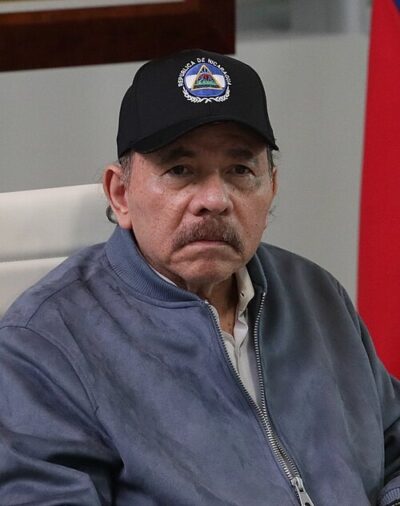
Daniel Ortega
Daniel Ortega is a Nicaraguan politician and former revolutionary. He first rose to prominence as a leader of the Sandinista movement. Ortega served as president of Nicaragua from 1985 to 1990, having previously held leadership roles in the post-revolutionary government.
He returned to the presidency in 2007 and has held the office since. In February 2025, he began serving as co-president with his wife, Rosario Murillo. Ortega's political career spans several decades and has been marked by significant influence over Nicaragua's governance.
Facts
28 facts · 1 confirmed by two sources · 11 cited · 16 from one source
Where this comes from
Papalocal keeps its own record. It started from these sources; what each one said is kept here as it was copied, so a change on their side never changes this page by itself. Tap one to read its version.
What Wikidata says · copied November 13, 2026 · revision 2567907160
- Described as
- Leader of Nicaragua (1979–1990; 2007–present)
- Born
- November 11, 1945 · 5 references
- Born in
- La Libertad · 1 reference
- Citizen of
- Nicaragua
- Occupation
- politician · 1 reference; writer · 1 reference; revolutionary · 1 reference
- Positions held
- President of Nicaragua (2 times) (1985–)
- Political party
- Sandinista National Liberation Front (1963–) · 1 reference
- Education
- Central American University (1962–1963) · 1 reference
- Awards
- Order of Friendship (2015) · 1 reference; Order of the Sun of Peru · 1 reference; Order of José Martí · 1 reference; Order of Sukhbaatar (1983) · 1 reference; Order of Honor and Glory First Class · 1 reference; Uatsamonga Order · 1 reference; Al-Gaddafi International Prize for Human Rights (2009) · 1 reference; Order of Augusto César Sandino · 1 reference; Orden de la Independencia Cultural Rubén Darío · 1 reference; Order of Honour and Glory · 1 reference; Order of Miguel Larreynage · 1 reference
- Spouse
- Rosario Murillo (1978–) · 1 reference
- Children
- Zoilamérica Ortega Murillo; Camila Ortega Murillo; Juan Carlos Ortega Murillo
- Siblings
- Camilo Ortega · 1 reference; Humberto Ortega · 1 reference
- Religion
- lapsed Catholic
- Lived in
- Managua · 1 reference
- Wikipedias with a page
- 95
Wikidata item Q57402 (wikidata.org/wiki/Q57402), public domain (CC0). Copied November 13, 2026.
What Wikipedia says · copied November 13, 2026 · revision 1385073222
José Daniel Ortega Saavedra ( or-TAY-gə; Spanish: [daˈnjel oɾˈteɣa]; born 11 November 1945) is a Nicaraguan politician, revolutionary, and former guerrilla fighter who, under various titles, has been the leader of Nicaragua since 2007 and previously from 1979 to 1990. He first came to power as the coordinator of the Junta of National Reconstruction from 1979 to 1985, and then served as president of Nicaragua from 1985 until 1990. He reassumed the presidency in 2007 and has served alongside his wife Rosario Murillo as co-president since February 2025. Ortega has been described as an authoritarian leader and has invited comparisons to Anastasio Somoza Debayle. He is widely considered to be a dictator along with his wife.
Ortega came to prominence with the overthrow and exile of US-backed dictator Anastasio Somoza Debayle in 1979 during the Nicaraguan Revolution. As a leader in the Sandinista National Liberation Front (Spanish: Frente Sandinista de Liberación Nacional, FSLN) Ortega became leader of the ruling Junta of National Reconstruction. A Marxist–Leninist, Ortega pursued a program of nationalization, land reform, wealth redistribution, and literacy programs during his first period in office. Ortega's government was responsible for the forced displacement of 10,000 indigenous people. In 1984, Ortega won Nicaragua's presidential election with over 60% of the vote as the FSLN's candidate. During his first term, he implemented policies to achieve leftist reforms across Nicaragua. Throughout the 1980s, Ortega's government faced a rebellion by US-backed rebels, known as the Contras. After a presidency marred by conflict and economic collapse, Ortega was defeated in the 1990 general election by Violeta Chamorro.
Ortega was an unsuccessful presidential candidate in 1996 and 2001 but won the 2006 general election. In office, he allied with fellow Latin American socialists. His second administration abandoned most of his earlier leftist principles, alienating many of his former revolutionary allies. Under his tenure, Nicaragua has experienced democratic backsliding. In June 2018, organizations such as Amnesty International and the Organization of American States reported that Ortega had engaged in a violent oppression campaign against anti-government protests. The violent crackdown and subsequent constriction of civil liberties have led to waves of emigration to neighboring Costa Rica, with more than 30,000 Nicaraguans filing for asylum in that country.
His government jailed many potential rival candidates in the 2021 general election, including Cristiana Chamorro Barrios. Ortega's government also imprisoned other opponents, such as former allies Dora María Téllez and Hugo Torres Jiménez. In August 2021, Nicaragua cancelled the operating permits of six US and European NGOs. Many critics of the Ortega government, including opposition leaders, journalists and members of civil society, fled the country in mid-2021. In his fourth term, Ortega ordered the closure of several NGOs, universities, and newspapers, and resumed his repression of the Catholic Church after a brief rapprochement, imprisoning prelate Rolando José Álvarez Lagos.
- Born, in its opening lines
- November 11, 1945
From the Wikipedia article “Daniel Ortega” (en.wikipedia.org/wiki/Daniel_Ortega), by its contributors, under CC BY-SA 4.0 (creativecommons.org/licenses/by-sa/4.0/). Copied November 13, 2026; not changed.
Confirmed Two sources agree. Cited One source, and it names where it got it. One source One source, without a reference of its own. Sources disagree The sources disagree. We show the best-supported value and keep theirs below.
