
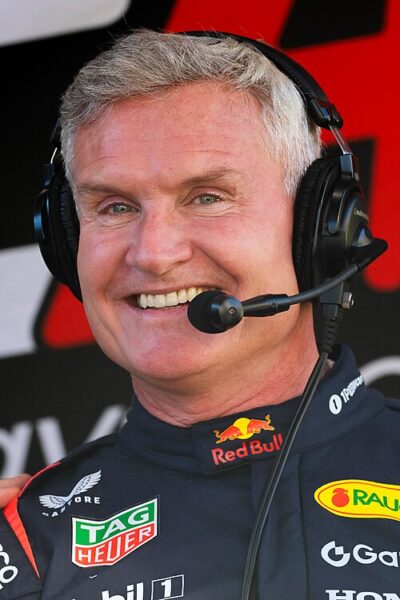
David Coulthard
David Coulthard is a British racing driver. Born March 27, 1971, in Twynholm. Teams include Williams Racing, McLaren and Red Bull Racing. Educated at Kirkcudbright Academy. Awards include Member of the Order of the British Empire.
Facts
19 facts · 1 confirmed by two sources · 4 cited · 14 from one source
Where this comes from
Papalocal keeps its own record. It started from these sources; what each one said is kept here as it was copied, so a change on their side never changes this page by itself. Tap one to read its version.
What Wikidata says · copied November 16, 2026 · revision 2557851119
- Described as
- British racing driver
- Other names
- DC, David Marshall Coulthard
- Born
- March 27, 1971 · 2 references
- Born in
- Twynholm · 1 reference
- Citizen of
- United Kingdom
- Occupation
- racing automobile driver · 1 reference; television presenter · 1 reference; Formula One driver · 1 reference
- Worked for
- British Broadcasting Corporation
- Education
- Kirkcudbright Academy
- Teams
- Williams Racing; McLaren; Red Bull Racing
- Sport
- auto racing
- Awards
- Member of the Order of the British Empire
- Field
- Formula One race · 1 reference
- Spouse
- Karen Minier (2013–2022); Sigrid Silversand (2026–) · 1 reference
- Lived in
- Monaco
- Height
- 1.83 m (6 ft 0 in)
- Website
- http://www.davidcoulthard.co.uk/
- Wikipedias with a page
- 60
Wikidata item Q172832 (wikidata.org/wiki/Q172832), public domain (CC0). Copied November 16, 2026.
What Wikipedia says · copied November 16, 2026 · revision 1385913551
David Marshall Coulthard (born 27 March 1971) is a British former racing driver and broadcaster from Scotland who competed in Formula One from 1994 to 2008. Nicknamed "DC", Coulthard was runner-up in the Formula One World Drivers' Championship in 2001 with McLaren, and won 13 Grands Prix across 15 seasons.
Born and raised in Kirkcudbrightshire, Coulthard began karting at age 11 and achieved early success before progressing to car racing in the British Formula Ford Championship and the Formula 3000 series. He first drove in Formula One with Williams in the 1994 season succeeding the late Ayrton Senna. The following year he won his first Grand Prix in Portugal, and then for the 1996 season, he moved to McLaren. After winning two races in the 1997 season, he finished 3rd in the World Drivers' Championship in the 1998 season.
Coulthard won five races during 1999 and 2000 before finishing second in the Drivers' Championship to Michael Schumacher in 2001. Two more victories followed between 2002 and 2003 before he left McLaren at the end of 2004. He moved to Red Bull in 2005 and secured their first podium a year later. Coulthard retired from Formula One at the end of 2008, having achieved 13 wins, 12 pole positions, 18 fastest laps, and 62 podiums.
After retiring from Formula One, Coulthard continued working for Red Bull as a consultant and joined the BBC as a commentator and pundit for their coverage of Formula One. He returned to active motorsports in 2010 joining Mücke Motorsport in DTM and retired at the end of 2012. Coulthard has also participated in the Race of Champions, finishing runner-up in the Drivers' Cup in 2008, and winning the competition in 2014 and 2018.
Since 2016, he has worked as a commentator and analyst for Channel 4 after they took over the BBC's terrestrial television rights. In 2022, he joined the Nordic streaming service Viaplay. He appears during Formula One race weekends as a reporter and expert commentator alongside Mika Häkkinen and Tom Kristensen.
In 2019, Coulthard was elected president of the British Racing Drivers' Club (which owns the Silverstone Circuit).
- Born, in its opening lines
- March 27, 1971
From the Wikipedia article “David Coulthard” (en.wikipedia.org/wiki/David_Coulthard), by its contributors, under CC BY-SA 4.0 (creativecommons.org/licenses/by-sa/4.0/). Copied November 16, 2026; not changed.
Confirmed Two sources agree. Cited One source, and it names where it got it. One source One source, without a reference of its own. Sources disagree The sources disagree. We show the best-supported value and keep theirs below.
