
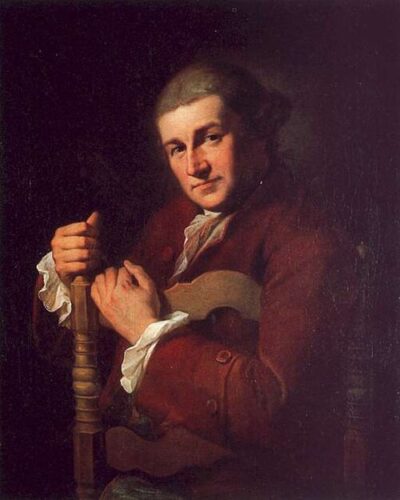
David Garrick
David Garrick was a British actor, playwright, theatre manager and producer. Born February 19, 1717, in Hereford. Died January 20, 1779, in London. Educated at King Edward VI School and Sir Joseph Williamson's Mathematical School.
Facts
19 facts · 1 confirmed by two sources · 7 cited · 10 from one source · 1 where the sources disagree
What’s different
- Born: we show February 19, 1717 (Sources disagree). Wikipedia says February 19, 1716
Where this comes from
Papalocal keeps its own record. It started from these sources; what each one said is kept here as it was copied, so a change on their side never changes this page by itself. Tap one to read its version.
What Wikidata says · copied November 16, 2026 · revision 2568056358
- Described as
- British actor, playwright, theatre manager and producer (1717–1779)
- Other names
- Devid Garrik
- Born
- February 19, 1717 · 6 references
- Died
- January 20, 1779 · 7 references
- Born in
- Hereford · 1 reference
- Died in
- London · 1 reference
- Buried in
- Poets' Corner
- Citizen of
- Kingdom of Great Britain
- Occupation
- playwright · 1 reference; theatrical producer; writer · 1 reference; screenwriter; stage actor; actor · 2 references; actor-manager; theatre manager · 1 reference
- Education
- King Edward VI School; Sir Joseph Williamson's Mathematical School
- Genre
- Shakespearean comedy
- Spouse
- Eva Marie Veigel · 1 reference
- Children
- Samuel Cautherley
- Wikipedias with a page
- 52
Wikidata item Q222390 (wikidata.org/wiki/Q222390), public domain (CC0). Copied November 16, 2026.
What Wikipedia says · copied November 16, 2026 · revision 1385403122
David Garrick (19 February 1716 – 20 January 1779) was an English actor who wrote, produced and influenced nearly all aspects of 18th century European theatrical practice, and was a pupil and friend of Samuel Johnson. He appeared in several amateur theatricals, and with his appearance in the title role of Shakespeare's Richard III, audiences and managers began to take notice.
Impressed by his portrayals of Richard III and several other roles, Charles Fleetwood engaged Garrick for a season at the Theatre Royal, Drury Lane in the West End. He remained with the Drury Lane company for the next five years and purchased a share of the theatre with James Lacy. This purchase inaugurated 29 years of Garrick's management of the Drury Lane, during which time it rose to prominence as one of the leading theatres in Europe. At his death, three years after he retired from Drury Lane and the stage, he was given a lavish public funeral at Westminster Abbey where he was buried in Poets' Corner.
As an actor, Garrick promoted realistic acting that departed from the bombastic style that was entrenched when he first came to prominence. His acting delighted many audiences and his direction of many of the top actors of the English stage influenced their styles as well. During his tenure as manager of Drury Lane, Garrick also sought to reform audience behaviour. While this led to some discontent among the theatre-going public, many of his reforms eventually did take hold. Garrick also sought reform in production matters, bringing an overarching consistency to productions that included set design, costumes and even special effects.
Garrick's influence extended into the literary side of theatre as well. Critics are almost unanimous in saying he was not a good playwright, but his work in bringing Shakespeare to contemporary audiences is notable. In addition, he adapted many older plays in the repertoire that might have been forgotten. These included many plays of the Restoration era. Indeed, while influencing the theatre towards a better standard he also gained a better reputation for theatre people. This accomplishment led Samuel Johnson to remark that "his profession made him rich and he made his profession respectable."
- Born, in its opening lines
- February 19, 1716
- Died, in its opening lines
- January 20, 1779
From the Wikipedia article “David Garrick” (en.wikipedia.org/wiki/David_Garrick), by its contributors, under CC BY-SA 4.0 (creativecommons.org/licenses/by-sa/4.0/). Copied November 16, 2026; not changed.
Confirmed Two sources agree. Cited One source, and it names where it got it. One source One source, without a reference of its own. Sources disagree The sources disagree. We show the best-supported value and keep theirs below.
