
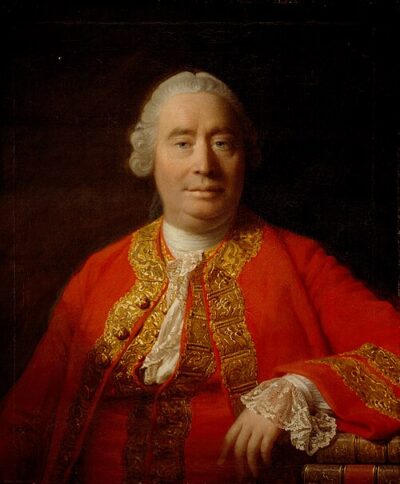
David Hume
David Hume was a Scottish philosopher, economist, and historian. Born April 26, 1711, in Edinburgh. Died August 25, 1776, in Edinburgh. Known for Philosophical Essays Concerning Human Understanding, An Enquiry Concerning the Principles of Morals and The History of England. Educated at University of Edinburgh.
Facts
33 facts · 1 confirmed by two sources · 10 cited · 21 from one source · 1 where the sources disagree
What’s different
- Born: we show April 26, 1711 (Sources disagree). Wikipedia says May 7, 1711
Where this comes from
Papalocal keeps its own record. It started from these sources; what each one said is kept here as it was copied, so a change on their side never changes this page by itself. Tap one to read its version.
What Wikidata says · copied November 16, 2026 · revision 2564342071
- Described as
- Scottish philosopher, economist, and historian (1711-1776)
- Other names
- David Home
- Born
- April 26, 1711 · 3 references
- Died
- August 25, 1776 · 16 references
- Born in
- Edinburgh · 5 references
- Died in
- Edinburgh · 4 references
- Buried in
- Old Calton Burial Ground
- Citizen of
- Kingdom of Great Britain · 1 reference
- Occupation
- philosopher · 5 references; economist · 2 references; librarian · 2 references; historian · 4 references; essayist; writer · 2 references
- Worked for
- Advocates Library (1752–1757); Embassy of the United Kingdom, Paris (1763–1766)
- Education
- University of Edinburgh · 1 reference
- Member of
- Royal Society of Edinburgh; The Select Society; The Poker Club
- Known for
- Philosophical Essays Concerning Human Understanding · 1 reference; An Enquiry Concerning the Principles of Morals; The History of England; A Treatise of Human Nature
- Field
- philosophy · 1 reference; metaphysics · 1 reference; epistemology · 1 reference; philosophy of mind · 1 reference; ethics · 1 reference; politics · 1 reference
- Father
- Joseph Hume, 10th of Ninewells · 2 references
- Mother
- Katherine Falconer · 2 references
- Siblings
- John Hume, 11th of Ninewells · 1 reference; Catherine Hume Fullerton
- Religion
- atheism
- Wikipedias with a page
- 159
Wikidata item Q37160 (wikidata.org/wiki/Q37160), public domain (CC0). Copied November 16, 2026.
What Wikipedia says · copied November 16, 2026 · revision 1383233203
David Hume (; born David Home; 7 May 1711 – 25 August 1776) was a Scottish philosopher, historian, economist and essayist who is known for his highly influential system of empiricism, philosophical scepticism and metaphysical naturalism. Beginning with A Treatise of Human Nature (1739–40), Hume strove to create a naturalistic science of man that examined the psychological basis of human nature. Following John Locke, Hume rejected the existence of innate ideas, holding that all our ideas derive ultimately from impressions, but in his fork he distinguished relations of ideas, known a priori, from matters of fact, whose knowledge rests on experience. This places him in the empiricist tradition of Locke and George Berkeley, while drawing his experimental method from Francis Bacon.
Hume argued that inductive reasoning and belief in causality cannot be justified empirically; instead, they result from custom and mental habit. People never actually perceive that one event causes another but experience only the "constant conjunction" of events. This problem of induction means that to draw any causal inferences from past experience, it is necessary to presuppose that the future will resemble the past; this metaphysical presupposition cannot itself be grounded in prior experience.
An opponent of philosophical rationalists, Hume held that passions rather than reason govern human behaviour, proclaiming that "Reason is, and ought only to be the slave of the passions." Hume was also a sentimentalist who held that ethics are based on emotion or sentiment rather than abstract moral principle. He maintained an early commitment to naturalistic explanations of moral phenomena and is usually accepted by historians of European philosophy to have first clearly expounded the is–ought problem, or the idea that a statement of fact alone can never give rise to a normative conclusion of what ought to be done.
Hume denied that people have an actual conception of the self, positing that they experience only a bundle of sensations and that the self is nothing more than this bundle of perceptions connected by an association of ideas. Hume's compatibilist theory of free will takes causal determinism as fully compatible with human freedom. His philosophy of religion, including his rejection of miracles and critique of the argument from design, was especially controversial.
During his lifetime, Hume was chiefly known as a historian and essayist, as his History of England became a bestseller, while his Treatise initially received little notice and his supposed atheism saw him passed over for university chairs. Hume left a legacy that affected utilitarianism, logical positivism, the philosophy of science, early analytic philosophy, cognitive science, theology and many other fields and thinkers. Immanuel Kant credited Hume as the inspiration that had awakened him from his "dogmatic slumbers".
- Born, in its opening lines
- May 7, 1711
- Died, in its opening lines
- August 25, 1776
From the Wikipedia article “David Hume” (en.wikipedia.org/wiki/David_Hume), by its contributors, under CC BY-SA 4.0 (creativecommons.org/licenses/by-sa/4.0/). Copied November 16, 2026; not changed.
Confirmed Two sources agree. Cited One source, and it names where it got it. One source One source, without a reference of its own. Sources disagree The sources disagree. We show the best-supported value and keep theirs below.
