
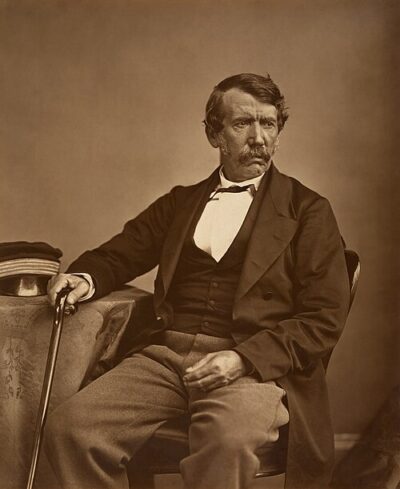
David Livingstone
David Livingstone was a Scottish missionary and explorer. Born March 19, 1813, in Blantyre. Died May 1, 1873, in Ilala Hill. Educated at University of Glasgow and Charing Cross Hospital Medical School. Awards include Fellow of the Royal Society, Patron’s Medal and Grande Médaille d'Or des Explorations.
Facts
28 facts · 2 confirmed by two sources · 11 cited · 15 from one source
Where this comes from
Papalocal keeps its own record. It started from these sources; what each one said is kept here as it was copied, so a change on their side never changes this page by itself. Tap one to read its version.
What Wikidata says · copied November 16, 2026 · revision 2564795261
- Described as
- Scottish missionary and explorer (1813-1873)
- Born
- March 19, 1813 · 12 references
- Died
- May 1, 1873 · 11 references
- Born in
- Blantyre · 3 references
- Died in
- Ilala Hill · 2 references
- Buried in
- Westminster Abbey · 2 references
- Cause of death
- malaria · 2 references
- Citizen of
- Scotland; United Kingdom · 1 reference
- Occupation
- explorer · 1 reference; physician writer; geographer · 1 reference; writer · 1 reference; missionary · 2 references
- Education
- University of Glasgow; Charing Cross Hospital Medical School; Imperial College School of Medicine; Gilbertfield House School
- Member of
- Royal Geographical Society; London Missionary Society · 1 reference; Royal Society of London
- Awards
- Fellow of the Royal Society (1858) · 1 reference; Patron’s Medal (1855) · 1 reference; Grande Médaille d'Or des Explorations (1857); Fellow of the Royal Geographical Society
- Spouse
- Mary Livingstone · 1 reference
- Children
- Agnes Livingstone Bruce
- Siblings
- Charles Livingstone
- Religion
- Congregational churches
- Wikipedias with a page
- 102
Wikidata item Q48373 (wikidata.org/wiki/Q48373), public domain (CC0). Copied November 16, 2026.
What Wikipedia says · copied November 16, 2026 · revision 1385729173
David Livingstone (; 19 March 1813 – 1 May 1873) was a Scottish doctor, Congregationalist, pioneer Christian missionary with the London Missionary Society, and an explorer in Africa. Livingstone was married to Mary Moffat Livingstone, from the prominent 18th-century Moffat missionary family. Livingstone came to have a mythic status as a Protestant missionary martyr, working-class "rags-to-riches" inspirational story, scientific investigator and explorer, imperial reformer, anti-slavery crusader, and advocate of British commercial and colonial expansion. As a result, he became one of the most popular British heroes of the late 19th-century Victorian era.
Livingstone's fame as an explorer and his obsession with learning the sources of the Nile was founded on the belief that if he could solve that age-old mystery, his fame would give him the influence to end the East African Arab–Swahili slave trade. "The Nile sources", he told a friend, "are valuable only as a means of opening my mouth with power among men. It is this power [with] which I hope to remedy an immense evil." His subsequent exploration of the central African watershed was the culmination of the classic period of European geographical discovery and colonial penetration of Africa. At the same time, his missionary travels, "disappearance" and eventual death in Africa—and subsequent glorification as a posthumous national hero in 1874—led to the founding of several major central African Christian missionary initiatives carried forward in the era of the European "Scramble for Africa", during which almost all of Africa fell under European rule for decades.
- Born, in its opening lines
- March 19, 1813
- Died, in its opening lines
- May 1, 1873
From the Wikipedia article “David Livingstone” (en.wikipedia.org/wiki/David_Livingstone), by its contributors, under CC BY-SA 4.0 (creativecommons.org/licenses/by-sa/4.0/). Copied November 16, 2026; not changed.
Confirmed Two sources agree. Cited One source, and it names where it got it. One source One source, without a reference of its own. Sources disagree The sources disagree. We show the best-supported value and keep theirs below.
