
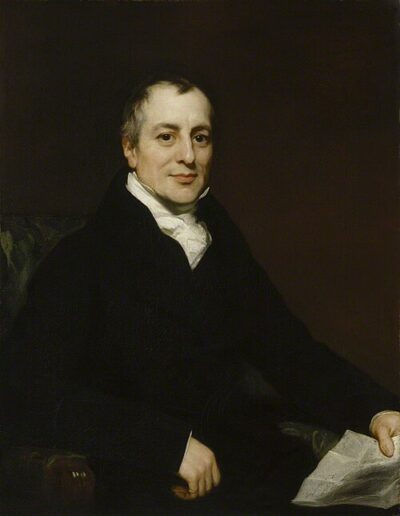
David Ricardo
David Ricardo was a British banker, classical economist and politician. Born April 18, 1772, in London. Died September 11, 1823, in Gatcombe Park. Positions held include member of the 6th Parliament of the United Kingdom (1819–1820), member of the 7th Parliament of the United Kingdom (1820–1823) and High Sheriff of Gloucestershire (1818–1819). Known for An Essay on the Influence of a Low Price of Corn on the Profits of Stock and The High Price of Bullion, a Proof of the Depreciation of Bank Notes. Educated at Talmud Torah school.
Facts
31 facts · 2 confirmed by two sources · 16 cited · 13 from one source
Where this comes from
Papalocal keeps its own record. It started from these sources; what each one said is kept here as it was copied, so a change on their side never changes this page by itself. Tap one to read its version.
What Wikidata says · copied November 16, 2026 · revision 2562728091
- Described as
- British banker, classical economist and politician (1772-1823)
- Born
- April 18, 1772 · 3 references
- Died
- September 11, 1823 · 7 references
- Born in
- London · 3 references
- Died in
- Gatcombe Park · 1 reference
- Buried in
- Church of St Nicholas, Hardenhuish
- Citizen of
- United Kingdom of Great Britain and Ireland; Kingdom of Great Britain (–1801)
- Occupation
- economist · 1 reference; stockbroker · 1 reference; philosopher; politician · 1 reference; writer · 1 reference; Master's Degree in Economics · 1 reference; member of parliament · 1 reference; banker · 1 reference
- Positions held
- member of the 6th Parliament of the United Kingdom (1819–1820) · 1 reference; member of the 7th Parliament of the United Kingdom (1820–1823) · 1 reference; High Sheriff of Gloucestershire (1818–1819) · 1 reference
- Political party
- Whigs
- Education
- Talmud Torah school · 1 reference
- Known for
- An Essay on the Influence of a Low Price of Corn on the Profits of Stock; The High Price of Bullion, a Proof of the Depreciation of Bank Notes
- Field
- economics; economy · 1 reference
- Spouse
- Priscilla Ann Wilkinson · 1 reference
- Children
- David Ricardo; Osman Ricardo
- Siblings
- Jacob Ricardo
- Religion
- Judaism (–1793) · 1 reference; Unitarianism (1793–) · 1 reference
- Lived in
- Gatcombe Park
- Wikipedias with a page
- 98
Wikidata item Q160270 (wikidata.org/wiki/Q160270), public domain (CC0). Copied November 16, 2026.
What Wikipedia says · copied November 16, 2026 · revision 1384880453
David Ricardo (18 April 1772 – 11 September 1823) was a British economist and politician. He is recognized as one of the most influential classical economists, alongside figures such as Thomas Malthus, Adam Smith and James Mill.
Ricardo was born in London as the third surviving child of a successful stockbroker and his wife. He came from a Sephardic Jewish family of Portuguese origin. At 21, he eloped with a Quaker and converted to Unitarianism, causing estrangement from his family. He made his fortune financing government borrowing and later retired to an estate in Gloucestershire. Ricardo served as High Sheriff of Gloucestershire and bought a seat in Parliament as an earnest reformer. He was friends with prominent figures like James Mill, Jeremy Bentham, and Thomas Malthus, engaging in debates over various topics. Ricardo was also a member of The Geological Society, and his youngest sister was an author.
As MP for Portarlington, Ricardo advocated for liberal political movements and reforms, including free trade, parliamentary reform, and criminal law reform. He believed free trade increased the well-being of people by making goods more affordable. Ricardo notably opposed the Corn Laws, which he saw as barriers to economic growth. His friend John Louis Mallett described Ricardo's conviction in his beliefs, though he expressed doubts about Ricardo's disregard for experience and practice. Ricardo died at 51 from an ear infection that led to septicaemia (sepsis). He left behind a considerable fortune and a lasting legacy, with his free trade views eventually becoming public policy in Britain.
Ricardo wrote his first economics article at age 37, advocating for a reduction in the note-issuing of the Bank of England. He was also an abolitionist and believed in the autonomy of a central bank as the issuer of money. Ricardo worked on fixing issues in Adam Smith's labour theory of value, stating that the value of a commodity depends on the labour necessary for its production. He contributed to the development of theories of rent, wages, and profits, defining rent as the difference between the produce obtained by employing equal quantities of capital and labour. Ricardo's Theory of Profit posited that as real wages increase, real profits decrease due to the revenue split between profits and wages.
Ricardian theory of international trade challenges the mercantilist concept of accumulating gold or silver by promoting industry specialization and free trade. Ricardo introduced the concept of "comparative advantage", suggesting that nations should concentrate resources only in industries where they have the greatest efficiency of production relative to their own alternative uses of resources. He argued that international trade is always beneficial, even if one country is more competitive in every area than its trading counterpart. Ricardo opposed protectionism for national economies and was concerned about the short-term impact of technological change on labour.
- Born, in its opening lines
- April 18, 1772
- Died, in its opening lines
- September 11, 1823
From the Wikipedia article “David Ricardo” (en.wikipedia.org/wiki/David_Ricardo), by its contributors, under CC BY-SA 4.0 (creativecommons.org/licenses/by-sa/4.0/). Copied November 16, 2026; not changed.
Confirmed Two sources agree. Cited One source, and it names where it got it. One source One source, without a reference of its own. Sources disagree The sources disagree. We show the best-supported value and keep theirs below.
