
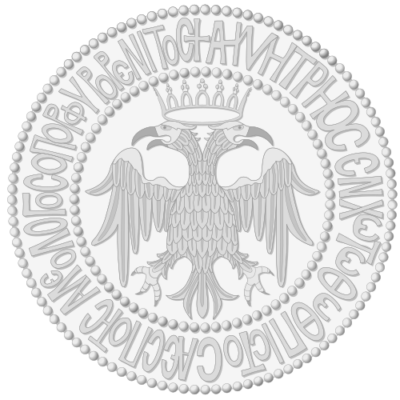
Demetrios Palaiologos
Demetrios Palaiologos was a Despot of Morea. Born 1407, in Constantinople. Died 1470, in Edirne. Positions held include Despot of the Morea.
Facts
18 facts · 2 confirmed by two sources · 0 cited · 16 from one source
Where this comes from
Papalocal keeps its own record. It started from these sources; what each one said is kept here as it was copied, so a change on their side never changes this page by itself. Tap one to read its version.
What Wikidata says · copied November 18, 2026 · revision 2536187769
- Described as
- Despot of Morea
- Born
- 1407
- Died
- 1470
- Born in
- Constantinople
- Died in
- Edirne
- Citizen of
- Byzantine Empire
- Occupation
- monk
- Positions held
- Despot of the Morea
- Spouse
- Zoe Paraspondilou; Theodora Asanina
- Children
- Helena Palaiologina
- Father
- Manuel II Palaiologos
- Mother
- Helena Dragaš
- Siblings
- Andronikos Palaiologos, Lord of Thessalonica; John VIII Palaiologos; Konstantinos XI Palaiologos; Thomas Palaiologos; Theodoros II Palaiologos
- Religion
- Eastern Orthodoxy · 1 reference
- Wikipedias with a page
- 21
Wikidata item Q175714 (wikidata.org/wiki/Q175714), public domain (CC0). Copied November 18, 2026.
What Wikipedia says · copied November 18, 2026 · revision 1386252580
Demetrios Palaiologos or Demetrius Palaeologus (Greek: Δημήτριος Παλαιολόγος, romanized: Dēmētrios Palaiologos; 1407–1470) was Despot of the Morea together with his brother Thomas from 1449 until the fall of the despotate in 1460. Demetrios and Thomas were sons of Byzantine Emperor Manuel II Palaiologos, and brothers of the final two emperors John VIII and Constantine XI. Demetrios had a complicated relationship with his brothers, whom he frequently quarrelled with, usually over the matter of Demetrios's wish to establish himself as the most senior of them and claim the imperial throne for himself.
In 1437, Demetrios accompanied his elder brother John VIII to the Council of Florence, the main objective of which was to unify the Roman Catholic and Eastern Orthodox churches so that Western Europe might be more inclined to lend military aid to the desperate Byzantine Empire. Even though Demetrios was staunchly against a union of the churches, he was brought along as John did not dare to leave him in the east without he himself being present. Demetrios attempted to claim the throne twice, first attempting to take it with Ottoman support in 1442 and then by hoping to be proclaimed emperor after John VIII's death in 1448. Both attempts failed and in 1449, Demetrios was proclaimed as Despot of the Morea by the new emperor, his brother Constantine XI.
John VIII had already made Thomas, Demetrios's younger brother, Despot of the Morea, and Constantine now desired for them to rule jointly. The two despots found it difficult to cooperate and often quarrelled with each other. In the aftermath of the Fall of Constantinople, the death of Constantine XI and end of the Byzantine Empire on 29 May 1453, Ottoman Sultan Mehmed II allowed Thomas and Demetrios to continue to rule as Ottoman vassals in the Morea. Though he never proclaimed himself emperor, some of the Moreots wished to proclaim Demetrios, the oldest living brother of Constantine XI, as Constantine's successor. Thomas hoped to turn the small despotate into a rallying point of a campaign to restore the empire, hoping to gain support from the Papacy and Western Europe. The constant disagreements between Thomas and Demetrios, who supported the Ottomans instead, eventually led Mehmed to invade and conquer the Morea in 1460.
Though Thomas escaped into exile, Demetrios was captured at the despotate's capital, Mystras, and surrendered to the Ottomans on 29 May 1460, exactly seven years after Constantinople's fall. As compensation for the loss of the Morea, Mehmed granted Demetrios lands in Thrace and some islands, which allowed Demetrios to live in relative comfort until he was stripped of his lands and income in 1467 following accusations against his brother-in-law. Shortly after, the sultan granted him an estate in Adrianople, where he lived with his wife, Theodora Asanina. After the death of his daughter and only child, Helena, in 1469 at Edirne, Demetrios retired and became a monk, dying a year later in 1470.
- Born, in its opening lines
- 1407
- Died, in its opening lines
- 1470
From the Wikipedia article “Demetrios Palaiologos” (en.wikipedia.org/wiki/Demetrios_Palaiologos), by its contributors, under CC BY-SA 4.0 (creativecommons.org/licenses/by-sa/4.0/). Copied November 18, 2026; not changed.
Confirmed Two sources agree. Cited One source, and it names where it got it. One source One source, without a reference of its own. Sources disagree The sources disagree. We show the best-supported value and keep theirs below.
