
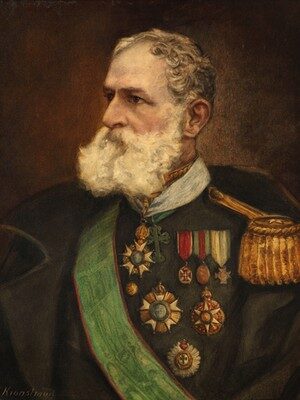
Deodoro da Fonseca
Deodoro da Fonseca was a President of Brazil. Born August 5, 1827, in Marechal Deodoro. Died August 23, 1892, in Barra Mansa. Positions held include President of Brazil (1889–1891) and governor of Rio Grande do Sul (1886). Educated at Academia Militar das Agulhas Negras. Awards include Order of the Southern Cross and Livro dos Heróis e Heroínas da Pátria.
Facts
20 facts · 2 confirmed by two sources · 3 cited · 15 from one source
Where this comes from
Papalocal keeps its own record. It started from these sources; what each one said is kept here as it was copied, so a change on their side never changes this page by itself. Tap one to read its version.
What Wikidata says · copied November 16, 2026 · revision 2562113210
- Described as
- President of Brazil (1827-1892)
- Other names
- Manuel Deodoro da Fonseca
- Born
- August 5, 1827 · 5 references
- Died
- August 23, 1892 · 5 references
- Born in
- Marechal Deodoro
- Died in
- Barra Mansa
- Buried in
- Caju Cemetery
- Citizen of
- Brazil
- Occupation
- politician · 1 reference; military personnel · 1 reference
- Positions held
- President of Brazil (1889–1891); governor of Rio Grande do Sul (1886)
- Political party
- independent politician · 1 reference
- Education
- Academia Militar das Agulhas Negras
- Awards
- Order of the Southern Cross; Livro dos Heróis e Heroínas da Pátria · 1 reference
- Spouse
- Mariana da Fonseca
- Mother
- Rosa Paulina da Fonseca
- Siblings
- Hermes Ernesto da Fonseca; Severiano Martins da Fonseca
- Military branch
- Brazilian Army
- Military rank
- marshal
- Wikipedias with a page
- 60
Wikidata item Q200812 (wikidata.org/wiki/Q200812), public domain (CC0). Copied November 16, 2026.
What Wikipedia says · copied November 16, 2026 · revision 1385196136
Manuel Deodoro da Fonseca (5 August 1827 – 23 August 1892) was a Brazilian military officer and politician who served as the first president of Brazil after leading the coup d'état that deposed Emperor Pedro II and established the First Brazilian Republic on 15 November 1889. Following the coup, Fonseca served as head of the provisional government and was subsequently elected in 1891 by the Constituent Congress as Brazil's first constitutional president. Fonseca resigned from office on 23 November 1891 under great political pressure after dissolving the National Congress on 3 November, being succeeded by vice president Floriano Peixoto. He died less than a year later.
Born in Alagoas in a military family, Fonseca studied artillery at the Military School of Rio de Janeiro between 1843 and 1847, and later took part in several military campaigns during the Brazilian Empire, most notably the Praieira Revolt, the Uruguayan War, and the Paraguayan War, becoming a national figure. In 1885, he became vice-president of the province of Rio Grande do Sul; the following year, upon the resignation of the incumbent president, the Baron of Lucena, Fonseca became president of Rio Grande do Sul. Due to his involvement in what became known as the "Military Question"—clashes between the armed forces and the imperial government—he returned to Rio de Janeiro. Appointed to the military command of the province of Mato Grosso in 1888, he resigned from office the following year following the appointment of the Empire's final ministerial cabinet, led by Prime Minister Afonso Celso, the Viscount of Ouro Preto. Amidst various crises plaguing the Brazilian monarchy, Fonseca led the coup d'état that deposed the Empire and proclaimed the republic in the country.
With the change in the system of government, Fonseca assumed command of the country as head of the Provisional Government of the Republic. The initial changes under his administration included the creation of the Brazilian Penal Code, the reform of the Brazilian Commercial Code, and measures that formalized the separation of Church and State—such as the establishment of civil marriage and the secularization of cemeteries. On the economic front, the country experienced the so-called "Encilhamento" crisis, a massive speculative bubble and high inflation, which stemmed from the economic policies of his Minister of Finance, Ruy Barbosa. In 1891, the nation's first republican constitution was enacted, and Fonseca was elected president through indirect vote. His constitutional government was marked by intense political tension between his own centralizing tendencies and the federalist inclinations held by civil society and segments of the military—a conflict that ultimately led to the dissolution of the National Congress on 3 November. Faced with the threat of the First Naval Revolt, Fonseca resigned from the presidency on 23 November 1891. He died the following year, on 23 August, after suffering a severe bout of dyspnea.
- Born, in its opening lines
- August 5, 1827
- Died, in its opening lines
- August 23, 1892
From the Wikipedia article “Deodoro da Fonseca” (en.wikipedia.org/wiki/Deodoro_da_Fonseca), by its contributors, under CC BY-SA 4.0 (creativecommons.org/licenses/by-sa/4.0/). Copied November 16, 2026; not changed.
Confirmed Two sources agree. Cited One source, and it names where it got it. One source One source, without a reference of its own. Sources disagree The sources disagree. We show the best-supported value and keep theirs below.
