
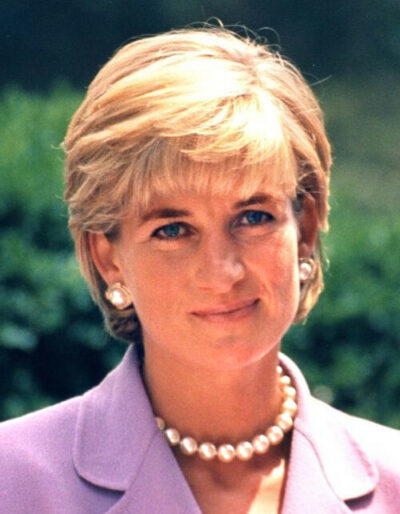
Diana, Princess of Wales
Diana, Princess of Wales was a member of the British royal family and Princess of Wales. Born July 1, 1961, in Park House. Died August 31, 1997, in Pitié-Salpêtrière Hospital. Educated at West Heath Girls' School and Institut Alpin Videmanette. Awards include Order of the Virtues, Royal Family Order of Elizabeth II and Order of the Crown (Netherlands).


Facts
44 facts · 2 confirmed by two sources · 17 cited · 25 from one source
Where this comes from
Papalocal keeps its own record. It started from these sources; what each one said is kept here as it was copied, so a change on their side never changes this page by itself. Tap one to read its version.
What Wikidata says · copied November 16, 2026 · revision 2568712409
- Described as
- member of the British royal family and Princess of Wales (1961–1997)
- Other names
- Lady Diana Spencer, The People's Princess, Lady Diana Frances Spencer, Diana Princess of Wales, Princess Di, Diana, The Princess of Wales, Princess Diana, Diana Frances Spencer, Diana Spencer, Lady Di
- Born
- July 1, 1961 · 13 references
- Died
- August 31, 1997 · 12 references
- Born in
- Park House · 2 references
- Died in
- Pitié-Salpêtrière Hospital · 5 references
- Buried in
- Althorp · 2 references
- Cause of death
- car collision · 1 reference
- Name at birth
- Diana Frances Spencer · 1 reference
- Citizen of
- United Kingdom · 2 references
- Occupation
- environmentalist; philanthropist; humanitarian; socialite; aristocrat; kindergarten teacher; HIV/AIDS activist; benefactor
- Education
- West Heath Girls' School (–1977) · 1 reference; Institut Alpin Videmanette; Riddlesworth Hall School
- Member of
- Charles and Diana, Prince and Princess of Wales; British royal family
- Awards
- Order of the Virtues; Royal Family Order of Elizabeth II (1981) · 1 reference; Order of the Crown (Netherlands) · 1 reference; Grand Cross of the Order of the House of Orange (1982) · 1 reference
- Spouse
- Charles III (1981–1996) · 4 references
- Children
- William, Prince of Wales · 3 references; Prince Harry, Duke of Sussex · 3 references
- Father
- John Spencer, 8th Earl Spencer · 2 references
- Mother
- Frances Shand Kydd · 2 references
- Siblings
- Jane Fellowes, Baroness Fellowes · 1 reference; Lady Sarah McCorquodale; John Spencer · 1 reference; Charles Spencer, 9th Earl Spencer · 1 reference
- Religion
- Church of England; Christianity · 1 reference
- Lived in
- Althorp (1975–1981); Sandringham (1961–1975); Kensington Palace (1981–1997); Highgrove House (1981–1996)
- Nickname
- Princess Diana; The People's Princess; Lady Di
- Website
- https://www.royal.uk/diana-princess-wales
- Wikipedias with a page
- 153
Wikidata item Q9685 (wikidata.org/wiki/Q9685), public domain (CC0). Copied November 16, 2026.
What Wikipedia says · copied November 16, 2026 · revision 1384840142
Diana, Princess of Wales (born Diana Frances Spencer; 1 July 1961 – 31 August 1997), was a member of the British royal family. She was the first wife of Charles III (then Prince of Wales) and mother of Princes William and Harry. Her activism and glamour made her an international icon and earned her enduring popularity.
Diana was born into the British nobility and grew up close to the royal family, living at Park House on their Sandringham estate. In 1981, while working as a preschool aide, she was engaged to Charles, eldest son of Queen Elizabeth II. Their wedding took place at St Paul's Cathedral in July 1981 and made her Princess of Wales, a role in which she was enthusiastically received by the public. The couple had two sons, William in 1982 and Harry in 1984, who were then respectively second and third in the line of succession to the British throne. Diana's marriage to Charles suffered due to their incompatibility and extramarital affairs. They separated in 1992, soon after the breakdown of their relationship became public knowledge. Their marital difficulties were widely publicised, and the couple divorced in 1996.
As Princess of Wales, Diana undertook royal duties on behalf of the Queen and represented her at functions across the Commonwealth realms. She was celebrated in the media for her beauty, style, charm, and later, her unconventional approach to charity work. Her patronages were initially centred on children and the elderly, but she later became known for her involvement in two particular campaigns: one involved the social attitudes towards and the acceptance of AIDS patients, and the other for the international removal of landmines, promoted through the International Red Cross. She also raised awareness and advocated for ways to help people affected by cancer and mental illness. Diana was initially noted for her shyness, but her charisma and friendliness endeared her to the public and helped her reputation survive the public collapse of her marriage. Considered photogenic, she was regarded as a fashion icon.
In August 1997, Diana died after a car crash in Paris; the incident led to extensive public mourning and global media attention. An inquest returned a verdict of unlawful killing due to gross negligence by a driver and the paparazzi pursuing her as found in Operation Paget, an investigation by the Metropolitan Police. Her legacy has had a significant impact on the royal family and British society.
- Born, in its opening lines
- July 1, 1961
- Died, in its opening lines
- August 31, 1997
From the Wikipedia article “Diana, Princess of Wales” (en.wikipedia.org/wiki/Diana,_Princess_of_Wales), by its contributors, under CC BY-SA 4.0 (creativecommons.org/licenses/by-sa/4.0/). Copied November 16, 2026; not changed.
Confirmed Two sources agree. Cited One source, and it names where it got it. One source One source, without a reference of its own. Sources disagree The sources disagree. We show the best-supported value and keep theirs below.
