
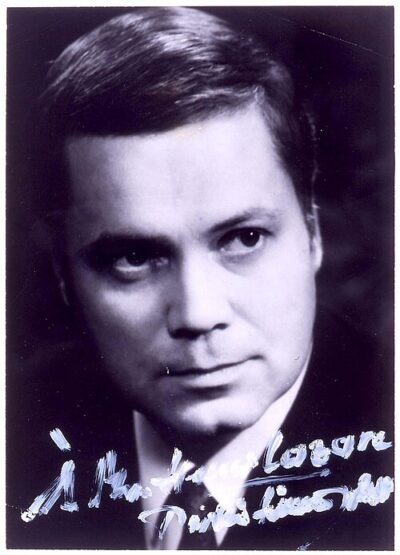
Dietrich Fischer-Dieskau
Dietrich Fischer-Dieskau was a German lyric baritone and conductor. Born May 28, 1925, in Berlin. Died May 18, 2012, in Berg. Educated at Berlin University of the Arts. Awards include Knight of the Legion of Honour, Commandeur des Arts et des Lettres and Pour le Mérite for Sciences and Arts order.
Facts
47 facts · 2 confirmed by two sources · 18 cited · 27 from one source
Where this comes from
Papalocal keeps its own record. It started from these sources; what each one said is kept here as it was copied, so a change on their side never changes this page by itself. Tap one to read its version.
What Wikidata says · copied November 16, 2026 · revision 2565539731
- Described as
- German lyric baritone and conductor (1925-2012)
- Other names
- Dietrich Dieskau, Dietrich Fischer
- Born
- May 28, 1925 · 17 references
- Died
- May 18, 2012 · 15 references
- Born in
- Berlin · 3 references
- Died in
- Berg · 1 reference
- Buried in
- Friedhof Heerstraße · 2 references
- Citizen of
- German Reich; Germany
- Occupation
- conductor · 1 reference; opera singer · 1 reference; composer; musicologist · 1 reference; painter · 1 reference; singer · 1 reference
- Education
- Berlin University of the Arts
- Member of
- Academy of Arts, Berlin; American Academy of Arts and Sciences; Bavarian Academy of Fine Arts
- Instrument
- voice
- Record label
- Deutsche Grammophon; EMI
- Awards
- Knight of the Legion of Honour (1990) · 1 reference; Commandeur des Arts et des Lettres (1995) · 1 reference; Pour le Mérite for Sciences and Arts order (1984) · 1 reference; honorary citizen of Berlin; Knight Commander's Cross of the Order of Merit of the Federal Republic of Germany; Ernst Reuter Medal (1993) · 1 reference; Musikpreis der Stadt Duisburg (2007); Praemium Imperiale (2002) · 1 reference; Léonie Sonning Music Prize (1975); Gramophone Award for Lifetime Achievement (1993); Bavarian Maximilian Order for Science and Art (1984); Royal Philharmonic Society Gold Medal (1988); Berliner Kunstpreis (1950); Gold Goethe medal (2009); Friedrich-Rückert-Preis (1977)
- Field
- opera; oratorio; chamber music
- Spouse
- Irmgard Poppen (1949–1963) · 1 reference; Ruth Leuwerik (1965–1967) · 1 reference; Kristina Pugell (1968–1975) · 1 reference; Júlia Várady (1977–2012) · 1 reference
- Children
- Mathias Fischer-Dieskau; Martin Fischer-Dieskau · 1 reference; Manuel Fischer-Dieskau · 1 reference
- Father
- Albert Fischer · 1 reference
- Siblings
- Klaus Fischer-Dieskau · 1 reference
- Wikipedias with a page
- 40
Wikidata item Q77060 (wikidata.org/wiki/Q77060), public domain (CC0). Copied November 16, 2026.
What Wikipedia says · copied November 16, 2026 · revision 1369630828
Dietrich Fischer-Dieskau (German: [ˌdiːtʁɪç ˌfɪʃɐ ˈdiːskaʊ̯] ; 28 May 1925 – 18 May 2012) was a German lyric baritone and conductor of classical music. One of the most famous Lieder (art song) performers of the post-war period, he is best known as a singer of Franz Schubert's Lieder, particularly "Winterreise" of which his recordings with accompanists Gerald Moore and Jörg Demus are still critically acclaimed half a century after their release.
Because he recorded an array of repertoire (spanning centuries), musicologist Alan Blyth asserted, "No singer in our time, or probably any other has managed the range and versatility of repertory achieved by Dietrich Fischer-Dieskau. Opera, Lieder and oratorio in German, Italian or English came alike to him, yet he brought to each a precision and individuality that bespoke his perceptive insights into the idiom at hand." In addition, he recorded in French, Russian, Hebrew, Latin and Hungarian. He was described as "one of the supreme vocal artists of the 20th century" and "the most influential singer of the 20th Century".
Fischer-Dieskau was ranked the second greatest singer of the century (after Jussi Björling) by Classic CD (United Kingdom) "Top Singers of the Century" Critics' Poll (June 1999). The French dubbed him "Le miracle Fischer-Dieskau" and Dame Elisabeth Schwarzkopf called him "a born god who has it all." At his peak, he was greatly admired for his interpretive insights and exceptional control of his soft, beautiful voice. He dominated both the opera and concert platforms for over thirty years.
- Born, in its opening lines
- May 28, 1925
- Died, in its opening lines
- May 18, 2012
From the Wikipedia article “Dietrich Fischer-Dieskau” (en.wikipedia.org/wiki/Dietrich_Fischer-Dieskau), by its contributors, under CC BY-SA 4.0 (creativecommons.org/licenses/by-sa/4.0/). Copied November 16, 2026; not changed.
Confirmed Two sources agree. Cited One source, and it names where it got it. One source One source, without a reference of its own. Sources disagree The sources disagree. We show the best-supported value and keep theirs below.
