
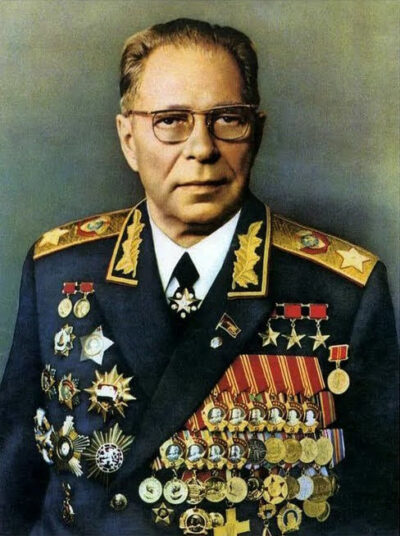
Dmitriy Ustinov
Dmitriy Ustinov was a Soviet military commander and politician. Born October 17, 1908, in Samara. Died December 20, 1984, in Moscow. Positions held include Minister of Defence (1976–1984), First Deputy Chairman of the Council of Ministers of the USSR (1963–1965) and deputy of the Supreme Soviet of the Soviet Union. Educated at Baltic State Technical University and Ivanovo-Voznesensky Polytechnic Institute. Awards include State Stalin Prize, 1st degree, USSR State Prize and Order of Lenin (11 times).
Facts
42 facts · 1 confirmed by two sources · 3 cited · 37 from one source · 1 where the sources disagree
What’s different
- Born: we show October 17, 1908 (Sources disagree). Wikipedia says October 30, 1908
Where this comes from
Papalocal keeps its own record. It started from these sources; what each one said is kept here as it was copied, so a change on their side never changes this page by itself. Tap one to read its version.
What Wikidata says · copied November 16, 2026 · revision 2568936142
- Described as
- Soviet military commander and politician (1908-1984)
- Other names
- Dmitriy Fyodorovich Ustinov
- Born
- October 17, 1908 · 2 references
- Died
- December 20, 1984 · 5 references
- Born in
- Samara · 2 references
- Died in
- Moscow · 2 references
- Buried in
- Kremlin Wall Necropolis
- Cause of death
- myocardial infarction
- Citizen of
- Soviet Union; Russian Empire
- Occupation
- politician; engineer; military officer; writer
- Positions held
- Minister of Defence (1976–1984); First Deputy Chairman of the Council of Ministers of the USSR (1963–1965); deputy of the Supreme Soviet of the Soviet Union; Minister of Defense Industry (1953–1957); Member of the Politburo of the CPSU Central Committee (1976–1984) · 1 reference; Candidate member of the Politburo of the CPSU Central Committee (1965–1976) · 1 reference
- Political party
- Communist Party of the Soviet Union (1927–1984)
- Worked for
- Supreme Council of the National Economy under the Council of Ministers of the USSR (1963–1965) · 1 reference
- Education
- Baltic State Technical University (1932–1934); Ivanovo-Voznesensky Polytechnic Institute (1929–)
- Member of
- Politburo of the Central Committee of the Communist Party of the Soviet Union
- Awards
- State Stalin Prize, 1st degree (1953); USSR State Prize (1983); Order of Lenin (11 times) (1939, 1942, 1944, 1951, 1956, 1957, 1958, 1968, 1971, 1978, 1983); Medal "For the Victory over Japan"; Medal "For the Victory over Germany in the Great Patriotic War 1941–1945"; Hero of Socialist Labour (2 times) (1942, 1961); Hero of the Soviet Union (1978); Order of Karl Marx (2 times) (1978, 1983); Order of the White Lion (1977); Order of Klement Gottwald (2 times) (1978, 1982); Scharnhorst Order (1977); Order of the White Rose of Finland (1978); Hero of the Czechoslovak Socialist Republic (1982); Order of Suvorov, 1st class (1945); Order of Kutuzov, 1st class (1944)
- Children
- Nikolay Ustinov
- Military branch
- Soviet Army · 1 reference
- Military rank
- Marshal of the Soviet Union (1976–); general of the army (1976–)
- Wikipedias with a page
- 53
Wikidata item Q48067 (wikidata.org/wiki/Q48067), public domain (CC0). Copied November 16, 2026.
What Wikipedia says · copied November 16, 2026 · revision 1368374271
Dmitry Fyodorovich Ustinov (Russian: Дмитрий Фёдорович Устинов; 30 October 1908 – 20 December 1984) was a Soviet politician and a Marshal of the Soviet Union during the Cold War. He served as a Central Committee secretary in charge of the Soviet military–industrial complex from 1965 to 1976 and as Minister of Defence of the Soviet Union from 1976 until his death in 1984.
Ustinov was born in the city of Samara to a Russian working-class family in 1908. Upon reaching adulthood, he joined the Communist Party in 1927 before pursuing a career in engineering. After graduating from the Institute of Military Mechanical Engineering in 1934, he became a construction engineer at the Leningrad Artillery Marine Research Institute. By 1937, he transferred to the "Bolshevik" Arms Factory where he ultimately rose to become the director. While serving as People's Commissar of Armaments during World War II, he achieved distinction within the party's ranks by successfully overseeing the evacuation of Leningrad's industries to the Ural Mountains, a feat for which he was awarded the title of Hero of Socialist Labour. At the war's end, he was entrusted with seizing raw materials, scientists and research left over from Germany's missile programme.
Under Leonid Brezhnev's leadership, Ustinov joined the Central Committee Secretariat and rose to become a candidate member of the Politburo by 1965. Following his rise to the central party apparatus, he was given the task of administering the Soviet Union's defense industry and its armed forces. By 1976, he succeeded Andrei Grechko as Minister of Defense, received the rank of Marshal of the Soviet Union, and had joined the Politburo as a full member.
Throughout his tenure as Defense Minister, Marshal Ustinov's hardline attitudes towards the West and unreserved backing for his country's arms buildup underlay the national security strategy of the Soviet Union. As Brezhnev's health deteriorated from the mid-1970s onward, he increasingly dictated Soviet policy alongside Foreign Minister Andrei Gromyko and KGB Chairman Yuri Andropov until Brezhnev's death in 1982. Upon Konstantin Chernenko's accession to the office of General Secretary in February 1984, Ustinov formed an unofficial triumvirate alongside Gromyko and Chernenko that led the Soviet Union until his death on 20 December 1984.
- Born, in its opening lines
- October 30, 1908
- Died, in its opening lines
- December 20, 1984
From the Wikipedia article “Dmitry Ustinov” (en.wikipedia.org/wiki/Dmitry_Ustinov), by its contributors, under CC BY-SA 4.0 (creativecommons.org/licenses/by-sa/4.0/). Copied November 16, 2026; not changed.
Confirmed Two sources agree. Cited One source, and it names where it got it. One source One source, without a reference of its own. Sources disagree The sources disagree. We show the best-supported value and keep theirs below.
