
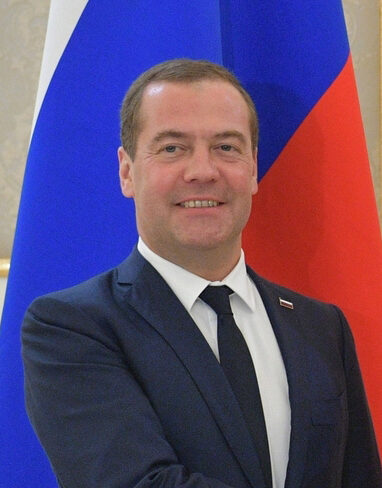
Dmitry Medvedev
Dmitry Medvedev is a President of Russia from 2008 to 2012, Prime Minister of Russia (2012-2020) and Deputy Chairman of the Security Council of Russia since 2020. Born September 14, 1965, in Saint Petersburg. Positions held include Prime Minister of Russia (2012–2020), President of Russia (2008–2012) and Deputy Chairman of the Government of the Russian Federation. Educated at Faculty of Law, Saint Petersburg State University and Saint Petersburg State University. Awards include Order of Glory, Medal "In Commemoration of the 1000th Anniversary of Kazan" and Order "For Merit to the Fatherland", 1st class.
Facts
52 facts · 1 confirmed by two sources · 15 cited · 36 from one source
Where this comes from
Papalocal keeps its own record. It started from these sources; what each one said is kept here as it was copied, so a change on their side never changes this page by itself. Tap one to read its version.
What Wikidata says · copied November 16, 2026 · revision 2569405843
- Described as
- President of Russia from 2008 to 2012, Prime Minister of Russia (2012-2020) and Deputy Chairman of the Security Council of Russia since 2020
- Other names
- Dima Medvedev, Dmitry A. Medvedev, Dmitrij Medvedev, Dmitrij Anatoljevič Medvedev, Dmitrij Anatolevič Medvedev, Dimitrij medvedev, Dimitry Medvedev, Dmitriy Anatolyevich Medvedev, President Medvedev, Dmitri A. Medvedev, Dmitrij Anatol'evic Medvedev, Dmitrij Anatolevic Medvedev
- Born
- September 14, 1965 · 7 references
- Born in
- Saint Petersburg · 2 references
- Citizen of
- Soviet Union (–1991); Russia (1991–) · 4 references
- Occupation
- jurist · 1 reference; politician · 1 reference; businessperson · 3 references
- Positions held
- Prime Minister of Russia (2012–2020); President of Russia (2008–2012); Deputy Chairman of the Government of the Russian Federation; First Deputy Chairman of the Government of the Russian Federation (2005–2008); Chairman of United Russia (2012–); Kremlin Chief of Staff (2003–2005) · 1 reference; Deputy Chairman of the Security Council of the Russian Federation (2020–) · 1 reference; Chairman of the Council of CIS Heads of State (2010) · 1 reference; Deputy Kremlin Chief of Staff (1999–2000) · 1 reference
- Political party
- United Russia (2012–) · 1 reference; Communist Party of the Soviet Union (1986–1991) · 1 reference
- Education
- Faculty of Law, Saint Petersburg State University (1982–1987); Saint Petersburg State University · 1 reference
- Sport
- competitive swimming; weightlifting
- Awards
- Order of Glory (2011) · 2 references; Medal "In Commemoration of the 1000th Anniversary of Kazan" (2005) · 1 reference; Order "For Merit to the Fatherland", 1st class (2015) · 2 references; Order of the Liberator (2008) · 1 reference; Order "Danaker" (2015) · 2 references; Medal "10 years of Astana" (2008) · 1 reference; Registered firearms; Commemorative medal of A. M. Gorchakov; Prize of the Government of the Russian Federation in the field of education (2001); Uatsamonga Order · 1 reference; maroon beret · 1 reference; Order of St. Sava (2009) · 1 reference; Order "For Merit to the Fatherland", 2nd class (2005) · 1 reference; Order "For Merit to the Fatherland", 3rd class (2020) · 1 reference; Order of the Star of Palestine (2011)
- Field
- politics; education; politician · 1 reference
- Spouse
- Svetlana Medvedeva (1993–) · 1 reference
- Children
- Ilya Medvedev
- Father
- Anatoly Medvedev
- Mother
- Yulia Medvedeva
- Religion
- Eastern Orthodoxy
- Military branch
- Russian Armed Forces
- Military rank
- colonel
- Lived in
- Saint Petersburg; Moscow; Novo-Ogaryovo
- Height
- 1.63 m (5 ft 4 in) · 1 reference
- Website
- http://da-medvedev.ru/
- Wikipedias with a page
- 170
Wikidata item Q23530 (wikidata.org/wiki/Q23530), public domain (CC0). Copied November 16, 2026.
What Wikipedia says · copied November 16, 2026 · revision 1385287008
Dmitry Anatolyevich Medvedev (born 14 September 1965) is a Russian politician and lawyer who served as the president of Russia from 2008 to 2012 and as prime minister of Russia from 2012 to 2020. Since 2020, he has served as the deputy chairman of the Security Council of Russia.
Medvedev was elected president in the 2008 election. He was seen as more liberal than his predecessor Vladimir Putin, who was prime minister in Medvedev's presidency. Medvedev's agenda as president was a wide-ranging modernisation programme, aimed at modernising Russia's economy and society, and lessening the country's reliance on oil and gas. During Medvedev's tenure, the United States and Russia signed the New START nuclear arms reduction treaty. In addition to overseeing Russia's recovery from the Great Recession, his presidency also witnessed the Russo-Georgian War. Medvedev also launched an anti-corruption campaign, yet was later being accused of corruption himself.
He served a single term in office and was succeeded by Putin following the 2012 presidential election. Putin then appointed Medvedev as prime minister. He resigned along with the rest of the government on 15 January 2020 to allow Putin to make sweeping constitutional changes and was succeeded by Mikhail Mishustin on 16 January 2020. Putin appointed Medvedev the same day to the new office of deputy chairman of the Security Council.
To some analysts, Medvedev's presidency seemed to promise positive changes both at home and in ties with the West, signaling "the possibility of a new, more liberal period in Russian politics". However, since the prelude to the Russian invasion of Ukraine, he has adopted increasingly hawkish and anti-Western positions. Observers both domestically and internationally suggested that the break with past rhetoric was Medvedev attempting to change his public image as a moderate subordinate to Putin. He is considered by many sources to be a potential successor of Putin.
- Born, in its opening lines
- September 14, 1965
From the Wikipedia article “Dmitry Medvedev” (en.wikipedia.org/wiki/Dmitry_Medvedev), by its contributors, under CC BY-SA 4.0 (creativecommons.org/licenses/by-sa/4.0/). Copied November 16, 2026; not changed.
Confirmed Two sources agree. Cited One source, and it names where it got it. One source One source, without a reference of its own. Sources disagree The sources disagree. We show the best-supported value and keep theirs below.
