
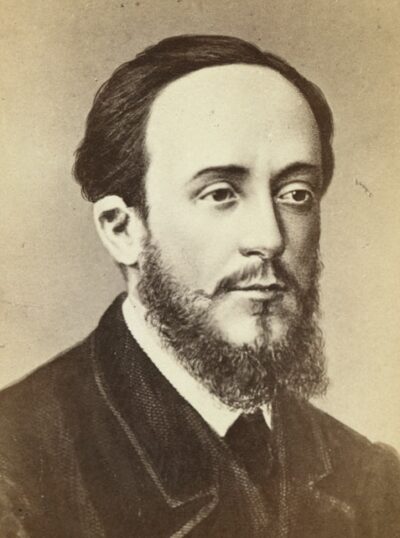
Dmitry Pisarev
Dmitry Pisarev was a Russian journalist. Born October 2, 1840, in Znamenskoe. Died July 4, 1868, in Dubulti. Educated at Saint Petersburg State University.
Facts
13 facts · 0 confirmed by two sources · 2 cited · 9 from one source · 2 where the sources disagree
What’s different
- Born: we show October 2, 1840 (Sources disagree). Wikipedia says October 14, 1840
- Died: we show July 4, 1868 (Sources disagree). Wikipedia says July 16, 1868
Where this comes from
Papalocal keeps its own record. It started from these sources; what each one said is kept here as it was copied, so a change on their side never changes this page by itself. Tap one to read its version.
What Wikidata says · copied November 16, 2026 · revision 2559114534
- Described as
- Russian journalist (1840–1868)
- Other names
- Dmitry Ivanovich Pisarev
- Born
- October 2, 1840
- Died
- July 4, 1868
- Born in
- Znamenskoe
- Died in
- Dubulti · 1 reference
- Buried in
- Volkovo Cemetery Writer's Walkways
- Cause of death
- drowning
- Citizen of
- Russian Empire
- Occupation
- essayist; journalist; writer; literary critic; literary historian · 1 reference
- Education
- Saint Petersburg State University
- Wikipedias with a page
- 41
Wikidata item Q378753 (wikidata.org/wiki/Q378753), public domain (CC0). Copied November 16, 2026.
What Wikipedia says · copied November 16, 2026 · revision 1375163990
Dmitry Ivanovich Pisarev (14 October [O.S. 2 October] 1840 – 16 July [O.S. 4 July] 1868) was a Russian literary critic and philosopher who was a central figure of Russian nihilism. He is noted as a forerunner of Nietzschean philosophy, and for the impact his advocacy of liberation movements and natural science had on Russian history.
A critique of his philosophy became the subject of Fyodor Dostoevsky's celebrated novel Crime and Punishment. Indeed, Pisarev's philosophy embraces the nihilist aims of negation and value-destruction; in freeing oneself from all human and moral authority, the nihilist becomes ennobled above the common masses and free to act according to sheer personal preference and usefulness. These new types, as Pisarev termed them, were to be pioneers of what he saw as the most necessary step for human development, namely the reset and destruction of the existing mode of thought. Among his most famous locutions is: "What can be smashed must be smashed. Whatever withstands the blow is fit to survive; what flies into pieces is rubbish. In any case, strike out right and left, no harm can come of it."
Pisarev wrote most of his works while imprisoned. He was arrested for political crimes the year after graduating university and drowned only two years after his release, aged 27. It is unknown whether his death was accidental or suicide as he had also suffered severe mental health issues throughout his life. His works had a deep influence throughout Russia on revolutionaries such as Lenin, anti-nihilists such as Dostoevsky, and scientists such as the Nobel Prize winner Ivan Pavlov.
- Born, in its opening lines
- October 14, 1840
- Died, in its opening lines
- July 16, 1868
From the Wikipedia article “Dmitry Pisarev” (en.wikipedia.org/wiki/Dmitry_Pisarev), by its contributors, under CC BY-SA 4.0 (creativecommons.org/licenses/by-sa/4.0/). Copied November 16, 2026; not changed.
Confirmed Two sources agree. Cited One source, and it names where it got it. One source One source, without a reference of its own. Sources disagree The sources disagree. We show the best-supported value and keep theirs below.
