
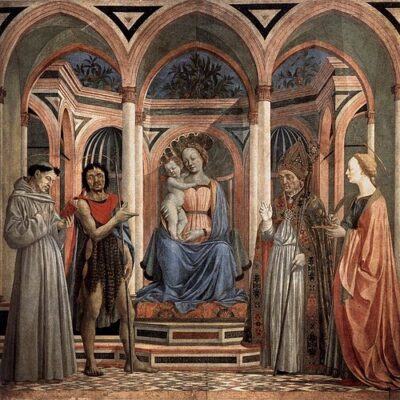
Domenico Veneziano was an Italian Renaissance painter. Born 1410, in Venice. Died May 15, 1461, in Florence. Known for Santa Lucia de' Magnoli Altarpiece, Adoration of the Magi and Madonna and Child.
Facts
12 facts · 2 confirmed by two sources · 3 cited · 7 from one source
Where this comes from
Papalocal keeps its own record. It started from these sources; what each one said is kept here as it was copied, so a change on their side never changes this page by itself. Tap one to read its version.
What Wikidata says · copied November 16, 2026 · revision 2547335795
- Described as
- Italian Renaissance painter (1410-1461)
- Other names
- Domenico di Bartolomeo da Venezia, Veneziano Domenico, v. domenicho
- Born
- 1410 · 1 reference
- Died
- May 15, 1461 · 2 references
- Born in
- Venice
- Died in
- Florence
- Citizen of
- Republic of Venice
- Occupation
- painter · 2 references
- Known for
- Santa Lucia de' Magnoli Altarpiece; Adoration of the Magi; Madonna and Child; Predella of Santa Lucia dei Magnoli altarpiece · 1 reference
- Field
- Renaissance painting · 1 reference; painting · 1 reference
- Wikipedias with a page
- 33
Wikidata item Q368546 (wikidata.org/wiki/Q368546), public domain (CC0). Copied November 16, 2026.
What Wikipedia says · copied November 16, 2026 · revision 1373720450
Domenico Veneziano (c. 1410 – May 15, 1461) was an Italian painter of the early Renaissance, active mostly in Perugia and Tuscany.
Little is known of his birth, though he is thought to have been born in Venice, hence his last name. He then moved to Florence in 1422–23 as a boy, to become a pupil of Gentile da Fabriano. He is said to have worked with Pisanello in Rome around 1423–1430. His work was influenced by the style of Benozzo Gozzoli.
In a letter from him to Piero di Cosimo de' Medici, dated from Perugia in 1438, where he likewise resided for many years, he mentions his long connection with the fortunes of the Medici family, and begs to be allowed to paint an altarpiece for the head of that house. He was a contemporary with Fra Angelico and Fra Filippo Lippi, since those two artists and himself are known to have valued the frescoes of Buonfigli at Perugia. Between 1439 and 1441 he painted a masterpiece of the Adoration of the Magi, a round panel which was probably commissioned for the palace of the wealthy Medici family and is now in Berlin.
Another masterpiece is considered to be the Santa Lucia de' Magnoli Altarpiece (c. 1445–1447), originally in Santa Lucia dei Magnoli, Florence and now in the Uffizi. Painted in tempera on panel, the altarpiece displays such an unusual palette for this period that Vasari wrote that it had been painted in oil. He influenced Andrea Mantegna.
Other important works are the Madonna del Roseto in the National Museum of Art of Romania and the Madonna Berenson in the Villa I Tatti in Florence, both dating to around 1432–1437.
Vasari alleged that Domenico was murdered by Andrea del Castagno. However, Castagno died c. 1457, four years before Domenico.
He worked at the decorations of the Portinari chapel in the hospital of Santa Maria Nuova in Florence from 1439–1445, and had as his assistants Piero della Francesca and Bicci di Lorenzo. It is certain that whilst employed there he used linseed oil as his medium, since the hospital books of that date make many allusions to this item in his expenses. His latter days were spent in Florence, where he died on May 15, 1461.
- Born, in its opening lines
- c. 1410
- Died, in its opening lines
- May 15, 1461
From the Wikipedia article “Domenico Veneziano” (en.wikipedia.org/wiki/Domenico_Veneziano), by its contributors, under CC BY-SA 4.0 (creativecommons.org/licenses/by-sa/4.0/). Copied November 16, 2026; not changed.
Confirmed Two sources agree. Cited One source, and it names where it got it. One source One source, without a reference of its own. Sources disagree The sources disagree. We show the best-supported value and keep theirs below.
