
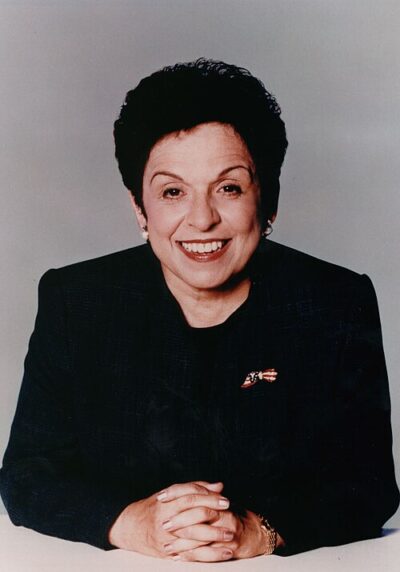
Donna Shalala
Donna Shalala is the 18th United States Secretary of Health and Human Services. Born February 14, 1941, in Cleveland. Positions held include United States Secretary of Health and Human Services (1993–2001) and United States representative (2019–2021). Educated at Western College for Women and Syracuse University. Awards include Guggenheim Fellowship, Presidential Medal of Freedom and National Women's Hall of Fame.
Facts
28 facts · 1 confirmed by two sources · 8 cited · 19 from one source
Where this comes from
Papalocal keeps its own record. It started from these sources; what each one said is kept here as it was copied, so a change on their side never changes this page by itself. Tap one to read its version.
What Wikidata says · copied November 16, 2026 · revision 2562779553
- Described as
- 18th United States Secretary of Health and Human Services
- Other names
- Donna Edna Shalala
- Born
- February 14, 1941 · 3 references
- Born in
- Cleveland · 1 reference
- Citizen of
- United States
- Occupation
- university teacher; trade unionist; politician
- Positions held
- United States Secretary of Health and Human Services (1993–2001); United States representative (2019–2021) · 2 references
- Political party
- Democratic Party
- Worked for
- University of Miami; Teachers College · 1 reference
- Education
- Western College for Women; Syracuse University; American University; Miami University · 1 reference
- Member of
- American Academy of Arts and Sciences; Peace Corps
- Awards
- Guggenheim Fellowship (1975) · 1 reference; Presidential Medal of Freedom (2008) · 1 reference; National Women's Hall of Fame (2011) · 1 reference; ASCB Public Service Award (2000); honorary doctor of Ben-Gurion University; Dr. Nathan Davis Award for Members of the Executive Branch by Presidential Appointment (1997); honorary doctorate from the American University of Beirut; honorary doctorate at the University of Iceland (2008); honorary doctor of the University of Miami (2016) · 1 reference; honorary degree from Spelman College (1994) · 1 reference
- Website
- https://donnashalala.com/
- Wikipedias with a page
- 21
Wikidata item Q292569 (wikidata.org/wiki/Q292569), public domain (CC0). Copied November 16, 2026.
What Wikipedia says · copied November 16, 2026 · revision 1380417374
Donna Edna Shalala ( shə-LAY-lə; born February 14, 1941) is an American former politician and academic who served as the U.S. representative for Florida's 27th congressional district from 2019 to 2021. She was the U.S. secretary of health and human services during the Clinton administration and served as assistant secretary of housing and urban development for policy development and research under Jimmy Carter. She is a member of the Democratic Party.
Shalala received a bachelor's degree in 1962 and served in the Peace Corps before earning a PhD from Syracuse University in 1970. She subsequently held faculty positions at Baruch College and Columbia University, and was appointed Assistant Secretary at the Department of Housing and Urban Development under President Jimmy Carter. She served as president of Hunter College from 1980 to 1988, then as chancellor of the University of Wisconsin–Madison. From 1993 to 2001, she served as U.S. Secretary of Health and Human Services under President Bill Clinton—the longest tenure in that role—and was the first Lebanese-American to hold a Cabinet position. She subsequently served as president of the University of Miami (2001–2015) and the Clinton Foundation (2015–2017). In 2008, she was awarded the Presidential Medal of Freedom.
Shalala was first elected to Congress in 2018. She served one term before losing re-election in 2020 to María Elvira Salazar in an upset. Shalala was interim president of The New School in New York City from 2023 to 2024.
- Born, in its opening lines
- February 14, 1941
From the Wikipedia article “Donna Shalala” (en.wikipedia.org/wiki/Donna_Shalala), by its contributors, under CC BY-SA 4.0 (creativecommons.org/licenses/by-sa/4.0/). Copied November 16, 2026; not changed.
Confirmed Two sources agree. Cited One source, and it names where it got it. One source One source, without a reference of its own. Sources disagree The sources disagree. We show the best-supported value and keep theirs below.
