
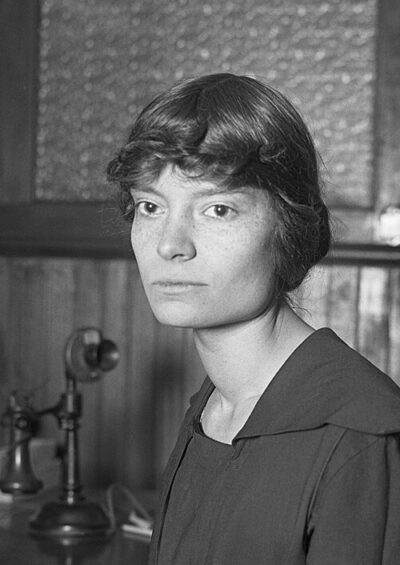
Dorothy Day
Dorothy Day was an American journalist, social activist, and Catholic convert. Born November 8, 1897, in Brooklyn Heights. Died November 29, 1980, in New York City. Known for The Long Loneliness, Loaves and Fishes: The Inspiring Story of the Catholic Worker Movement and Catholic Worker. Educated at University of Illinois Urbana-Champaign and Lincoln Park High School. Awards include Gandhi Peace Award, Pacem in Terris Award and National Women's Hall of Fame.
Facts
41 facts · 2 confirmed by two sources · 15 cited · 24 from one source
Where this comes from
Papalocal keeps its own record. It started from these sources; what each one said is kept here as it was copied, so a change on their side never changes this page by itself. Tap one to read its version.
What Wikidata says · copied November 13, 2026 · revision 2564224024
- Described as
- American journalist, social activist, and Catholic convert (1897-1980)
- Born
- November 8, 1897 · 6 references
- Died
- November 29, 1980 · 6 references
- Born in
- Brooklyn Heights · 1 reference
- Died in
- New York City
- Buried in
- Cemetery of the Resurrection · 1 reference
- Cause of death
- myocardial infarction · 1 reference
- Citizen of
- United States · 1 reference
- Occupation
- journalist · 3 references; writer · 3 references; social activist · 1 reference; editor · 1 reference; trade unionist; peace activist; autobiographer · 1 reference; suffragist · 1 reference
- Worked for
- The Liberator · 1 reference; The Masses · 1 reference; New York Call · 1 reference; Pathé · 1 reference; Staten Island Advance · 1 reference; Commonweal · 1 reference
- Education
- University of Illinois Urbana-Champaign · 1 reference; Lincoln Park High School
- Member of
- Industrial Workers of the World · 1 reference; Silent Sentinels; National Woman's Party · 1 reference
- Known for
- The Long Loneliness; Loaves and Fishes: The Inspiring Story of the Catholic Worker Movement; Catholic Worker · 1 reference; Catholic Worker Movement · 1 reference
- Awards
- Gandhi Peace Award (1975) · 1 reference; Pacem in Terris Award (1971) · 1 reference; National Women's Hall of Fame (2001) · 1 reference; Laetare Medal (1972) · 1 reference; Thomas Merton Award (1973); Eugene V. Debs Award (1971) · 1 reference
- Siblings
- Grace Delafield Day Spier · 1 reference; Donald S. Day · 1 reference
- Religion
- Catholicism · 1 reference
- Lived in
- Oakland · 1 reference; Lower East Side · 1 reference
- Wikipedias with a page
- 55
Wikidata item Q150281 (wikidata.org/wiki/Q150281), public domain (CC0). Copied November 13, 2026.
What Wikipedia says · copied November 13, 2026 · revision 1384903489
Dorothy May Day (November 8, 1897 – November 29, 1980) was an American journalist, social activist and anarchist who, after a bohemian youth, became a Catholic. She was perhaps the best-known political radical among American Catholics.
Day's conversion is described in her 1952 autobiography, The Long Loneliness. Day was also an active journalist, and described her social activism in her writings. In 1917, she was imprisoned as a member of suffragist Alice Paul's nonviolent Silent Sentinels. In the 1930s, Day worked closely with fellow activist Peter Maurin to establish the Catholic Worker Movement, a pacifist movement that combines direct aid for the poor and homeless with nonviolent direct action on their behalf. She practiced civil disobedience, which led to additional arrests in 1955, 1957, and (aged 75) in 1973.
As part of the Catholic Worker Movement, Day co-founded the Catholic Worker newspaper in 1933, and served as its editor from 1933 until her death in 1980. In this newspaper, Day advocated the Catholic economic theory of distributism, which she considered a third way between capitalism and socialism. Pope Benedict XVI used her conversion story as an example of how to "journey towards faith... in a secularized environment." In an address before the United States Congress, Pope Francis included her in a list of four exemplary Americans who "buil[t] a better future".
The Catholic Church has opened a beatification process for Dorothy Day. For that reason, the Church refers to her with the title Servant of God.
- Born, in its opening lines
- November 8, 1897
- Died, in its opening lines
- November 29, 1980
From the Wikipedia article “Dorothy Day” (en.wikipedia.org/wiki/Dorothy_Day), by its contributors, under CC BY-SA 4.0 (creativecommons.org/licenses/by-sa/4.0/). Copied November 13, 2026; not changed.
Confirmed Two sources agree. Cited One source, and it names where it got it. One source One source, without a reference of its own. Sources disagree The sources disagree. We show the best-supported value and keep theirs below.
