
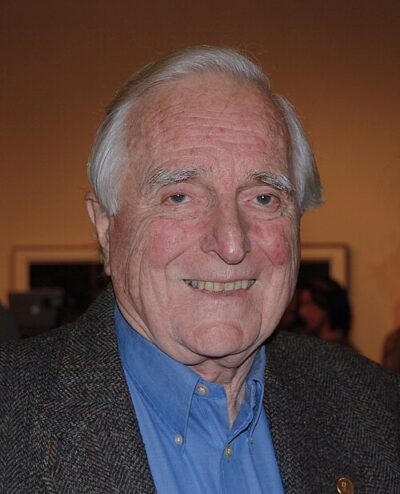
Douglas Engelbart
Douglas Engelbart was an American engineer and inventor. Born January 30, 1925, in Portland. Died July 2, 2013, in Atherton. Known for computer mouse, graphical user interface and human–computer interaction. Educated at Franklin High School and Oregon State University. Awards include ACM Software System Award, Computer Pioneer Award and Yuri Rubinsky Memorial Award.
Facts
50 facts · 2 confirmed by two sources · 33 cited · 15 from one source
Where this comes from
Papalocal keeps its own record. It started from these sources; what each one said is kept here as it was copied, so a change on their side never changes this page by itself. Tap one to read its version.
What Wikidata says · copied November 13, 2026 · revision 2545165655
- Described as
- American engineer and inventor (1925–2013)
- Other names
- Doug C. Engelbart, Douglas Carl Engelbart, Doug Engelbart, Douglas C. Engelbart
- Born
- January 30, 1925 · 4 references
- Died
- July 2, 2013 · 5 references
- Born in
- Portland · 4 references
- Died in
- Atherton · 1 reference
- Cause of death
- kidney failure · 1 reference
- Citizen of
- United States · 2 references
- Occupation
- inventor; engineer; professor; computer scientist · 1 reference; presenter
- Worked for
- Ames Research Center (1948–1951) · 1 reference; University of California, Berkeley (1955–1956) · 1 reference; SRI International (1957–1977) · 1 reference; Tymshare (1977–1984) · 1 reference; McDonnell Douglas (1984–1986) · 1 reference
- Education
- Franklin High School · 1 reference; Oregon State University (–1948) · 1 reference; University of Oregon · 1 reference; University of California, Berkeley (2 times) (1952–1955)
- Member of
- American Academy of Arts and Sciences (1994–) · 1 reference; National Academy of Engineering (1996–) · 1 reference
- Known for
- computer mouse (1967) · 2 references; graphical user interface · 1 reference; human–computer interaction (1969)
- Awards
- ACM Software System Award (1990) · 1 reference; Computer Pioneer Award (1992) · 1 reference; Yuri Rubinsky Memorial Award (1995); Turing Award (1997) · 1 reference; Lemelson–MIT Prize (1997) · 1 reference; National Inventors Hall of Fame (1998) · 1 reference; IEEE John von Neumann Medal (1999) · 1 reference; Benjamin Franklin Medal in Computer and Cognitive Science (1999) · 2 references; National Medal of Technology and Innovation (2000) · 1 reference; Lovelace Medal (2001) · 1 reference; Webby Lifetime Achievement Award (2001) · 1 reference; CHI Academy (2002) · 1 reference; Norbert Wiener Award for Social and Professional Responsibility (2005) · 1 reference; Computer History Museum Fellow (2005) · 1 reference; honorary doctor of Yale University (2011) · 1 reference
- Field
- informatics; invention; electrical engineering
- Spouse
- Ballard Fish · 2 references; Karen O'Leary Engelbart (2008–) · 1 reference
- Children
- Christina Engelbart · 1 reference
- Military branch
- United States Navy · 1 reference
- Lived in
- Atherton · 1 reference; Portland
- Website
- https://dougengelbart.org/
- Wikipedias with a page
- 74
Wikidata item Q92614 (wikidata.org/wiki/Q92614), public domain (CC0). Copied November 13, 2026.
What Wikipedia says · copied November 13, 2026 · revision 1371987766
Douglas Carl Engelbart (January 30, 1925 – July 2, 2013) was an American engineer, inventor, and a pioneer in many aspects of computer science. He is best known for his work on founding the field of human–computer interaction, particularly while at his Augmentation Research Center Lab in SRI International, which resulted in creation of the computer mouse, and the development of hypertext, networked computers, and precursors to graphical user interfaces. These were demonstrated at The Mother of All Demos in 1968. Engelbart's law, the observation that the intrinsic rate of human performance is exponential, is named after him.
The "oN-Line System" (NLS) developed by the Augmentation Research Center under Engelbart's guidance with funding mostly from the Advanced Research Projects Agency (ARPA), later renamed Defense Advanced Research Projects Agency (DARPA), demonstrated many technologies, most of which are now in widespread use; it included the computer mouse, bitmapped screens, word processing, and hypertext; all of which were displayed at "The Mother of All Demos" in 1968. The lab was transferred from SRI to Tymshare in the late 1970s, which was acquired by McDonnell Douglas in 1984, and NLS was renamed Augment (now the Doug Engelbart Institute). At both Tymshare and McDonnell Douglas, Engelbart was limited by a lack of interest in his ideas and funding to pursue them and retired in 1986.
In 1988, Engelbart and his daughter Christina launched the Bootstrap Institute – later known as The Doug Engelbart Institute – to promote his vision, especially at Stanford University; this effort did result in some DARPA funding to modernize the user interface of Augment.
Engelbart won the 1997 ACM Turing Award. In December 2000, United States President Bill Clinton awarded Engelbart the National Medal of Technology, the U.S.'s highest technology award. In December 2008, he was honored by SRI at the 40th anniversary of the "Mother of All Demos".
- Born, in its opening lines
- January 30, 1925
- Died, in its opening lines
- July 2, 2013
From the Wikipedia article “Douglas Engelbart” (en.wikipedia.org/wiki/Douglas_Engelbart), by its contributors, under CC BY-SA 4.0 (creativecommons.org/licenses/by-sa/4.0/). Copied November 13, 2026; not changed.
Confirmed Two sources agree. Cited One source, and it names where it got it. One source One source, without a reference of its own. Sources disagree The sources disagree. We show the best-supported value and keep theirs below.
