
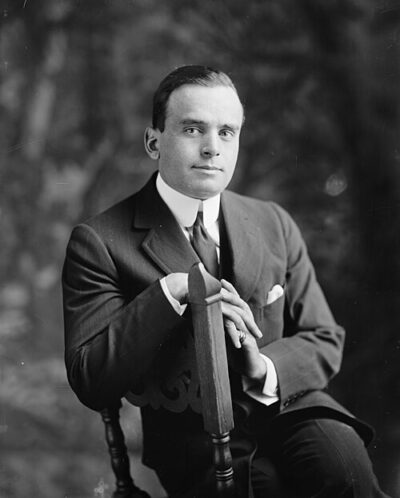
Douglas Fairbanks
Douglas Fairbanks was an American actor, screenwriter, director, and producer. Born May 23, 1883, in Denver. Died December 12, 1939, in Santa Monica. Educated at Harvard University and East High School. Awards include Academy Honorary Award and star on Hollywood Walk of Fame.
Facts
35 facts · 2 confirmed by two sources · 10 cited · 23 from one source
Where this comes from
Papalocal keeps its own record. It started from these sources; what each one said is kept here as it was copied, so a change on their side never changes this page by itself. Tap one to read its version.
What Wikipedia says · copied November 13, 2026 · revision 1376407032
Douglas Elton Fairbanks Sr. (born Douglas Elton Thomas Ullman; May 23, 1883 – December 12, 1939) was an American actor and filmmaker best known for being the first actor to play the masked vigilante Zorro and other swashbuckling roles in silent films. One of the biggest stars of the silent era, Fairbanks was referred to as "The King of Hollywood". He was also a founding member of United Artists as well as the Motion Picture Academy and hosted the 1st Academy Awards in 1929.
Born in Denver, Colorado, Fairbanks started acting from an early age and established himself as an accomplished stage actor on Broadway by the late 1800s. He made his film debut in 1915 and quickly became one of the most popular and highest paid actors in Hollywood. In 1919, he co-founded United Artists alongside Charlie Chaplin, Mary Pickford and D. W. Griffith. Fairbanks married Pickford in 1920 and the couple came to be regarded as "Hollywood royalty". Primarily a comedic actor early in his career, he moved into the adventure genre with the 1920 film The Mark of Zorro and found further success in films including Robin Hood (1922) and The Thief of Bagdad (1924).
Fairbanks' career rapidly declined with the advent of the "talkies" in the late 1920s. His final film was The Private Life of Don Juan (1934), after which he retired from acting but continued to be marginally involved in the film industry and United Artists. He died in 1939 at the age of 56.
- Born, in its opening lines
- May 23, 1883
- Died, in its opening lines
- December 12, 1939
From the Wikipedia article “Douglas Fairbanks” (en.wikipedia.org/wiki/Douglas_Fairbanks), by its contributors, under CC BY-SA 4.0 (creativecommons.org/licenses/by-sa/4.0/). Copied November 13, 2026; not changed.
What Wikidata says · copied November 14, 2026 · revision 2569153776
- Described as
- American actor, screenwriter, director, and producer (1883–1939)
- Other names
- Douglas Fairbanks, Sr., Douglas Ullman, Doug Fairbanks, Douglas Elton Thomas Ullman
- Born
- May 23, 1883 · 16 references
- Died
- December 12, 1939 · 17 references
- Born in
- Denver · 3 references
- Died in
- Santa Monica · 6 references
- Buried in
- Hollywood Forever Cemetery
- Cause of death
- myocardial infarction
- Name at birth
- Douglas Elton Thomas Ullman
- Citizen of
- United States
- Occupation
- screenwriter · 3 references; film director · 3 references; film producer · 2 references; writer; businessperson · 2 references; film actor · 1 reference; stage actor; stunt performer · 1 reference
- Worked for
- University of Southern California
- Education
- Harvard University; East High School · 1 reference
- Genre
- Western film; silent film; action film; comedy film; romance film
- Awards
- Academy Honorary Award (1939); star on Hollywood Walk of Fame · 1 reference
- Spouse
- Mary Pickford (1920–1936) · 1 reference; Sylvia Ashley (1936–1939) · 1 reference; Anna Beth Sully (1907–1919) · 1 reference
- Children
- Douglas Fairbanks Jr. · 1 reference
- Father
- Hezekiah Charles Ullman
- Mother
- Ella Adelaide Marsh · 1 reference
- Siblings
- John Fairbanks
- Lived in
- Denver
- Height
- 1.73 m (5 ft 8 in)
- Wikipedias with a page
- 61
Wikidata item Q104127 (wikidata.org/wiki/Q104127), public domain (CC0). Copied November 14, 2026.
Confirmed Two sources agree. Cited One source, and it names where it got it. One source One source, without a reference of its own. Sources disagree The sources disagree. We show the best-supported value and keep theirs below.
