
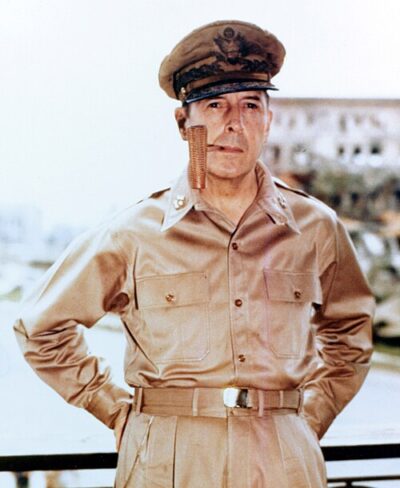
Douglas MacArthur
Douglas MacArthur was an United States Army general in WWI, WWII and Korea. Born January 26, 1880, in Little Rock. Died April 5, 1964, in Washington, D.C.. Positions held include Chief of Staff of the United States Army (1930–1935). Educated at United States Army Command and General Staff College and United States Military Academy. Awards include Croix de guerre 1914–1918, Medal of Honor and Distinguished Service Cross.
Facts
40 facts · 2 confirmed by two sources · 4 cited · 34 from one source
Where this comes from
Papalocal keeps its own record. It started from these sources; what each one said is kept here as it was copied, so a change on their side never changes this page by itself. Tap one to read its version.
What Wikipedia says · copied November 13, 2026 · revision 1385541961
Douglas MacArthur (26 January 1880 – 5 April 1964) was an American general. He served with distinction in World War I; as chief of staff of the United States Army from 1930 to 1935; as Supreme Commander, Southwest Pacific Area, from 1942 to 1945; as Supreme Commander for the Allied Powers overseeing the occupation of Japan from 1945 to 1951; and as head of the United Nations Command in the Korean War from 1950 to 1951. He is one of only five people to hold the rank of General of the Army, and the only person to hold the rank of Field Marshal in the Philippine Army.
MacArthur, a son of Medal of Honor recipient Arthur MacArthur Jr., graduated first in his class from the U.S. Military Academy in 1903. During the 1914 U.S. occupation of Veracruz, he conducted a reconnaissance mission for which he was nominated for the Medal of Honor. On the Western Front during World War I, he rose to the rank of brigadier general, was again nominated for a Medal of Honor, and was awarded the Distinguished Service Cross twice and the Silver Star seven times. From 1919 to 1922, MacArthur served as Superintendent of the U.S. Military Academy. His next posting was in the Philippines, where in 1924 he was instrumental in quelling the Philippine Scout Mutiny. In 1925, MacArthur became the Army's youngest major general at the age of 45, and in 1930 was appointed Chief of Staff of the U.S. Army. He was involved in the controversial expulsion of the Bonus Army protesters in Washington, D.C., in 1932, and organized the Civilian Conservation Corps. In 1935, MacArthur was appointed Military Advisor to the Commonwealth of the Philippines. He retired from the Army in 1937, but continued as an advisor and as a Field Marshal in the Philippine Army from 1936.
MacArthur was recalled to active duty in 1941 as commander of U.S. Army Forces in the Far East. A large portion of his air forces were destroyed in December 1941 in the Japanese attack on Clark Field, and an invasion of the Philippines followed. In March 1942, MacArthur escaped to Australia, where he was appointed Supreme Commander of the Southwest Pacific Area in April. He promised that he would return to the Philippines, and for his defense of the islands was awarded the Medal of Honor. From Australia, he commanded the New Guinea campaign, and in October 1944 led the campaign which liberated the Philippines. In December 1944, he was promoted to General of the Army.
At the end of the war, MacArthur accepted the surrender of Japan. As the Supreme Commander for the Allied Powers and effective ruler of Japan, he oversaw the war crimes tribunals and the demilitarization and democratization of the country. During the Korean War, he led the United Nations Command with initial success, but suffered major defeats after China's entry into the war in October 1950. MacArthur was contentiously removed from his command in Korea by President Harry S. Truman in April 1951. He died in Washington, D.C., in 1964.
- Born, in its opening lines
- January 26, 1880
- Died, in its opening lines
- April 5, 1964
From the Wikipedia article “Douglas MacArthur” (en.wikipedia.org/wiki/Douglas_MacArthur), by its contributors, under CC BY-SA 4.0 (creativecommons.org/licenses/by-sa/4.0/). Copied November 13, 2026; not changed.
What Wikidata says · copied November 14, 2026 · revision 2568922566
- Described as
- United States Army general in WWI, WWII and Korea (1880–1964)
- Other names
- General Douglas MacArthur, MacArthur, General MacArthur, D. MacArthur
- Born
- January 26, 1880 · 17 references
- Died
- April 5, 1964 · 18 references
- Born in
- Little Rock · 3 references
- Died in
- Washington, D.C. · 4 references
- Buried in
- MacArthur Memorial
- Cause of death
- kidney failure
- Citizen of
- United States
- Occupation
- military officer; army officer
- Positions held
- Chief of Staff of the United States Army (1930–1935)
- Political party
- Republican Party
- Education
- United States Army Command and General Staff College; United States Military Academy; Milwaukee High School of the Arts · 1 reference
- Awards
- Croix de guerre 1914–1918; Medal of Honor; Distinguished Service Cross; Navy Distinguished Service Medal; Silver Star; Distinguished Flying Cross; Air Medal; Philippine Campaign Medal; Mexican Service Medal; World War I Victory Medal (United States) · 1 reference; Army of Occupation of Germany Medal; American Defense Service Medal; Asiatic-Pacific Campaign Medal; World War II Victory Medal; Army of Occupation Medal
- Spouse
- Jean MacArthur; Louise Cromwell
- Children
- Arthur McArthur IV
- Father
- Arthur MacArthur Jr.
- Mother
- Mary Pinckney Hardy · 1 reference
- Siblings
- Arthur MacArthur III
- Military branch
- Philippine Army; United States Army (1903–1951)
- Military rank
- General of the Army (1944–) · 1 reference; Field Marshal of the Philippines (1936–) · 1 reference; general · 1 reference
- Wikipedias with a page
- 114
Wikidata item Q127417 (wikidata.org/wiki/Q127417), public domain (CC0). Copied November 14, 2026.
Confirmed Two sources agree. Cited One source, and it names where it got it. One source One source, without a reference of its own. Sources disagree The sources disagree. We show the best-supported value and keep theirs below.
