
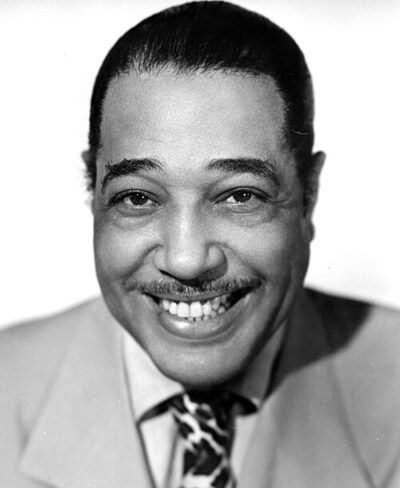
Duke Ellington
Duke Ellington was an American jazz pianist and composer. Born April 29, 1899, in Washington, D.C.. Died May 24, 1974, in New York City. Known for Just Squeeze Me (But Please Don't Tease Me), It Don't Mean a Thing and Solitude. Educated at Armstrong High School. Awards include Spingarn Medal, Presidential Medal of Freedom and Grammy Lifetime Achievement Award.
Facts
56 facts · 2 confirmed by two sources · 20 cited · 34 from one source
Where this comes from
Papalocal keeps its own record. It started from these sources; what each one said is kept here as it was copied, so a change on their side never changes this page by itself. Tap one to read its version.
What Wikidata says · copied November 13, 2026 · revision 2566995167
- Described as
- American jazz pianist and composer (1899–1974)
- Other names
- Duke Elington, Mood Ellington, Edward Kennedy "Duke" Ellington, Edward Kennedy Ellington
- Born
- April 29, 1899 · 19 references
- Died
- May 24, 1974 · 17 references
- Born in
- Washington, D.C. · 5 references
- Died in
- New York City · 4 references
- Buried in
- Woodlawn Cemetery · 1 reference
- Cause of death
- lung cancer · 1 reference
- Name at birth
- Edward Kennedy Ellington · 1 reference
- Citizen of
- United States
- Occupation
- pianist · 2 references; composer · 2 references; autobiographer; jazz musician; conductor · 2 references; bandleader · 2 references; record producer; film score composer
- Education
- Armstrong High School
- Member of
- American Academy of Arts and Letters; American Academy of Arts and Sciences; Royal Swedish Academy of Music; Alpha Phi Alpha; Duke Ellington Orchestra · 1 reference; Duke Ellington and his Washingtonians · 1 reference; The Oscar Pettiford Quartet
- Genre
- jazz; swing; gospel music · 1 reference; vocal music · 1 reference
- Instrument
- piano
- Record label
- Columbia Records; Decca; Philips Records
- Known for
- Just Squeeze Me (But Please Don't Tease Me); It Don't Mean a Thing · 1 reference; Solitude · 1 reference; Black, Brown and Beige · 1 reference; Harlem · 1 reference; Diminuendo and Crescendo in Blue · 1 reference
- Awards
- Spingarn Medal (1959) · 1 reference; Presidential Medal of Freedom (1969) · 2 references; Grammy Lifetime Achievement Award (1966) · 1 reference; Grammy Trustees Award (1968); German Film Award for best original music (1957); Fellow of the American Academy of Arts and Sciences · 1 reference; star on Hollywood Walk of Fame · 1 reference; Pulitzer Prize Special Citations and Awards (1999) · 1 reference; Songwriters Hall of Fame (1971) · 1 reference; honorary doctor of the Berklee College of Music (1971) · 1 reference; Grammy Award for Best Large Jazz Ensemble Album (1972) · 1 reference
- Spouse
- Edna Thompson
- Children
- Mercer Ellington · 1 reference
- Siblings
- Ruth Dorothea Kennedy Ellington
- Lived in
- Duke Ellington House (1939–1969)
- Nickname
- The Duke · 1 reference; Dumpy
- Website
- http://www.dukeellington.com/
- Wikipedias with a page
- 88
Wikidata item Q4030 (wikidata.org/wiki/Q4030), public domain (CC0). Copied November 13, 2026.
What Wikipedia says · copied November 13, 2026 · revision 1383891707
Edward Kennedy "Duke" Ellington (April 29, 1899 – May 24, 1974) was an American jazz pianist, composer, and leader of his eponymous jazz orchestra from 1924 through the rest of his life. Music critic Ralph J. Gleason called him "America's most important composer".
Born and raised in Washington, D.C., Ellington was based in New York City from the mid-1920s and gained a national profile through his orchestra's appearances at the Cotton Club in Harlem. A master at writing miniatures for the three-minute 78 rpm recording format, Ellington wrote or collaborated on more than one thousand compositions; his extensive body of work is the largest recorded personal jazz legacy, and many of his pieces have become standards. He also recorded songs written by his bandsmen, such as Juan Tizol's "Caravan", which brought a Spanish tinge to big band jazz.
At the end of the 1930s, Ellington began a nearly thirty-year collaboration with composer-arranger-pianist Billy Strayhorn, whom he called his writing and arranging companion. With Strayhorn, he composed multiple extended compositions, or suites, as well as many short pieces. For a few years at the beginning of Strayhorn's involvement, Ellington's orchestra featured bassist Jimmy Blanton and tenor saxophonist Ben Webster, and reached what many claim to be a creative peak for the group. Some years later, following a low-profile period, an appearance by Ellington and his orchestra at the Newport Jazz Festival in July 1956 led to a major revival and regular world tours. Ellington recorded for most American record companies of his era, performed in and scored several films, and composed a handful of stage musicals.
Although a pivotal figure in the history of jazz, in the opinion of Gunther Schuller and Barry Kernfeld, "the most significant composer of the genre", Ellington himself embraced the phrase "beyond category", considering it a liberating principle, and referring to his music as part of the more general category of American music. Ellington was known for his inventive use of the orchestra, or big band, as well as for his eloquence and charisma. He was awarded a posthumous Pulitzer Prize Special Award for music in 1999.
- Born, in its opening lines
- April 29, 1899
- Died, in its opening lines
- May 24, 1974
From the Wikipedia article “Duke Ellington” (en.wikipedia.org/wiki/Duke_Ellington), by its contributors, under CC BY-SA 4.0 (creativecommons.org/licenses/by-sa/4.0/). Copied November 13, 2026; not changed.
Confirmed Two sources agree. Cited One source, and it names where it got it. One source One source, without a reference of its own. Sources disagree The sources disagree. We show the best-supported value and keep theirs below.
