
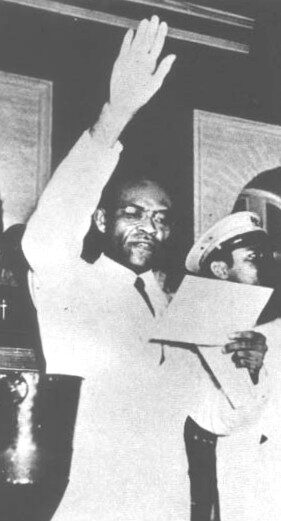
Dumarsais Estimé
Dumarsais Estimé was a President of Haiti. Born April 21, 1900, in Verrettes. Died July 20, 1953, in NewYork–Presbyterian Hospital. Positions held include President of Haiti (1946–1950).
Facts
9 facts · 2 confirmed by two sources · 0 cited · 7 from one source
Where this comes from
Papalocal keeps its own record. It started from these sources; what each one said is kept here as it was copied, so a change on their side never changes this page by itself. Tap one to read its version.
What Wikidata says · copied November 18, 2026 · revision 2563068082
- Described as
- President of Haiti (1900-1953)
- Other names
- Dumarsais Estime
- Born
- April 21, 1900 · 3 references
- Died
- July 20, 1953 · 4 references
- Born in
- Verrettes
- Died in
- NewYork–Presbyterian Hospital
- Cause of death
- kidney disease
- Citizen of
- Haiti
- Occupation
- politician
- Positions held
- President of Haiti (1946–1950)
- Political party
- independent politician · 1 reference
- Wikipedias with a page
- 22
Wikidata item Q738355 (wikidata.org/wiki/Q738355), public domain (CC0). Copied November 18, 2026.
What Wikipedia says · copied November 18, 2026 · revision 1370791808
Léon Dumarsais Estimé (French pronunciation: [leɔ̃ dymaʁsɛ ɛstime]; April 21, 1900 – July 20, 1953) was a Haitian politician and President of the Haitian Republic from August 16, 1946, to May 10, 1950.
Previously, he was a member of the Parliament for Verrettes for 16 years, as well as President of the Chamber and Minister (Secretary of State) for Public Education, Agriculture, and Labour.
Dumarsais Estimé's political ideology is a mixture of nationalism and progressivism. This ideology is called estimism. He advocated for collaborationism with the bourgeoisie, centralization policies, nationalization and liberalization economic policies.
The memory of his presidency remains very prominent among many Haitians due to the reforms undertaken and the undeniable economic and social progress that the Republic of Haiti experienced during this era. Among his more notable achievements are things such as the International Exhibition organized in 1949 to commemorate the bicentenary of the founding of Port-au-Prince in 1749 by the French colonists from the island of Santo Domingo (Le Livre Bleu), the expansion of the city of Belladère along the Dominican Republic border as a symbol of development, and the construction of a suspension bridge over the Grande-Anse River which still continues to serve region as river crossing to this day. It is important to also remember the laws passed and the investments made for the development of rural areas, the construction of many schools and the modernisation of the whole education system, as well as the protection of workers’ rights through the Labor Code and ultimately the creation of proper conditions for economic growth, mostly in tourism and small industry sectors. During this period, there was also significant improvement in the living conditions of the Haitian population.
In May 1950, a coup d’état organized by a military junta overthrew the government of Estimé and placed its leader, Paul Magloire, as head of the country, where he would be elected to the presidency in October 1950. Estimé was shortly deposed and exiled by the Haitian army led by Franck Lavaud. After travelling in France, Jamaica, and the US, he died in New York on July 20, 1953. Estimé was the last president to be constitutionally elected to office by the Chamber of Deputies, whereas Magloire was the first to be elected to office by universal adult male suffrage.
- Born, in its opening lines
- April 21, 1900
- Died, in its opening lines
- July 20, 1953
From the Wikipedia article “Dumarsais Estimé” (en.wikipedia.org/wiki/Dumarsais_Estimé), by its contributors, under CC BY-SA 4.0 (creativecommons.org/licenses/by-sa/4.0/). Copied November 18, 2026; not changed.
Confirmed Two sources agree. Cited One source, and it names where it got it. One source One source, without a reference of its own. Sources disagree The sources disagree. We show the best-supported value and keep theirs below.
