
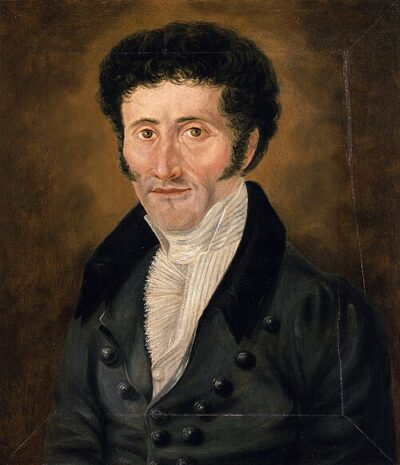
E. T. A. Hoffmann
E. T. A. Hoffmann was a German writer. Born January 24, 1776, in Königsberg. Died June 25, 1822, in Berlin. Known for Undine, The Devil's Elixirs and The Nutcracker and the Mouse King. Educated at University of Königsberg.
Facts
40 facts · 2 confirmed by two sources · 15 cited · 22 from one source · 1 where the sources disagree
What’s different
- Died: we show June 25, 1822 (Confirmed). Wikidata also lists 1822
- Cause of death: we show cancer (Sources disagree). Wikidata also lists tuberculosis
Where this comes from
Papalocal keeps its own record. It started from these sources; what each one said is kept here as it was copied, so a change on their side never changes this page by itself. Tap one to read its version.
What Wikidata says · copied November 16, 2026 · revision 2569995098
- Described as
- German writer (1776-1822)
- Other names
- Ernst Theodor Hoffmann, Ernst T. A. Hoffmann, Ernst Theodor Wilhelm Hoffman, Ernst Theodore Wilhelm Hoffmann, E. T. Hoffmann, Amadeus Hoffmann, Ernst Theodor Amedeus Hoffmann, Amadeus Hoffman, Ernst Theodor Wilhelm. Hoffman, ETA Hoffmann, Ernst Theodor Wilhelm Hoffmann, E.T.A. Hoffmann
- Born
- January 24, 1776 · 25 references
- Died
- June 25, 1822 · 11 references; 1822 · 1 reference
- Born in
- Königsberg · 6 references
- Died in
- Berlin · 4 references
- Buried in
- Friedhof III der Gemeinde Jerusalems- und Neue Kirche · 1 reference
- Cause of death
- cancer; tuberculosis
- Name at birth
- Ernst Theodor Wilhelm Hoffmann
- Citizen of
- Kingdom of Prussia; Germany
- Occupation
- composer · 3 references; judge; caricaturist; painter · 1 reference; children's writer; writer · 5 references; conductor · 3 references; science fiction writer
- Education
- University of Königsberg
- Genre
- horror literature; fairy tale; grotesque
- Instrument
- organ
- Known for
- Undine; The Devil's Elixirs; The Nutcracker and the Mouse King; Mademoiselle de Scuderi; The Sandman; The Golden Pot; Master Flea
- Field
- creative and professional writing · 1 reference; prose · 1 reference; music · 1 reference; music criticism · 1 reference; conducting · 1 reference; painting · 1 reference
- Spouse
- Maria Thekla Michaelina Hoffmann · 1 reference
- Children
- Caecilia Hoffmann · 1 reference
- Father
- Christoph Ludwig Hoffmann · 1 reference
- Mother
- Louise Albertine Hoffmann · 1 reference
- Website
- http://www.etahg.de
- Wikipedias with a page
- 92
Wikidata item Q150471 (wikidata.org/wiki/Q150471), public domain (CC0). Copied November 16, 2026.
What Wikipedia says · copied November 16, 2026 · revision 1384898773
Ernst Theodor Amadeus Hoffmann (born Ernst Theodor Wilhelm Hoffmann; 24 January 1776 – 25 June 1822) was a German Romantic author of fantasy and gothic horror, a jurist, composer, music critic and artist. His short story "The Sandman" is seen as a pioneering work of horror fiction, while his novella Mademoiselle de Scuderi is regarded as one of the earliest examples of crime fiction.
Several of his works have been reimagined in other media: He is the author of the novella The Nutcracker and the Mouse King, on which Pyotr Ilyich Tchaikovsky's ballet The Nutcracker is based. In addition, his stories form the basis of Jacques Offenbach's opera The Tales of Hoffmann, in which Hoffmann appears (heavily fictionalized) as the hero. The ballet Coppélia is based on two other stories that Hoffmann wrote, while Schumann's Kreisleriana is based on Hoffmann's character Johannes Kreisler.
Hoffmann's stories highly influenced 19th-century literature, and he is one of the major authors of the Romantic movement.
- Born, in its opening lines
- January 24, 1776
- Died, in its opening lines
- June 25, 1822
From the Wikipedia article “E. T. A. Hoffmann” (en.wikipedia.org/wiki/E._T._A._Hoffmann), by its contributors, under CC BY-SA 4.0 (creativecommons.org/licenses/by-sa/4.0/). Copied November 16, 2026; not changed.
Confirmed Two sources agree. Cited One source, and it names where it got it. One source One source, without a reference of its own. Sources disagree The sources disagree. We show the best-supported value and keep theirs below.
