
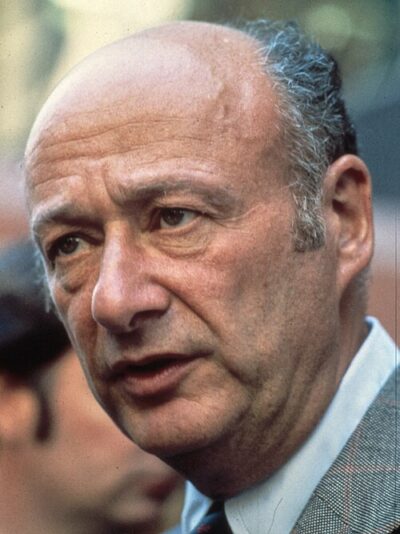
Ed Koch
Ed Koch was a former mayor of New York City. Born December 12, 1924, in The Bronx. Died February 1, 2013, in Greenwich Village. Positions held include Mayor of New York City (1978–1989) and United States representative (1969–1977). Educated at City College of New York and New York University School of Law. Awards include European-African-Middle Eastern Campaign Medal, service star and World War II Victory Medal.
Facts
30 facts · 2 confirmed by two sources · 5 cited · 23 from one source
Where this comes from
Papalocal keeps its own record. It started from these sources; what each one said is kept here as it was copied, so a change on their side never changes this page by itself. Tap one to read its version.
What Wikidata says · copied November 15, 2026 · revision 2567542021
- Described as
- former mayor of New York City (1924-2013)
- Other names
- Edward Irving "Ed" Koch, Edward I. Koch, Edward Irving Koch
- Born
- December 12, 1924 · 6 references
- Died
- February 1, 2013 · 7 references
- Born in
- The Bronx
- Died in
- Greenwich Village
- Buried in
- Trinity Church Cemetery and Mausoleum · 1 reference
- Cause of death
- heart failure
- Name at birth
- Edward Irving Koch
- Citizen of
- United States
- Occupation
- politician · 1 reference; lawyer · 1 reference; writer; judge; film critic · 1 reference; jurist · 1 reference; mayor · 1 reference
- Positions held
- Mayor of New York City (1978–1989); United States representative (1969–1977)
- Political party
- Democratic Party
- Worked for
- New York University
- Education
- City College of New York; New York University School of Law; Malcolm X Shabazz High School · 1 reference
- Awards
- European-African-Middle Eastern Campaign Medal; service star · 1 reference; World War II Victory Medal · 1 reference; Combat Infantryman Badge · 1 reference
- Siblings
- Pat Koch Thaler
- Religion
- Judaism
- Military branch
- United States Army
- Military rank
- Sergeant · 1 reference
- Wikipedias with a page
- 38
Wikidata item Q467122 (wikidata.org/wiki/Q467122), public domain (CC0). Copied November 15, 2026.
What Wikipedia says · copied November 15, 2026 · revision 1385276348
Edward Irving Koch ( KOTCH; December 12, 1924 – February 1, 2013) was an American politician who served in the United States House of Representatives from 1969 to 1977 and was mayor of New York City from 1978 to 1989. A popular figure, Koch rode the New York City Subway and stood at street corners greeting passersby with the slogan "How'm I doin'?"
Koch was a lifelong Democrat who described himself as a "liberal with sanity". The author of an ambitious public housing renewal program in his later years as mayor, he began by cutting spending and taxes and cutting 7,000 employees from the city payroll. He was the city's second Jewish mayor after his predecessor Abraham Beame. He crossed party lines to endorse Rudy Giuliani for mayor of New York City in 1993, Al D'Amato for Senate in 1998, Michael Bloomberg for mayor of New York City in 2001, and George W. Bush for president in 2004.
Koch was first elected mayor of New York City in 1977 and was re-elected in 1981 with 75% of the vote. He was the first New York City mayor to win endorsement on both the Democratic and Republican party tickets. In 1985, Koch was elected to a third term with 78% of the vote. His third term was fraught with scandal regarding political associates (although the scandal never touched him personally) and with racial tensions, including the killings of Michael Griffith and Yusuf Hawkins. In a close race, Koch lost the 1989 Democratic primary to his successor, David Dinkins.
Koch was a lifelong bachelor. Though he publicly denied being gay on numerous occasions, he attempted to find a boyfriend late in life.
- Born, in its opening lines
- December 12, 1924
- Died, in its opening lines
- February 1, 2013
From the Wikipedia article “Ed Koch” (en.wikipedia.org/wiki/Ed_Koch), by its contributors, under CC BY-SA 4.0 (creativecommons.org/licenses/by-sa/4.0/). Copied November 15, 2026; not changed.
Confirmed Two sources agree. Cited One source, and it names where it got it. One source One source, without a reference of its own. Sources disagree The sources disagree. We show the best-supported value and keep theirs below.
