
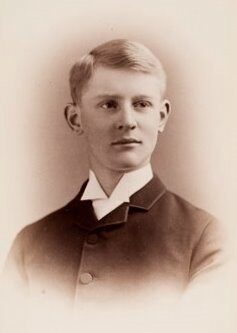
Edgar Buckingham
Edgar Buckingham was an American physicist. Born July 8, 1867, in Philadelphia. Died April 29, 1940, in Washington, D.C.. Educated at Harvard University and Leipzig University. Awards include Fellow of the American Physical Society.
Facts
15 facts · 2 confirmed by two sources · 0 cited · 13 from one source
Where this comes from
Papalocal keeps its own record. It started from these sources; what each one said is kept here as it was copied, so a change on their side never changes this page by itself. Tap one to read its version.
What Wikidata says · copied November 18, 2026 · revision 2567457340
- Described as
- American physicist (1867–1940)
- Born
- July 8, 1867 · 1 reference
- Died
- April 29, 1940 · 1 reference
- Born in
- Philadelphia
- Died in
- Washington, D.C.
- Citizen of
- United States
- Occupation
- physicist; mathematician; chemist
- Worked for
- University of Wisconsin–Madison; Bryn Mawr College
- Education
- Harvard University; Leipzig University · 1 reference; University of Strasbourg · 1 reference
- Awards
- Fellow of the American Physical Society
- Lived in
- United States · 1 reference
- Wikipedias with a page
- 14
Wikidata item Q710276 (wikidata.org/wiki/Q710276), public domain (CC0). Copied November 18, 2026.
What Wikipedia says · copied November 18, 2026 · revision 1384932259
Edgar Buckingham (July 8, 1867 in Philadelphia, Pennsylvania – April 29, 1940 in Washington DC) was an American physicist.
He graduated from Harvard University with a bachelor's degree in physics in 1887. He did graduate work at Strasbourg and then studied under the chemist Wilhelm Ostwald at Leipzig, from which he was granted a PhD in 1893. He worked as a soil physicist at the USDA Bureau of Soils from 1902 to 1906. He worked at the (US) National Bureau of Standards (now the National Institute of Standards and Technology, or NIST) 1906–1937. His fields of expertise included soil physics, gas properties, acoustics, fluid mechanics, and blackbody radiation. He is also the originator of the Buckingham π theorem in the field of dimensional analysis.
In 1923, Buckingham published a report which voiced skepticism that jet propulsion would be economically competitive with propeller driven aircraft at low altitudes and at the speeds of that period.
Buckingham's first work on soil physics is on soil aeration, particularly the loss of carbon dioxide from the soil and its subsequent replacement by oxygen. From his experiments he found that the rate of gas diffusion in soil was not dependent significantly on the soil structure, compactness or water content of the soil. Using an empirical formula based on his data, Buckingham was able to give the diffusion coefficient as a function of air content. This relation is still commonly cited in many modern textbooks and used in modern research. The outcomes of his research on gas transport were to conclude that the exchange of gases in soil aeration takes place by diffusion and is sensibly independent of the variations of the outside barometric pressure.
Buckingham then worked on soil water, research for which he is now renowned. Buckingham's work on soil water is published in Bulletin 38 USDA Bureau of Soils: Studies on the movement of soil moisture, which was released in 1907. This document contained three sections, the first of which looked at evaporation of water from below a layer of soil. He found that soils of various textures could strongly inhibit evaporation, particularly where capillary flow through the uppermost layers was prevented. The second section of Bulletin 38 looked at the drying of soils under arid and humid conditions. Buckingham found evaporative losses were initially higher from the arid soil, then after three days the evaporation under arid conditions became less than under humid conditions, with the total loss ending up greater from the humid soil. Buckingham believed this occurred due to the self-mulching behaviour (he referred to it as the soil forming a natural mulch) exhibited by the soil under arid conditions.
The third section of Bulletin 38 contains the work on unsaturated flow and capillary action for which Buckingham is famous. He firstly recognized the importance of the potential of the forces arising from interactions between soil and water. He called this the capillary potential, this is now known as the moisture or water potential (matric potential). He combined capillary theory and an energy potential in soil physics theory, and was the first to expound the dependence of soil hydraulic conductivity on capillary potential. This dependence later came to be known as relative permeability in petroleum engineering. He also applied a formula equivalent to Darcy's law to unsaturated flow.
- Born, in its opening lines
- July 8, 1867
- Died, in its opening lines
- April 29, 1940
From the Wikipedia article “Edgar Buckingham” (en.wikipedia.org/wiki/Edgar_Buckingham), by its contributors, under CC BY-SA 4.0 (creativecommons.org/licenses/by-sa/4.0/). Copied November 18, 2026; not changed.
Confirmed Two sources agree. Cited One source, and it names where it got it. One source One source, without a reference of its own. Sources disagree The sources disagree. We show the best-supported value and keep theirs below.
