
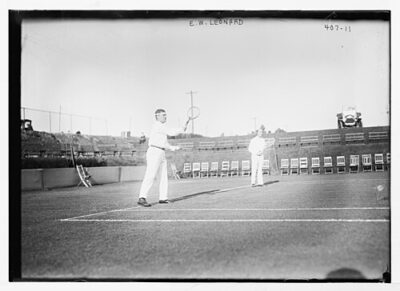
Edgar Leonard
Edgar Leonard was an US tennis player. Born June 19, 1881, in West Newton. Died October 7, 1948, in New York City. Educated at Harvard University.
Facts
9 facts · 2 confirmed by two sources · 3 cited · 4 from one source
Where this comes from
Papalocal keeps its own record. It started from these sources; what each one said is kept here as it was copied, so a change on their side never changes this page by itself. Tap one to read its version.
What Wikidata says · copied November 16, 2026 · revision 2541463720
- Described as
- US tennis player (1881–1948)
- Other names
- Edgar Welch Leonard
- Born
- June 19, 1881 · 1 reference
- Died
- October 7, 1948
- Born in
- West Newton
- Died in
- New York City
- Citizen of
- United States · 1 reference
- Occupation
- tennis player · 1 reference; businessperson · 1 reference
- Education
- Harvard University
- Sport
- tennis · 1 reference
- Wikipedias with a page
- 23
Wikidata item Q492566 (wikidata.org/wiki/Q492566), public domain (CC0). Copied November 16, 2026.
What Wikipedia says · copied November 16, 2026 · revision 1368400159
Edgar Welch Leonard (June 19, 1881 – October 7, 1948) was a Harvard graduate and male tennis player from the United States.
He is best known for his gold medal at the St. Louis Olympics (1904) in the men's doubles event, with partner Beals Wright. In the men's singles event, he won a bronze medal.
Leonard reached the semifinals of the U.S. National Championships in 1904 and the quarterfinals in 1901 and 1906.At the Cincinnati Open in 1904, Leonard was a singles quarterfinalist and a doubles finalist (with Beals Wright).
- Born, in its opening lines
- June 19, 1881
- Died, in its opening lines
- October 7, 1948
From the Wikipedia article “Edgar Leonard” (en.wikipedia.org/wiki/Edgar_Leonard), by its contributors, under CC BY-SA 4.0 (creativecommons.org/licenses/by-sa/4.0/). Copied November 16, 2026; not changed.
Confirmed Two sources agree. Cited One source, and it names where it got it. One source One source, without a reference of its own. Sources disagree The sources disagree. We show the best-supported value and keep theirs below.
