
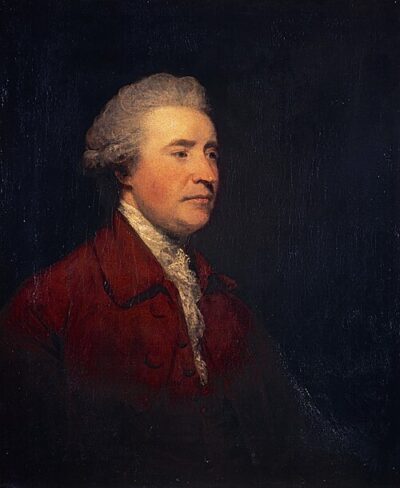
Edmund Burke
Edmund Burke was an Anglo-Irish statesman, political theorist and conservative philosopher. Born January 12, 1729, in Dublin. Died July 9, 1797, in Beaconsfield. Positions held include member of the 12th Parliament of Great Britain, member of the 13th Parliament of Great Britain and member of the 14th Parliament of Great Britain. Known for Reflections on the Revolution in France and A Philosophical Enquiry into the Origin of Our Ideas of the Sublime and Beautiful. Educated at Trinity College, Dublin.
Facts
27 facts · 2 confirmed by two sources · 11 cited · 14 from one source
Where this comes from
Papalocal keeps its own record. It started from these sources; what each one said is kept here as it was copied, so a change on their side never changes this page by itself. Tap one to read its version.
What Wikidata says · copied November 16, 2026 · revision 2569721813
- Described as
- Anglo-Irish statesman, political theorist and conservative philosopher (1729–1797)
- Born
- January 12, 1729 · 9 references
- Died
- July 9, 1797 · 10 references
- Born in
- Dublin · 2 references
- Died in
- Beaconsfield · 2 references
- Citizen of
- Kingdom of Ireland
- Occupation
- politician · 1 reference; philosopher · 2 references; writer · 2 references; political scientist · 1 reference
- Positions held
- member of the 12th Parliament of Great Britain; member of the 13th Parliament of Great Britain; member of the 14th Parliament of Great Britain; member of the 15th Parliament of Great Britain; member of the 16th Parliament of Great Britain; member of the 17th Parliament of Great Britain
- Political party
- Whigs; Rockingham Whigs (1765–1784)
- Worked for
- University of Glasgow
- Education
- Trinity College, Dublin
- Known for
- Reflections on the Revolution in France; A Philosophical Enquiry into the Origin of Our Ideas of the Sublime and Beautiful
- Field
- political science · 1 reference; political ideology · 1 reference; conservatism · 1 reference; philosophy · 1 reference
- Spouse
- Jane Mary Nugent · 1 reference
- Religion
- Church of Ireland
- Wikipedias with a page
- 124
Wikidata item Q165792 (wikidata.org/wiki/Q165792), public domain (CC0). Copied November 16, 2026.
What Wikipedia says · copied November 16, 2026 · revision 1384952160
Edmund Burke (; 12 January [NS] 1729 – 9 July 1797) was an Anglo-Irish writer, philosopher, and politician who is widely credited as the founder of the cultural and political philosophy of conservatism. Regarded as one of the most influential conservative thinkers and political writers of the 18th century, Burke spent the majority of his career in Great Britain and was elected as a member of Parliament (MP) from 1766 to 1794 in the House of Commons of Great Britain with the Whig Party. His writings played a significant role in influencing public views and opinions in both Great Britain and France following the French Revolution in 1789, and he remains a major figure in modern conservative circles.
Burke was a proponent of underpinning virtues with manners in society and of the importance of religious institutions for the moral stability and good of the state. These views were expressed in his satirical work, A Vindication of Natural Society (1756). He also criticised the actions of the British government towards the American colonies, including its taxation policies. Burke supported the rights of the colonists to resist metropolitan authority, although he opposed the attempt to achieve independence. He is particularly remembered for his long-term support for Catholic emancipation, his opposition to the French Revolution, and leading the attempt at impeachment of Warren Hastings from the East India Company. In 1774, Burke was elected a member of Parliament for Bristol.
In his Reflections on the Revolution in France (1790), Burke asserted that the revolution was destroying the fabric of good society and traditional institutions of state and society, and he condemned the persecution of the Catholic Church that resulted from it. This led to him becoming a popular leading figure within the conservative faction of the Whig Party, which he dubbed the Old Whigs as opposed to the pro-French Revolution New Whigs led by Charles James Fox. Burke had a close relation with some of the public intellectuals of his time, including Samuel Johnson, David Garrick, Oliver Goldsmith, and Joshua Reynolds. In his debates, he often argued against unrestricted ruling power and the importance of political parties having the ability to maintain a principled opposition that was capable of preventing abuse of power.
In the 19th century, Burke was praised by both conservatives and liberals. Subsequently, in the 20th century, he became widely regarded, especially in the United States and the United Kingdom, as the philosophical founder of conservatism, along with his French ultra-royalist and ultramontanist counterpart Joseph de Maistre. His writings and literary publications influenced British conservative thought to a great extent, and helped establish the earliest foundations for modern conservatism and liberal democracy.
- Born, in its opening lines
- January 12, 1729
- Died, in its opening lines
- July 9, 1797
From the Wikipedia article “Edmund Burke” (en.wikipedia.org/wiki/Edmund_Burke), by its contributors, under CC BY-SA 4.0 (creativecommons.org/licenses/by-sa/4.0/). Copied November 16, 2026; not changed.
Confirmed Two sources agree. Cited One source, and it names where it got it. One source One source, without a reference of its own. Sources disagree The sources disagree. We show the best-supported value and keep theirs below.
