
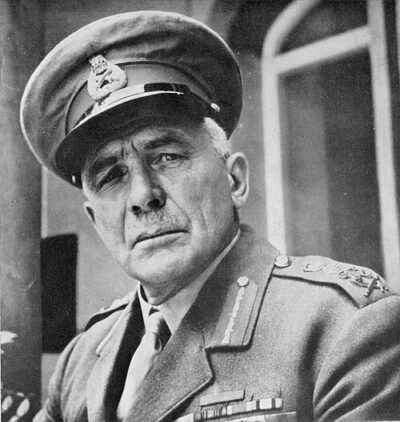
Edmund Ironside, 1st Baron Ironside
Edmund Ironside, 1st Baron Ironside was a British Army officer. Born May 6, 1880, in Edinburgh. Died September 22, 1959, in London. Positions held include member of the House of Lords and Chief of the General Staff (United Kingdom) (1939–1940). Educated at Staff College, Camberley and Royal Military Academy, Woolwich. Awards include Grand Cross of the Legion of Honour, Croix de guerre 1914–1918 and Knight Grand Cross of the Order of the Bath.
Facts
31 facts · 2 confirmed by two sources · 7 cited · 22 from one source
Where this comes from
Papalocal keeps its own record. It started from these sources; what each one said is kept here as it was copied, so a change on their side never changes this page by itself. Tap one to read its version.
What Wikidata says · copied November 18, 2026 · revision 2561865188
- Described as
- British Army officer (1880-1959)
- Other names
- Edmund Ironside
- Born
- May 6, 1880 · 3 references
- Died
- September 22, 1959 · 2 references
- Born in
- Edinburgh
- Died in
- London
- Citizen of
- United Kingdom
- Occupation
- politician · 1 reference; diarist; writer; military personnel; Generalfeldmarschall · 1 reference
- Positions held
- member of the House of Lords; Chief of the General Staff (United Kingdom) (1939–1940)
- Education
- Staff College, Camberley; Royal Military Academy, Woolwich; Tonbridge School
- Awards
- Grand Cross of the Legion of Honour; Croix de guerre 1914–1918; Knight Grand Cross of the Order of the Bath; Distinguished Service Order; Companion of the Order of St Michael and St George; Commander of the Order of the British Empire; Order of Saint John · 1 reference; Officer of the Legion of Honour · 1 reference
- Spouse
- Mariot Ysobel Cheyne (1915–) · 1 reference
- Children
- Elspeth Mariot Ironside · 1 reference; Edmund Ironside, 2nd Baron Ironside · 1 reference
- Father
- William Ironside · 1 reference
- Mother
- Emma Maria Richards · 1 reference
- Military branch
- British Army
- Military rank
- field marshal; general · 1 reference
- Wikipedias with a page
- 21
Wikidata item Q335248 (wikidata.org/wiki/Q335248), public domain (CC0). Copied November 18, 2026.
What Wikipedia says · copied November 18, 2026 · revision 1382271622
Field Marshal William Edmund Ironside, 1st Baron Ironside (6 May 1880 – 22 September 1959) was a senior officer of the British Army who served as Chief of the Imperial General Staff during the first year of the Second World War.
Ironside joined the Royal Artillery in 1899, and served throughout the Second Boer War. This was followed by a brief period spying on the German colonial forces in German South West Africa. Returning to regular duty, he served on the staff of the 6th Infantry Division during the first two years of the First World War, before being appointed to a position on the staff of the newly raised 4th Canadian Division in 1916. In 1918, he was given command of a brigade on the Western Front. In 1919, he was promoted to command the Allied intervention force in northern Russia. Ironside was then assigned to an Allied force occupying Turkey, and then to the British forces based in Persia in 1921. He was offered the post of the commander of British forces in Iraq, but was unable to take up the role due to injuries in a flying accident.
He returned to the Army as Commandant of the Staff College, Camberley, where he advocated the ideas of a close friend, J. F. C. Fuller, who was a proponent of mechanisation. He later commanded a division, and military districts in both Britain and India, but his youth and his blunt approach limited his career prospects, and after being passed over for the role of Chief of the Imperial General Staff (CIGS) in 1937 he became Governor of Gibraltar, a traditional staging post to retirement. He was recalled from "exile" in mid-1939, being appointed as Inspector-General of Overseas Forces, a role which led most observers to expect he would be given the command of the British Expeditionary Force (BEF) on the outbreak of war.
However, after some political manoeuvring, General John Vereker, 6th Viscount Gort, was given this command and Ironside was appointed as the new Chief of the Imperial General Staff. Ironside himself believed that he was temperamentally unsuited to the job, but felt obliged to accept it. In early 1940 he argued heavily for Allied intervention in Scandinavia, but this plan was shelved at the last minute when the Finnish–Soviet Winter War ended. During the invasion of Norway and the Battle of France he played little part; his involvement in the latter was limited by a breakdown in relations between him and Gort. He was replaced as CIGS at the end of May, and given a role to which he was more suited: Commander-in-Chief, Home Forces, responsible for anti-invasion defences and for commanding the Army in the event of German landings. However, he served less than two months in this role before being replaced. After this, Ironside was promoted to field marshal and raised to the peerage as Baron Ironside.
Lord Ironside retired to Morley Old Hall in Norfolk to write, and never again saw active service or held any official position.
- Born, in its opening lines
- May 6, 1880
- Died, in its opening lines
- September 22, 1959
From the Wikipedia article “Edmund Ironside, 1st Baron Ironside” (en.wikipedia.org/wiki/Edmund_Ironside,_1st_Baron_Ironside), by its contributors, under CC BY-SA 4.0 (creativecommons.org/licenses/by-sa/4.0/). Copied November 18, 2026; not changed.
Confirmed Two sources agree. Cited One source, and it names where it got it. One source One source, without a reference of its own. Sources disagree The sources disagree. We show the best-supported value and keep theirs below.
