
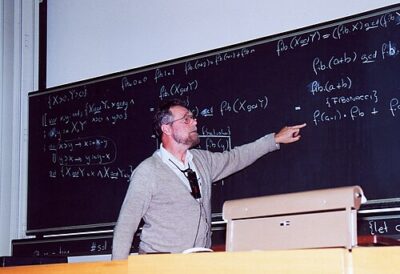
Edsger W. Dijkstra
Edsger W. Dijkstra was a Dutch computer scientist. Born May 11, 1930, in Rotterdam. Died August 6, 2002, in Nuenen. Known for Dijkstra's algorithm, banker's algorithm and shunting-yard algorithm. Educated at Leiden University and Gymnasium Erasmianum. Awards include Turing Award, ACM Fellow and Dijkstra Prize.
Facts
46 facts · 2 confirmed by two sources · 26 cited · 18 from one source
Where this comes from
Papalocal keeps its own record. It started from these sources; what each one said is kept here as it was copied, so a change on their side never changes this page by itself. Tap one to read its version.
What Wikidata says · copied November 16, 2026 · revision 2568279227
- Described as
- Dutch computer scientist (1930–2002)
- Other names
- Edsger Wybe Dijkstra, Dijkstra, E. W. Dijkstra, Edsger Dijkstra, EWD
- Born
- May 11, 1930 · 8 references
- Died
- August 6, 2002 · 6 references
- Born in
- Rotterdam · 2 references
- Died in
- Nuenen · 3 references
- Cause of death
- colorectal cancer
- Name at birth
- Edsger Wybe Dijkstra · 1 reference
- Citizen of
- Kingdom of the Netherlands · 1 reference
- Occupation
- mathematician; physicist; computer scientist · 1 reference; engineer; university teacher · 1 reference; information scientist · 1 reference; programmer · 1 reference
- Worked for
- University of Texas at Austin (1984–1999); Eindhoven University of Technology (1962–1984) · 1 reference; Centrum Wiskunde & Informatica (1952–1962); Burroughs Corporation (1973–1984); Radboud University (1971–1972) · 1 reference
- Education
- Leiden University (1948–1956) · 1 reference; Gymnasium Erasmianum (–1948) · 1 reference; University of Amsterdam (1956–1959) · 2 references; University of Cambridge (1951) · 1 reference
- Member of
- Royal Netherlands Academy of Arts and Sciences; American Academy of Arts and Sciences; Association for Computing Machinery (1994–) · 1 reference
- Known for
- Dijkstra's algorithm; banker's algorithm; shunting-yard algorithm; smoothsort; Go To Statement Considered Harmful; The humble programmer
- Awards
- Turing Award (1972) · 1 reference; ACM Fellow (1994) · 1 reference; Dijkstra Prize (2002) · 2 references; Harry H. Goode Memorial Award (1974) · 2 references; Fellow of the British Computer Society (1971) · 1 reference; Computer Pioneer Award (1982) · 1 reference; C&C Prize (2002)
- Field
- informatics; computing · 1 reference; mathematics · 1 reference; computer programming · 1 reference; physics · 1 reference; computer algorithm · 1 reference
- Spouse
- Maria C. Debets · 2 references
- Wikipedias with a page
- 86
Wikidata item Q8556 (wikidata.org/wiki/Q8556), public domain (CC0). Copied November 16, 2026.
What Wikipedia says · copied November 16, 2026 · revision 1384536654
Edsger Wybe Dijkstra ( DYKE-strə; Dutch: [ˈɛtsxər ˈʋibə ˈdɛikstraː] ; 11 May 1930 – 6 August 2002) was a Dutch computer scientist, programmer, mathematician, and science essayist.
Born in Rotterdam in the Netherlands, Dijkstra studied mathematics and physics and then theoretical physics at the University of Leiden. Adriaan van Wijngaarden offered him a job as the first computer programmer in the Netherlands at the Mathematical Centre in Amsterdam, where he worked from 1952 until 1962. He formulated and solved the shortest path problem in 1956, and in 1960 developed the first compiler for the programming language ALGOL 60 in conjunction with colleague Jaap A. Zonneveld. In 1962 he moved to Eindhoven, where he became a professor in the Mathematics Department at the Technische Hogeschool Eindhoven. In the late 1960s, he built the THE multiprogramming system, which influenced the designs of subsequent systems through its use of software-based paged virtual memory. Dijkstra joined Burroughs Corporation as its sole research fellow in August 1973. The Burroughs years saw him at his most prolific in output of research articles. He wrote nearly 500 documents in the "EWD" series, most of them technical reports, for private circulation within a select group.
Dijkstra accepted the Schlumberger Centennial Chair in the Computer Science Department at the University of Texas at Austin in 1984, working until his retirement in November 1999. Following a cancer diagnosis, he and his wife left Austin in 2002 for Nuenen, where he died on 6 August.
He received the 1972 ACM Turing Award for fundamental contributions to developing structured programming languages. Shortly before his death, he received the ACM PODC Influential Paper Award in distributed computing for his work on self-stabilization of program computation. This annual award was renamed the Dijkstra Prize the following year, in his honor.
- Born, in its opening lines
- May 11, 1930
- Died, in its opening lines
- August 6, 2002
From the Wikipedia article “Edsger W. Dijkstra” (en.wikipedia.org/wiki/Edsger_W._Dijkstra), by its contributors, under CC BY-SA 4.0 (creativecommons.org/licenses/by-sa/4.0/). Copied November 16, 2026; not changed.
Confirmed Two sources agree. Cited One source, and it names where it got it. One source One source, without a reference of its own. Sources disagree The sources disagree. We show the best-supported value and keep theirs below.
